


Marriage is an exciting new chapter in life. Between planning the wedding, preparing a new home and making future plans together, health check-ups may not always be a priority. However, a pre-marriage health check-up can be a valuable step towards building a healthier future together.
A pre-marital health check-up involves medical screening to understand each partner’s general health, identify certain infections, assess inherited health risks and address reproductive health concerns where appropriate. It can also help couples identify conditions that may benefit from early treatment or medical advice.
At Sparsh Diagnostic Centre, Kolkata, we believe that understanding your health is an important part of preventive healthcare. A pre-marriage check-up can help couples make informed decisions about their well-being, future family planning and healthcare needs.
In this guide, we explain the importance of pre-marital screening, the tests that may be recommended, how to prepare for the check-up and what couples should know before booking an appointment.
What is a pre-marriage health check-up?
A pre-marriage health check-up is a medical assessment undertaken by one or both partners before marriage. It may include routine blood tests, screening for selected infections, tests for inherited blood disorders and additional investigations based on individual medical needs.
The purpose is not to determine whether someone is fit to get married. Instead, it is to help individuals understand their health status and identify issues that may require medical attention.
For example, a person may have anaemia, elevated blood sugar, a thyroid disorder or an inherited blood condition without experiencing obvious symptoms. Appropriate testing can help identify these concerns and guide further evaluation.
Similarly, couples planning to have children may benefit from discussing genetic carrier screening, vaccination status and preconception health with a qualified healthcare professional.
The tests included in a pre-marriage health check-up can differ from person to person. There is no single set of tests that is necessary for every couple.
Why is a pre-marriage health check-up important?
A pre-marital health check-up can help couples approach their new phase of life with greater awareness and confidence.
1. Identify underlying health conditions
Some medical conditions develop gradually and may remain unnoticed for a long time. Depending on age, symptoms and medical history, screening may help identify anaemia, diabetes, abnormal cholesterol levels, thyroid problems or other health concerns.
Early identification allows individuals to discuss suitable treatment, lifestyle changes or further investigations with their doctor.
2. Understand inherited health risks
Certain genetic conditions, including thalassaemia and sickle cell disease, can be inherited from parents.
Carrier screening can help identify whether an individual carries particular genetic changes. When both partners carry changes associated with the same recessive disorder, genetic counselling can explain the potential risks to future children and the available reproductive options.
Not every couple requires extensive genetic testing. The decision should be guided by family history, clinical advice and individual preferences.
3. Screen for selected infections
Certain infections, including HIV, hepatitis B, hepatitis C and syphilis, may not always produce noticeable symptoms in the early stages.
When clinically appropriate, screening can help identify infections that need treatment, monitoring or preventive measures. Testing can also help couples discuss ways to protect each other’s health.
Testing should always be undertaken with appropriate consent, privacy and counselling.
4. Prepare for future pregnancy
Couples who plan to have children may benefit from a preconception health assessment. This can help identify medical conditions, review medications, assess vaccination needs and address reproductive health concerns before pregnancy.
Women planning pregnancy may need advice about folic acid supplementation, immunity to certain infections and the management of existing health conditions.
A pre-marriage check-up does not, however, guarantee fertility or predict whether a couple will conceive naturally.
5. Encourage open communication about health
Discussing health concerns before marriage can help couples make informed decisions about medical care, lifestyle changes and future family planning.
The process should encourage mutual understanding rather than judgement. Each partner has the right to make informed decisions about their own medical testing and share health information voluntarily.
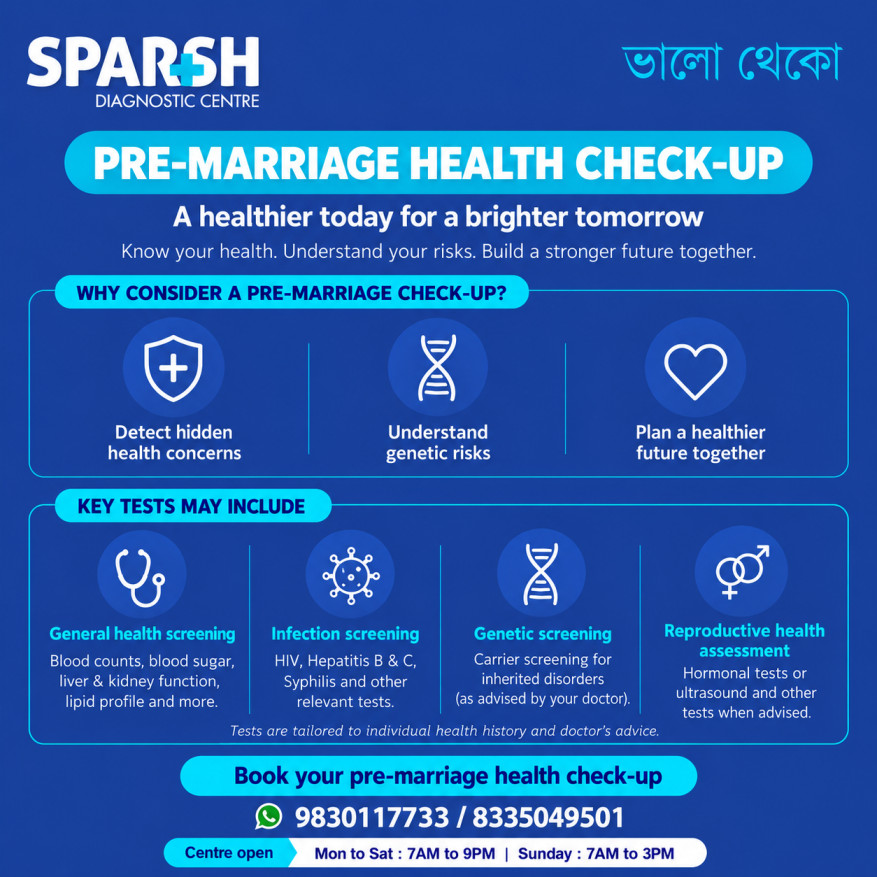
Which tests are included in a pre-marriage health check-up?
The recommended tests depend on the individual’s health, family history, symptoms and future plans. The following are examples of investigations that a healthcare professional may consider.
1. General health screening
Routine blood tests can provide useful information about overall health.
| Test | What it helps assess |
|---|---|
| Complete blood count (CBC) | Anaemia and abnormalities in blood cells |
| Blood glucose or HbA1c | Blood sugar levels and diabetes risk |
| Liver function tests | Markers of liver health |
| Kidney function tests | Kidney function and related abnormalities |
| Lipid profile | Cholesterol and triglyceride levels |
| Thyroid-stimulating hormone (TSH) | Thyroid function when indicated |
| Urine routine examination | Selected urinary abnormalities |
Not everyone needs every test listed above. A doctor can help determine which investigations are appropriate.
2. Infectious disease screening
Depending on individual circumstances and clinical advice, screening may include:
- HIV testing: Helps identify HIV infection.
- Hepatitis B surface antigen (HBsAg): Helps detect current hepatitis B infection.
- Hepatitis C testing: Helps identify possible hepatitis C infection.
- Syphilis screening: Blood tests such as VDRL or other appropriate serological tests may be recommended.
- Other infection-related tests: Additional investigations may be advised depending on symptoms, exposure history or medical requirements.
A positive screening result may require confirmatory testing. Results should be interpreted by a qualified healthcare professional, who can explain treatment, prevention and follow-up options.
3. Genetic and blood disorder screening
Inherited blood disorders are an important consideration for couples planning a family.
Depending on family history and clinical advice, investigations may include:
- Complete blood count with red blood cell indices.
- Haemoglobin analysis, including high-performance liquid chromatography (HPLC), where indicated.
- Additional tests for suspected thalassaemia, sickle cell disease or other haemoglobin disorders.
If one partner is found to carry a relevant genetic variant, testing the other partner may be recommended. When both partners carry variants associated with the same inherited disorder, genetic counselling can help explain the possible outcomes in future pregnancies.
A carrier is not necessarily affected by the disease. Equally, a normal result on one screening test does not rule out every inherited condition.
4. Blood group and Rh typing
Knowing your blood group can be useful for future medical care and pregnancy planning.
Rh status is particularly relevant during pregnancy when an Rh-negative woman carries an Rh-positive baby. Appropriate antenatal care and preventive treatment, when indicated, can significantly reduce the risk of Rh-related complications.
Blood group compatibility should not be treated as a general measure of whether two people are medically compatible for marriage.
5. Reproductive health assessment
Reproductive health investigations should be based on individual concerns, symptoms and plans for pregnancy.
For women, a doctor may recommend thyroid testing, hormonal investigations, pelvic ultrasonography or other tests when clinically indicated.
For men, semen analysis may be considered when there are fertility concerns or specific medical indications.
Tests such as anti-Müllerian hormone (AMH), follicle-stimulating hormone (FSH), luteinising hormone (LH) and prolactin are not automatically required for every person before marriage. Their usefulness depends on the clinical situation.
It is important to understand that a single hormone test or ultrasound cannot reliably establish a person’s overall fertility.
6. Additional tests when required
Depending on symptoms, age, medical history or risk factors, a doctor may recommend additional investigations, such as:
- Electrocardiogram (ECG) for selected cardiac concerns.
- Vitamin B12, vitamin D or iron studies when indicated.
- Additional imaging for specific symptoms.
- Further hormonal or reproductive investigations when clinically appropriate.
Routine chest X-rays, extensive hormone panels and other specialised investigations are not necessary for every healthy individual simply because they are getting married.
Who should consider a pre-marriage health check-up?
A pre-marriage health check-up may be useful for anyone who wants to understand their health before beginning married life.
It can be particularly worth discussing with a doctor if you:
- Have a family history of thalassaemia, sickle cell disease or another inherited condition.
- Have diabetes, hypertension, thyroid disease or another chronic medical condition.
- Have symptoms that need medical evaluation.
- Have concerns about reproductive health or future pregnancy.
- Have possible exposure to an infection and need appropriate testing.
- Want to review vaccinations, medications and general health before planning a pregnancy.
Couples do not need to have a known health problem to discuss preventive screening. At the same time, undergoing every available test is not necessarily beneficial.
How much does a pre-marriage health check-up cost in Kolkata?
The cost of a pre-marriage health check-up in Kolkata depends on the tests included in the package.
A basic package containing routine blood tests may cost less than a more comprehensive package that includes infection screening, haemoglobin analysis, specialised investigations or consultations.
Before booking, check the following:
- Which tests are included in the package.
- Whether both partners need separate packages.
- Whether confirmatory tests are charged separately.
- Whether doctor consultation is included.
- The expected time for reports.
- Whether additional investigations may be required based on the results.
Rather than choosing a package solely by price, consider whether the tests are relevant to your medical needs.
For current package details and pricing, contact Sparsh Diagnostic Centre directly.
How to prepare for your pre-marital health check-up
A little preparation can make the testing process more convenient and help ensure that results are interpreted appropriately.
Follow fasting instructions: Some tests, including certain blood glucose and lipid assessments, may require fasting. Ask the diagnostic centre whether fasting is necessary for your selected tests.
Share your medical history: Inform your doctor about existing conditions, medications, previous surgeries, allergies and any ongoing treatment.
Discuss family history: Mention any known inherited blood disorders or significant medical conditions among close relatives.
Bring previous reports: Earlier blood tests, imaging reports and relevant prescriptions may help avoid unnecessary repeat investigations.
Ask about vaccinations: If you are planning pregnancy in the near future, discuss your vaccination history and any recommended vaccines with your healthcare professional.
Understand the purpose of each test: Ask what a test can detect, whether further testing might be needed and how the results could affect your healthcare decisions.
Respect individual consent: Each partner should understand and voluntarily agree to their own medical tests. Results should be handled confidentially.
What happens if a test result is abnormal?
An abnormal result does not automatically mean that a person has a serious disease or that the couple will face complications after marriage.
Some results may be temporarily abnormal or influenced by factors such as medication, recent illness or the testing method. Other findings may require repeat testing, confirmatory investigations or consultation with a specialist.
For example, a positive infection screening result may require additional testing to establish the diagnosis. A suspected inherited blood disorder may require haemoglobin analysis or genetic counselling.
The next step is to discuss the report with a qualified healthcare professional rather than attempting to interpret the findings in isolation.
Where a potentially inherited condition is identified, counselling can help couples understand the actual risk and the options available to them.
Why choose Sparsh Diagnostic Centre for a pre-marriage health check-up in Kolkata?
Choosing a diagnostic centre that offers appropriate testing, clear instructions and reliable support can make the process more convenient.
Sparsh Diagnostic Centre provides diagnostic services in Kolkata, including pathology and other diagnostic investigations. Couples can contact the centre to enquire about pre-marriage health check-up options and the tests that may be suitable for their needs.
When considering a pre-marital health package, it is important to understand the tests included, any preparation requirements and the process for receiving reports.
To enquire about a pre-marriage health check-up at Sparsh Diagnostic Centre, Kolkata, call +91 98301 17733 and +91 83350 49501
The team can help you obtain information about available packages, timings and booking arrangements.
Frequently asked questions about pre-marriage health check-ups
1. Is a pre-marriage health check-up mandatory in India?
No. There is no universal legal requirement for every couple in India to undergo a standard pre-marriage health check-up. However, individuals may choose screening to understand their health, assess inherited risks and prepare for future pregnancy.
2. Which tests are most important before marriage?
There is no single list of tests that is essential for everyone. Depending on individual circumstances, a doctor may recommend a CBC, blood glucose testing, selected infection screening, haemoglobinopathy screening or other investigations based on medical and family history.
3. Should both partners undergo testing?
Both partners may benefit from discussing their health and screening needs with a healthcare professional. Testing requirements can differ between individuals, and each person should provide their own informed consent.
4. Can a pre-marriage health check-up detect infertility?
No. Routine screening cannot establish whether a person is fertile or guarantee future conception. Specific investigations may be appropriate if there are reproductive health concerns, but fertility assessment depends on the clinical situation.
5. Is genetic screening necessary before marriage?
Genetic screening is not compulsory for every couple. It may be particularly useful when there is a family history of inherited disorders or when a healthcare professional identifies a relevant risk. Carrier screening and genetic counselling can help couples understand potential risks to future children.
6. What is the importance of thalassaemia screening before marriage?
Thalassaemia screening can help identify people who carry certain inherited blood disorder variants. If both partners carry variants associated with beta-thalassaemia, there may be a risk of having an affected child. Genetic counselling can explain the risk and available reproductive options.
7. Can a pre-marriage health check-up detect sexually transmitted infections?
Selected tests can help detect infections such as HIV, hepatitis B, hepatitis C and syphilis. The appropriate tests depend on individual circumstances, and some positive screening results require confirmation.
8. Do I need to fast before a pre-marital health check-up?
Not always. Some investigations require fasting, while others do not. Confirm the preparation instructions for your specific package before visiting the diagnostic centre.
9. How long does a pre-marriage health check-up take?
The time required depends on the number and type of tests included. Many routine blood and urine samples can be collected during a single visit, while specialised tests may take longer to process. Ask the centre about the expected reporting time when booking.
10. Is a pre-marriage health check-up confidential?
Medical test results should be handled confidentially and shared according to applicable law and the patient’s consent. Each individual should understand how their results will be communicated and stored.
11. Can blood group incompatibility cause problems in marriage?
Blood group differences do not generally determine whether two people are compatible for marriage. Rh status can, however, be important during pregnancy, and appropriate antenatal care can help manage associated risks.
12. When should we get a pre-marriage health check-up done?
It is sensible to plan the check-up sufficiently early to allow time for testing, follow-up consultations and any recommended treatment or vaccination. Couples planning pregnancy soon after marriage may also benefit from a preconception consultation.
Build a healthier future together
A pre-marriage health check-up is an opportunity to understand your health, address potential concerns and make informed decisions about the future. It is not about judging a partner or expecting perfect health. It is about approaching married life with awareness, responsibility and mutual respect.
The right tests depend on your individual circumstances, family history and plans for the future. Discussing your needs with a qualified healthcare professional can help you avoid unnecessary investigations while identifying those that may be genuinely useful.
If you are planning to get married and want to explore pre-marital health screening in Kolkata, contact Sparsh Diagnostic Centre to enquire about available testing options.
To get a pre marriage health check up done at Sparsh Diagnostic Centre call our helpline numbers +91 98301 17733 and +91 83350 49501..
#BhaloTheko
Disclaimer:
No content on this site, regardless of date, should ever be used as a substitute for direct medical advice from your doctor or other qualified clinician.

Sources and further reading
The following resources provide background information on premarital screening, inherited blood disorders, genetic counselling and preventive healthcare.
- National Health Mission, Ministry of Health and Family Welfare, Government of India – Guidelines on hemoglobinopathies in India: Information on screening, diagnosis and counselling for inherited blood disorders.
https://nhm.gov.in/images/pdf/programmes/RBSK/Resource_Documents/Guidelines_on_Hemoglobinopathies_in%20India.pdf - World Health Organization – Premarital testing and counselling guidelines: Background on screening for inherited and infectious conditions and the role of counselling.
https://platform.who.int/docs/default-source/mca-documents/policy-documents/guideline/OMN-CH-50-08-GUIDELINE-2018-eng-Premarital-Testing-Counselling-National-Guideline.pdf - National AIDS Control Organisation, Ministry of Health and Family Welfare, Government of India: Resources on HIV testing, counselling and prevention.
https://naco.gov.in/ - Indian Council of Medical Research – Ethical guidelines for human genetics testing and research: Background on genetic testing, informed consent and interpretation of genetic findings.
https://www.icmr.gov.in/
Medical note: This article is intended for general health education and does not replace individual medical advice. The need for specific tests should be determined in consultation with a qualified healthcare professional.
This blog has been medically reviewed by Dr. Shubhayu Som.
Medical reviewer: Dr. Shubhayu Som
Qualification: MBBS
Specialisation: General Physician
Medical registration: West Bengal Medical Council (WBMC), Registration No. 81060
Date medically reviewed: 30th October 2026
This article has been reviewed by a qualified medical professional to support the accuracy and reliability of the health information provided.


Got my fiance and myself tested at Sparsh after coming across this blog. They sent over a blood collector once the booking was made and I received the reports the same day. Kudos to Sparsh for spreading such useful information.