


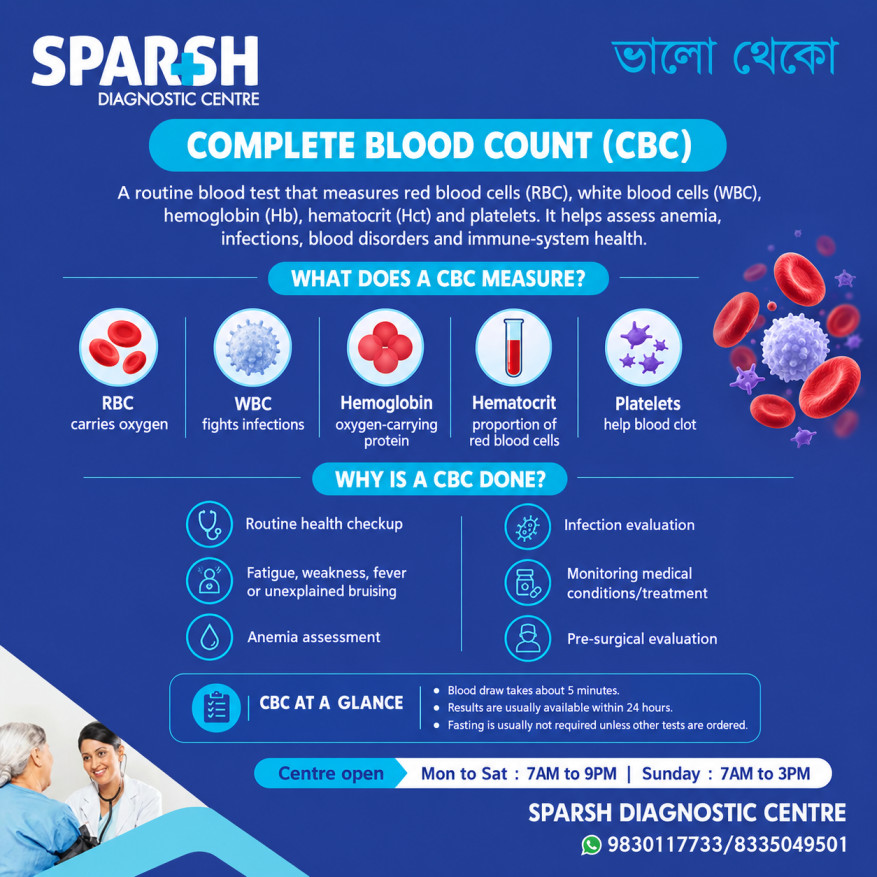
A complete blood count (CBC) is one of the most commonly ordered blood tests. It gives doctors a broad picture of what is happening in your blood by measuring red blood cells, white blood cells, platelets, haemoglobin and several related parameters.
A CBC may be recommended during a routine health check-up, when you have symptoms such as tiredness or fever, before surgery, or when your doctor wants to monitor an existing medical condition or treatment.
The useful thing about a CBC is that it looks at several components of your blood at the same time. An unusual result may provide an important clue about anaemia, infection, inflammation, bleeding, nutritional deficiencies, immune disorders or certain blood-related diseases. However, an abnormal CBC does not automatically mean that you have a serious illness. Results need to be interpreted along with your symptoms, medical history and other investigations.
What is a CBC blood test?
A CBC blood test, or complete blood count, is a laboratory test that measures the number and characteristics of different blood cells.
The main components include:
- Red blood cells (RBCs): Carry oxygen from the lungs to tissues throughout the body.
- Haemoglobin (Hb): The protein inside red blood cells that carries oxygen.
- Haematocrit (Hct): Shows what percentage of your blood volume is made up of red blood cells.
- White blood cells (WBCs): Help the immune system fight infections and respond to disease.
- Platelets: Help the blood clot and control bleeding.
- MCV: Measures the average size of red blood cells.
- MCH and MCHC: Provide information about the amount and concentration of haemoglobin in red blood cells.
- RDW: Measures variation in red blood cell size.
A CBC may also be ordered with a differential count, which gives information about different types of white blood cells, including neutrophils, lymphocytes, monocytes, eosinophils and basophils.
Why would a doctor order a CBC?
Doctors order a CBC for many different reasons. It can be part of a routine health check-up or used to investigate specific symptoms.
A doctor may recommend a CBC if you have:
- Persistent tiredness or weakness
- Fever or suspected infection
- Unexplained bruising or bleeding
- Pale skin
- Shortness of breath
- Dizziness
- Unexplained weight loss
- Symptoms suggesting anaemia
- Recurrent infections
- Swelling or other unexplained symptoms
A CBC is also commonly used to monitor conditions that affect blood cells and to assess the effects of certain medicines or treatments. It may be included as part of pre-surgical testing as well.
In simple terms, your doctor may order a CBC because it can provide several useful clues from a single blood sample.
What are the 5 things a CBC can show signs of?
A CBC can provide clues about many conditions. Five important areas it can help identify or investigate are:
1. Anaemia
Low haemoglobin, red blood cell count or haematocrit may indicate anaemia. Additional CBC parameters such as MCV and RDW can provide clues about the possible type of anaemia.
2. Infection
An increased white blood cell count may occur with infections, although the pattern of white blood cells is often more informative than the total number alone.
3. Blood or bone marrow disorders
Significant abnormalities involving red cells, white cells or platelets can sometimes point towards a blood or bone marrow disorder and may require further testing.
4. Bleeding or platelet disorders
A low platelet count can increase the risk of abnormal bleeding, while a high platelet count can occur for several different reasons, including infection and inflammation.
5. Nutritional or chronic health problems
Abnormal red blood cell indices may provide clues about deficiencies such as iron, vitamin B12 or folate deficiency. Changes in blood counts may also occur with chronic diseases.
It is important to remember that a CBC usually raises clues rather than providing a final diagnosis. An abnormal result may have several possible explanations.
What is the normal CBC count range?
There is no single “normal CBC number” because a CBC contains multiple measurements. Reference ranges can also vary between laboratories depending on the testing method, age, sex, pregnancy status and other factors.
For adults, commonly used reference ranges include:
| CBC parameter | Typical adult reference range |
|---|---|
| WBC | 4,000–10,000 cells/µL |
| RBC – females | 4.0–5.4 million cells/µL |
| RBC – males | 4.5–6.1 million cells/µL |
| Haemoglobin – females | 11.5–15.5 g/dL |
| Haemoglobin – males | 13–17 g/dL |
| Haematocrit – females | 36–48% |
| Haematocrit – males | 40–55% |
| MCV | 80–100 fL |
| MCH | 27–31 pg |
| MCHC | 32–36 g/dL |
| RDW | 12–15% |
| Platelets | 150,000–400,000 cells/µL |
These figures are useful as a general guide, but the reference range printed on your own laboratory report should be used when interpreting your result.
Children, pregnant women and people with certain medical conditions may have different reference ranges.
What if the CBC is high or low?
A CBC itself is not simply “high” or “low”. Individual components of the CBC can be high or low.
For example:
High WBC: May occur with infections, inflammation, certain medicines and some blood disorders.
Low WBC: May occur with some infections, autoimmune conditions, medicines or bone marrow disorders.
Low haemoglobin: Often indicates anaemia, but the underlying cause can vary from iron deficiency and blood loss to vitamin deficiencies, chronic disease or other conditions.
High RBC or haemoglobin: May occur because of dehydration, certain heart or lung conditions, smoking, living at high altitude or specific blood disorders.
Low platelets: Can occur because of infections, immune conditions, medicines, liver-related problems, bone marrow disorders and other causes.
High platelets: May occur in response to infection, inflammation, iron deficiency or other conditions.
Therefore, one abnormal number should not be interpreted in isolation.
Is 9.5 haemoglobin normal?
For most non-pregnant adults, a haemoglobin level of 9.5 g/dL is below the usual reference range and indicates anaemia.
According to WHO’s updated haemoglobin guidance, anaemia in non-pregnant adults is generally defined below 12 g/dL for women aged 15–65 years and below 13 g/dL for men aged 15–65 years. Pregnancy has different thresholds depending on the trimester.
However, a haemoglobin result of 9.5 g/dL does not tell you why the haemoglobin is low.
Possible causes include:
- Iron deficiency
- Vitamin B12 or folate deficiency
- Blood loss
- Heavy menstrual bleeding
- Chronic disease
- Kidney disease
- Inherited blood disorders such as thalassaemia
- Other causes of reduced red blood cell production or increased red blood cell destruction
Your doctor may therefore recommend additional tests such as iron studies, ferritin, vitamin B12, folate, kidney function tests or other investigations depending on your history.
What are 10 warning signs of anaemia?
Anaemia can develop gradually, so some people may not notice symptoms immediately. Common warning signs include:
- Persistent tiredness
- General weakness
- Dizziness or light-headedness
- Shortness of breath, particularly during activity
- Headaches
- Pale skin or pale appearance inside the mouth or under the nails
- Cold hands and feet
- Fast heartbeat or noticeable palpitations
- Reduced ability to exercise or perform physical work
- Increased bruising or other symptoms associated with severe anaemia
Some people with iron deficiency can also develop unusual cravings, known as pica, such as craving ice or non-food substances.
These symptoms are not specific to anaemia. They can occur with many other conditions, which is why a CBC and appropriate follow-up testing can be useful when symptoms persist.
What is an abnormal CBC?
An abnormal CBC means that one or more measured blood parameters fall outside the laboratory’s reference range.
For example, your report may show:
- Low haemoglobin
- Low or high RBC count
- Low or high WBC count
- Low or high platelet count
- Abnormal MCV
- Increased RDW
- Abnormal differential white blood cell counts
An abnormal result does not necessarily mean that something serious is wrong.
Factors such as dehydration, recent illness, medicines, physical activity and other circumstances can affect blood counts. Some results may also be temporarily outside the reference range without representing a significant disease.
The pattern matters. For example, low haemoglobin together with a low MCV may suggest a different group of causes than low haemoglobin with a high MCV.
This is why doctors generally interpret the CBC as a whole rather than focusing on one number.
What cancers does a CBC detect?
A CBC does not directly “detect” cancer in the same way that a biopsy or a cancer-specific diagnostic test can. However, it can provide important clues that may lead a doctor to investigate certain cancers, particularly blood and bone marrow cancers.
CBC abnormalities may be seen in conditions such as:
- Leukemia
- Some lymphomas
- Myelodysplastic syndromes
- Myeloproliferative disorders
- Multiple myeloma and other blood-related malignancies
For example, leukemia may produce unusual white blood cell counts and can also affect red blood cells and platelets.
A CBC can also reveal anaemia or other blood abnormalities that may occur alongside certain solid cancers. For example, iron-deficiency anaemia can sometimes be associated with chronic blood loss from the digestive tract, including colorectal cancer. But a CBC cannot diagnose colorectal cancer or another solid tumour by itself.
If cancer is suspected, doctors may order additional tests such as a peripheral blood smear, imaging, flow cytometry, molecular testing, bone marrow examination or biopsy, depending on the situation.
Can a CBC detect illness?
Yes, a CBC can provide clues that an illness may be present.
For example, changes in white blood cells can occur with infections or inflammatory conditions. Changes in haemoglobin and red blood cell indices can suggest anaemia or nutritional deficiencies. Platelet abnormalities can provide clues about bleeding, clotting or other medical problems.
But a CBC cannot identify every illness, and an abnormal CBC does not automatically identify the cause.
Think of the CBC as an early-warning and investigation tool rather than a test that gives a diagnosis for every disease. Your doctor may combine it with your symptoms, examination and other blood tests, imaging or specialist investigations.
What is the danger zone for WBC?
There is no single WBC number that can be called a universal “danger zone”.
For many adults, a WBC count above approximately 11,000 cells/µL is considered leukocytosis, but a raised WBC can occur for many reasons, including infection, inflammation, medicines and stress.
Extremely high WBC counts are more concerning. A WBC count above 100,000 cells/µL, known as hyperleukocytosis, requires urgent medical assessment because it is often associated with leukemia or other myeloproliferative disorders.
There is also an important “low WBC” concern: neutrophils. Severe neutropenia, generally defined as an absolute neutrophil count below 500 cells/µL, is associated with a substantially increased risk of serious infection.
Therefore, the WBC number should always be interpreted alongside the differential count and the person’s symptoms.
Is fasting required for a CBC blood test?
No. Fasting is generally not required for a CBC alone.
You can normally eat and drink before a CBC blood test. However, if your doctor has ordered other blood tests at the same time, fasting may be required for those tests.
For example, some glucose or lipid tests may have specific preparation requirements. Your laboratory or doctor should tell you if fasting is necessary.
The CBC itself is a relatively simple blood test. A healthcare professional usually collects a small blood sample from a vein in your arm, and the collection generally takes only a few minutes.
How is a CBC test performed?
A small blood sample is collected, usually from a vein in the arm, using a sterile needle and collection tube.
The sample is then analysed in the laboratory to measure the different blood cell parameters.
Most people experience only a brief sting during collection. Mild soreness or bruising at the collection site can occasionally occur.
Results may be available within a few hours or a day depending on the laboratory, the test panel and the reporting process.
How should you interpret your CBC report?
It can be tempting to look at every number on a CBC report and immediately search for the meaning of anything marked “high” or “low”. However, this can sometimes create unnecessary worry.
Instead, look at the overall pattern.
For example:
- Low Hb + low MCV may point towards a microcytic pattern of anaemia.
- Low Hb + high MCV may suggest a macrocytic pattern.
- High WBC + raised neutrophils may occur with infection or inflammation.
- Low platelets may require evaluation depending on how low they are and whether there is bleeding.
- Abnormalities involving several blood cell lines may require more detailed investigation.
The next step depends on your age, symptoms, medical history, medications and previous test results.
If a CBC is abnormal, your doctor may recommend repeating the test, ordering a CBC with differential, examining a peripheral blood smear or conducting additional blood tests.
When should you speak to a doctor about a CBC result?
You should discuss an abnormal CBC with your healthcare provider, particularly if you have symptoms such as persistent fever, unexplained weight loss, significant fatigue, unusual bleeding or bruising, recurrent infections, breathlessness or other unexplained changes in health.
Seek prompt medical attention if an abnormal blood count is accompanied by severe symptoms such as difficulty breathing, significant bleeding, fainting, chest pain, confusion or a high fever, particularly when the white blood cell or neutrophil count is markedly abnormal.
The urgency depends on the actual result and the clinical situation, rather than simply whether a number is marked “high” or “low”.
Frequently asked questions about CBC
What is a CBC blood test?
A CBC, or complete blood count, is a blood test that measures red blood cells, white blood cells, platelets, haemoglobin, haematocrit and several red blood cell indices. It is used to assess overall health and investigate or monitor many medical conditions.
What if the CBC is high or low?
Individual CBC parameters can be high or low. A high WBC may occur with infection or inflammation, while low haemoglobin may indicate anaemia. The meaning depends on which parameter is abnormal and how significant the change is.
Is 9.5 haemoglobin normal?
For most non-pregnant adults, 9.5 g/dL is below the normal range and indicates anaemia. The cause needs to be investigated rather than assuming that iron deficiency is always responsible.
What are 5 things the CBC can show signs of?
A CBC can provide clues about anaemia, infection, platelet disorders, blood or bone marrow disorders, and some nutritional or chronic health problems.
What is the normal CBC count range?
A CBC contains several different measurements, so there is no single normal CBC count. Reference ranges vary according to age, sex, pregnancy status, laboratory methods and other factors.
What cancers does CBC detect?
A CBC can provide clues that may lead to investigation for blood cancers such as leukemia and some other haematological malignancies. It cannot diagnose cancer on its own.
What are 10 warning signs of anaemia?
Common signs include tiredness, weakness, dizziness, breathlessness, headaches, pale skin, cold hands and feet, palpitations, reduced exercise tolerance and, in some cases, unusual cravings such as ice.
What is an abnormal CBC?
An abnormal CBC means one or more blood measurements fall outside the laboratory’s reference range. It does not automatically mean that you have a serious illness.
Why would a doctor order a CBC?
A doctor may order a CBC for a routine health check-up, to investigate symptoms such as fever or fatigue, to assess suspected anaemia or infection, before surgery, or to monitor a known condition or treatment.
Is fasting required for a CBC blood test?
Usually, no. Fasting is not normally required for a CBC alone. However, other blood tests ordered at the same time may require fasting.
What is the danger zone for WBC?
There is no universal danger-zone number. A WBC above 100,000 cells/µL is considered hyperleukocytosis and requires urgent medical assessment. On the low side, an absolute neutrophil count below 500 cells/µL represents severe neutropenia and a high risk of infection.
Can a CBC detect illness?
A CBC can provide clues about infections, anaemia, inflammation, blood disorders and other health problems. However, it cannot diagnose every illness and is often combined with other tests and clinical assessment.
The bottom line
A complete blood count is a simple but highly informative blood test that provides a snapshot of your blood cells and can help doctors identify important health clues.
Whether you are checking haemoglobin, investigating fatigue, looking for signs of infection or monitoring an existing condition, the CBC is often one of the first investigations doctors use.
The most important thing to remember is that one abnormal CBC value does not automatically mean disease. Your results should be interpreted according to the reference range provided by the laboratory and considered alongside your symptoms, medical history and other investigations.
If your CBC shows an abnormal haemoglobin, WBC, platelet count or red blood cell index, speak with your doctor before starting supplements or treatment on your own. The right follow-up test depends on the pattern of abnormalities and the underlying reason for the change.
👉 Book your CBC Test at Sparsh Diagnostic Centre
#BhaloTheko
Disclaimer:
No content on this site, regardless of date, should ever be used as a substitute for direct medical advice from your doctor or other qualified clinician.
Sources
- Mayo Clinic – Complete blood count (CBC): Overview, components, reasons for testing and interpretation of abnormal results.
Mayo Clinic – Complete blood count (CBC) - MedlinePlus – Complete Blood Count (CBC): CBC components, preparation, uses and interpretation of high or low results.
MedlinePlus – Complete blood count (CBC) - Cleveland Clinic – Complete Blood Count (CBC): What It Is & Normal Ranges: Adult reference ranges and explanations of abnormal CBC results.
Cleveland Clinic – Complete Blood Count (CBC) - World Health Organization – Anaemia: Causes, symptoms and clinical significance of anaemia.
World Health Organization – Anaemia - World Health Organization – Guideline on haemoglobin cutoffs to define anaemia: Updated haemoglobin thresholds and anaemia severity guidance.
WHO – Guideline on haemoglobin cutoffs to define anaemia - National Cancer Institute – Tests and Procedures Used to Diagnose Cancer: Role and limitations of CBC and other diagnostic tests in cancer evaluation.
National Cancer Institute – Cancer diagnosis - American Academy of Family Physicians – Evaluation of Patients with Leukocytosis: Clinical interpretation of high WBC counts and hyperleukocytosis.




[…] 4. Complete Blood Count (CBC) […]
[…] 1. Complete Blood Count (CBC) […]
[…] Complete Blood Count (CBC): May show anemia, thrombocytopenia, elevated ESR. […]
[…] Complete Blood Count (CBC): Low platelet count, rising hematocrit […]
[…] Complete blood count (CBC) […]
[…] Complete Blood Count (CBC) […]
[…] 2. Complete Blood Count (CBC) […]
[…] CBC (Complete Blood Count) […]
[…] CBC (Complete Blood Count): Assesses infection or leukemia […]
[…] Complete Blood Count (CBC) […]
[…] Complete Blood Count (CBC): Elevated white blood cells (WBCs) indicate infection. […]
[…] Complete blood count (CBC): Reveals elevated white blood cell count. […]
[…] Complete blood count (CBC): To check for signs of infection or inflammation. […]
[…] Complete blood count (CBC): Measures red and white blood cells, hemoglobin, and platelets, helping to detect infections, anemia, and other conditions. […]
[…] Complete Blood Count (CBC) – Checks for signs of infection, inflammation, or anemia. […]
[…] CBC (complete blood count) […]
[…] tests may be required to identify the specific virus responsible for the fever. Tests may include complete blood count (CBC), viral cultures, polymerase chain reaction (PCR) tests, and serological tests to detect antibodies […]
[…] Tests: A complete blood count (CBC) may reveal abnormal levels of white blood cells, red blood cells, or platelets, which can indicate […]
[…] Complete blood count (CBC): Many people with GCA have mild anemia and an elevated platelet count. […]