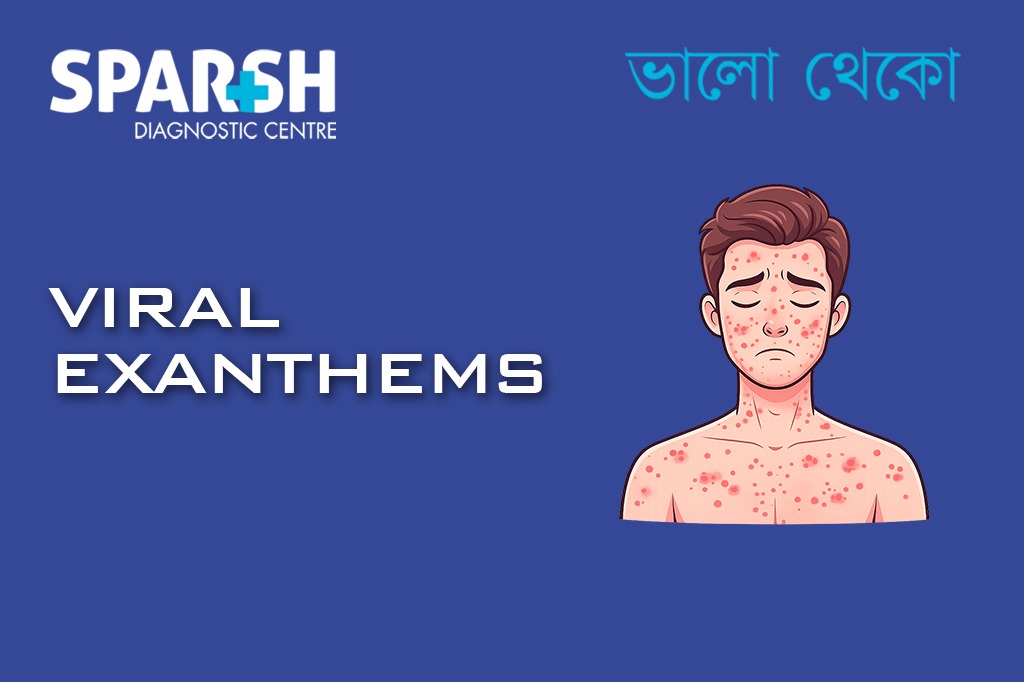
A sudden rash can be worrying, especially when it appears along with fever, body aches, headache or other flu-like symptoms. One possible explanation is a viral exanthem, a widespread skin rash that occurs during a viral infection.
The word exanthem simply means a widespread rash, usually accompanied by symptoms affecting the rest of the body. Viral exanthems are particularly common in children, but adults can develop them too. The rash may consist of small red spots, flat patches, raised bumps or, depending on the infection, blisters or other types of lesions. It may be itchy or completely non-itchy.
Importantly, a viral exanthem is not a single disease. It is a pattern of skin eruption associated with different viral infections. Measles, rubella, chickenpox, roseola, parvovirus B19, enteroviruses and several other viruses can cause characteristic or nonspecific exanthems. Dengue and chikungunya can also cause fever with skin eruptions and are important considerations in tropical regions such as India.
What is a viral exanthem?
A viral exanthem is a widespread rash that develops as part of a viral illness. The rash may occur because of the body’s immune response to the infection, direct effects of the virus on the skin, or other inflammatory mechanisms associated with the infection.
In many cases, the rash appears after one or more days of fever or other symptoms. However, the timing varies considerably depending on the virus.
A person with a viral exanthem may also experience:
- Fever
- Fatigue
- Headache
- Muscle or body aches
- Sore throat
- Runny nose
- Cough
- Loss of appetite
- Swollen lymph nodes
- Joint pain
- Nausea or abdominal discomfort
Some infections have distinctive rash patterns that make the diagnosis easier. Others produce a nonspecific rash that looks similar to several other conditions. This is why the rash should be assessed together with the patient’s age, symptoms, vaccination history, recent medication use, travel, insect exposure and possible contact with someone who was ill.
What does a viral exanthem look like?
There is no single appearance that defines a viral exanthem.
A viral exanthem rash may look like:
- Flat red or pink spots
- Small raised red bumps
- Red blotches
- A widespread maculopapular rash
- Fine, lace-like patches
- Small blisters in certain viral infections
- Petechial or purpuric spots in some infections
The rash may begin on the face, trunk or another part of the body and then spread. Some viral infections have a predictable pattern, while nonspecific viral exanthems may be distributed more randomly.
The rash can also change over time. It may become lighter, merge into larger areas, fade from one region while remaining visible elsewhere, or leave temporary discoloration.
The appearance alone is therefore not always enough to identify the virus responsible.
What viruses cause exanthems?
Many different viruses can cause exanthems. Some of the better-known causes include:
| Viral infection | Typical rash or associated clues |
|---|---|
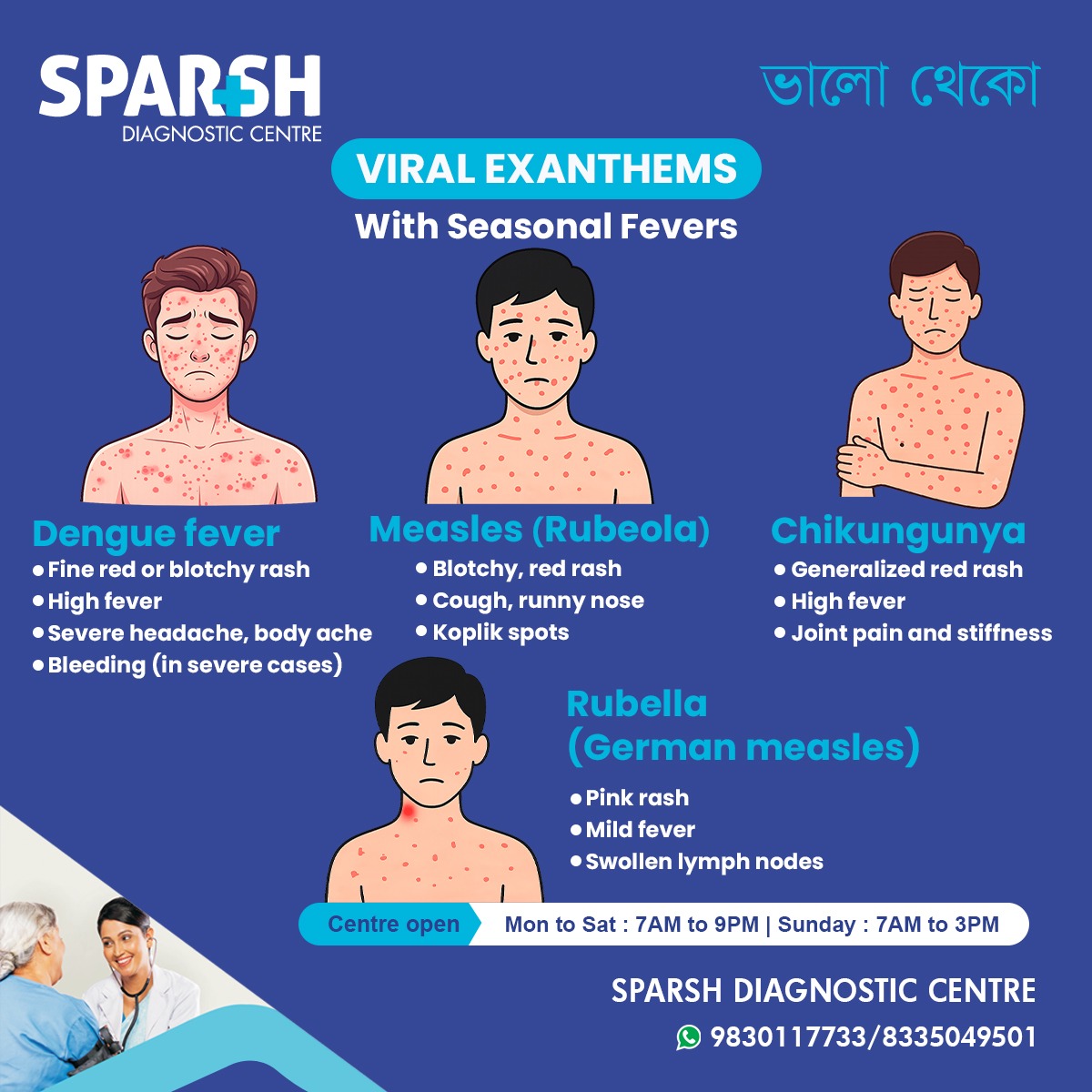
| Measles | Red, blotchy rash that typically begins on the face and spreads downward; fever, cough, runny nose and conjunctivitis are characteristic |
| Rubella | Fine pink or red rash, often beginning on the face; swollen lymph nodes may occur |
| Chickenpox | Very itchy lesions that progress from spots to bumps, fluid-filled blisters and crusts |
| Roseola | High fever followed by a rash, particularly in young children |
| Parvovirus B19 | Characteristic “slapped cheek” facial rash followed by a lacy body rash |
| Enteroviruses | Variable rashes; hand, foot and mouth disease may cause mouth sores and lesions on the hands and feet |
| Dengue | Fever, headache, body aches and sometimes a generalized rash |
| Chikungunya | Fever, prominent joint pain and a generalized maculopapular-type rash |
| Epstein-Barr virus | Fever, sore throat, swollen lymph nodes and sometimes a rash, particularly after certain antibiotics |
| COVID-19 | Several different types of skin eruption have been reported |
This list is not exhaustive. Viral exanthems may also occur with other infections, including some hepatitis viruses and acute HIV infection. The appropriate diagnosis depends on the complete clinical picture rather than the rash alone.
What causes viral exanthems?
Viral exanthems develop because of the interaction between the virus and the body’s immune system.
In some cases, the virus directly affects the skin. In others, the rash is primarily an immune response to the infection. Inflammatory substances and immune cells can produce visible changes in the skin even when the virus is not directly damaging skin cells.
This explains why two people infected with the same virus may have different skin findings. Age, immune status, previous exposure, vaccination, the amount of virus involved and individual immune responses can all influence how the illness presents.
How did I get a viral exanthem?
You generally do not “catch” a viral exanthem itself. You catch the virus that causes the exanthem.
Depending on the virus, transmission can occur through:
- Respiratory droplets or close contact
- Coughing and sneezing
- Saliva or respiratory secretions
- Direct contact with infected skin lesions
- Contaminated hands or surfaces
- The faecal-oral route for some enteroviruses
- Mosquito bites in infections such as dengue and chikungunya
The exact route depends on the underlying infection.
For example, measles is highly contagious and spreads through the respiratory route, while dengue and chikungunya are transmitted through infected mosquitoes. Therefore, identifying the cause of the rash is important not only for treatment but also for preventing transmission.
What are the common symptoms of a viral exanthem?
The rash is only one part of the illness.
Many people develop a combination of fever and constitutional symptoms before or around the time the rash appears. These can include tiredness, headache, body aches, sore throat, cough, runny nose and reduced appetite.
Some viruses have additional clues.
For example:
- Measles: high fever, cough, runny nose, conjunctivitis and Koplik spots.
- Rubella: relatively mild fever and swollen lymph nodes, particularly behind the ears or at the back of the neck.
- Chickenpox: intensely itchy lesions that progress through several stages.
- Roseola: several days of high fever followed by the appearance of a rash as the fever settles.
- Parvovirus B19: bright red cheeks followed by a lacy rash.
- Chikungunya: fever accompanied by significant joint pain or stiffness.
- Dengue: fever, severe headache, muscle and joint pain, and sometimes a generalized rash.
These patterns can provide useful clues, but they do not replace medical assessment when the diagnosis is uncertain.
How long does a viral exanthem last?
A viral exanthem can last a few days to several weeks, depending on the underlying infection and the individual’s immune response.
Some uncomplicated viral rashes fade relatively quickly as the infection resolves. Others may remain visible for longer, especially when the eruption is part of a specific viral syndrome.
The duration of the rash and the duration of contagiousness are also not necessarily the same. A person may remain infectious even after the rash has started improving, depending on the virus.
If a rash continues to worsen, persists significantly longer than expected, repeatedly returns, or is accompanied by ongoing fever or other concerning symptoms, it should be medically evaluated.
Is viral exanthem serious?
Most nonspecific viral exanthems in otherwise healthy people are mild and resolve without long-term problems. However, the phrase “viral exanthem” should not automatically be taken to mean that the underlying infection is harmless.
Some viruses associated with exanthems can cause serious complications, particularly in:
- Infants and very young children
- Pregnant individuals
- Older adults
- People with weakened immune systems
- People with significant underlying illnesses
For example, measles can cause serious complications, while rubella is particularly important during pregnancy because maternal infection can harm the developing fetus. Certain viral infections can also be more severe in people with impaired immunity.
The severity of the underlying illness matters more than the appearance of the rash alone.
Is viral exanthem the same as chickenpox?
No. Chickenpox is one specific viral infection that can produce an exanthem, but not every viral exanthem is chickenpox.
Chickenpox is caused by the varicella-zoster virus. Its rash is usually particularly itchy and evolves through recognisable stages: red spots may become raised bumps, then fluid-filled vesicles and finally crusted lesions. Importantly, different lesions can be present at different stages at the same time.
A nonspecific viral exanthem is more often flat or maculopapular and does not typically consist of the classic crops of fluid-filled vesicles seen in chickenpox.
A doctor may also consider vaccination history, exposure to chickenpox, fever pattern and the distribution and evolution of the lesions when making the diagnosis.
How is a viral exanthem diagnosed?
Diagnosis usually begins with a detailed history and physical examination.
A doctor may ask:
- When did the fever start?
- When did the rash appear?
- Where did the rash begin?
- Has it spread?
- Is it itchy or painful?
- Are there blisters?
- Is there mouth or eye involvement?
- Have you recently started any medication?
- Have you travelled recently?
- Have you had mosquito exposure?
- Are your vaccinations up to date?
- Has anyone around you had a similar illness?
- Are there associated symptoms such as joint pain, cough, sore throat or swollen lymph nodes?
Many characteristic viral exanthems can be diagnosed clinically. However, laboratory testing may be appropriate when the diagnosis is unclear, the illness is severe, public-health implications exist, or the patient belongs to a higher-risk group. Depending on the suspected infection, testing may include PCR, antigen testing or blood tests for antibodies.
Testing should therefore be targeted rather than a blanket viral panel for every rash.
How to differentiate drug rash from viral exanthem?
This can be surprisingly difficult because viral rashes and medication-related rashes can look very similar. Clinical studies and reviews have noted that routine blood tests and clinical features do not always reliably distinguish the two.
There are, however, useful clues.
| Feature | Viral exanthem | Drug rash |
| Recent infection symptoms | Often present | May be absent |
| Fever | Common with some infections | Possible, but often absent or low-grade in uncomplicated eruptions |
| Rash | Often macular or maculopapular | Often symmetric and morbilliform |
| Itching | May be absent or mild | Itching is common |
| Cough/sore throat | May occur | Usually not a primary feature |
| Conjunctivitis | Can support certain viral infections | Less typical |
| Lymph nodes | May be enlarged | May occur in some drug reactions |
| Mouth involvement | Can occur with some infections | Concerning for a significant drug reaction |
| Timing | Often follows the course of an infection | Often follows introduction of a medication, but timing varies |
| Vesicles/petechiae | Can point toward infection in the appropriate context | Less typical in an uncomplicated drug eruption |
A new medication within the preceding days or weeks increases suspicion for a drug eruption, but timing alone cannot prove the diagnosis. Previous exposure to the same medication can also alter the timing of a reaction.
Conversely, fever, cough, conjunctivitis, gastrointestinal symptoms, lymph-node enlargement, mouth lesions or other features of a viral syndrome may support an infectious cause. Some studies have also found that vesicles, petechiae and mucosal lesions can provide clues toward an infectious origin.
Importantly, do not stop an essential prescription medication on your own simply because a rash has appeared. Contact the prescribing doctor promptly so the medication can be assessed safely.
A rapidly spreading rash, blistering, skin pain, facial swelling, mucosal involvement, breathing difficulty or systemic illness after starting a medicine can represent a serious drug reaction and requires urgent medical attention.
How are viral exanthems treated?
Treatment depends primarily on the underlying viral infection.
For many uncomplicated viral illnesses, treatment is supportive because the immune system clears the infection naturally. Rest, adequate fluids and measures to control fever or itching may be sufficient.
Depending on the patient’s symptoms, a doctor may recommend:
- Adequate fluids
- Rest
- Appropriate fever-reducing medication
- Cool compresses for discomfort
- Moisturisers for dry or irritated skin
- Appropriate treatment for itching when required
However, treatment should be tailored to the suspected infection.
For example, dengue requires particular caution with medications that increase bleeding risk, and suspected dengue with significant fever should be medically assessed rather than treated as an ordinary viral rash.
Antibiotics do not treat viral infections unless a bacterial infection is also present.
When should you seek medical attention?
A rash accompanied by fever deserves medical attention when the diagnosis is uncertain or the person is becoming unwell.
Seek prompt medical assessment for:
- Very high or persistent fever
- Difficulty breathing
- Severe headache or neck stiffness
- Confusion, unusual drowsiness or altered consciousness
- Repeated vomiting or inability to drink
- Signs of dehydration
- A rapidly spreading rash
- Purple or non-blanching spots
- Significant bleeding or unusual bruising
- Severe abdominal pain
- Severe joint pain or swelling
- Blisters over large areas of the body
- Skin peeling
- Severe skin pain
- Eye involvement
- Mouth or genital sores
- Facial swelling
- A rash that develops soon after starting a medication
- Rash and fever during pregnancy
- Rash and fever in an immunocompromised person
Some of these features can indicate conditions that require urgent treatment rather than a simple self-limited viral exanthem.
Can viral exanthems be prevented?
Prevention depends on preventing the underlying infection.
Useful measures include regular handwashing, avoiding close contact with people who are actively ill, covering coughs and sneezes, improving ventilation and staying home when contagious. Vaccination is particularly important for vaccine-preventable infections such as measles, rubella and chickenpox where vaccination is recommended.
For mosquito-borne infections such as dengue and chikungunya, reducing mosquito exposure is important. This includes using appropriate mosquito repellents, wearing clothing that reduces exposed skin and eliminating standing water around homes where mosquitoes can breed.
Viral exanthem during seasonal fever outbreaks
In India, fever accompanied by a rash can have several possible causes. During periods when dengue or chikungunya are circulating, a person with fever and a rash may need to be assessed for these infections, particularly when there is prominent body pain, joint pain or other compatible symptoms.
At the same time, respiratory viruses, enteroviruses, measles, rubella and other infections can also cause fever and rash. A rash should therefore not automatically be labelled “viral fever” without considering the clinical context.
The combination of fever + rash + the timing of symptoms + rash distribution + other symptoms + exposure history is much more useful than the rash alone.
Frequently asked questions about viral exanthems
What causes viral exanthems?
Viral exanthems are caused by viral infections. The rash may result from the body’s immune response to the virus, direct effects of the infection on the skin, or inflammatory mechanisms associated with the infection. Common causes include measles, rubella, chickenpox, roseola, parvovirus B19 and enteroviruses. Dengue and chikungunya can also cause fever with a rash.
How long does a viral exanthem last?
A viral exanthem may last from several days to several weeks. The exact duration depends on the virus, the person’s immune response and the particular type of rash.
Is viral exanthem serious?
Most uncomplicated viral exanthems are self-limited, particularly in otherwise healthy people. However, some underlying viral infections can be serious, and complications are more likely in infants, pregnant people and those with weakened immune systems.
What does a viral exanthem look like?
It can appear as flat red or pink spots, blotches, raised bumps or, with certain viral infections, blisters or other lesions. Some rashes begin on the face and spread downward, while others primarily affect the trunk or extremities.
Is viral exanthem the same as chickenpox?
No. Chickenpox is one particular viral infection caused by varicella-zoster virus. Its characteristic rash usually consists of itchy lesions that progress through spots, bumps, fluid-filled blisters and crusts. Other viral exanthems may have completely different appearances.
How long can viral exanthems last?
There is no single duration for every viral exanthem. Many resolve within days, while some may persist for a few weeks. If the rash is not improving or is accompanied by persistent or worsening symptoms, medical evaluation is appropriate.
How did I get a viral exanthem?
You acquired the infection responsible for the rash. Depending on the virus, it may have spread through respiratory droplets, close contact, contaminated hands or surfaces, direct contact with lesions, the faecal-oral route or mosquito bites.
What viruses cause exanthems?
Common causes include measles virus, rubella virus, varicella-zoster virus, human herpesvirus 6, parvovirus B19 and enteroviruses. Other viruses, including Epstein-Barr virus, hepatitis viruses, HIV, dengue virus and chikungunya virus, can also be associated with exanthematous eruptions.
What does a viral exanthem rash look like?
A viral exanthem can be macular, meaning flat; papular, meaning raised; or maculopapular, meaning a combination of flat and raised lesions. Some viral infections produce vesicles, petechiae or distinctive patterns. Because the appearance overlaps with drug eruptions and other diseases, diagnosis should consider the entire clinical picture.
How can you differentiate a drug rash from a viral exanthem?
A recent medication, particularly when followed by an itchy symmetric morbilliform rash, can suggest a drug eruption. Fever, respiratory symptoms, conjunctivitis, lymph-node enlargement, mucosal symptoms or other signs of an infection may point toward a viral cause. However, the two can look very similar, and sometimes clinical examination and targeted testing are needed to distinguish them.
Do all viral exanthems require blood tests?
No. Many viral exanthems can be diagnosed clinically when the presentation is characteristic. Testing may be recommended when the diagnosis is uncertain, the patient is significantly unwell, the infection has public-health implications, or the patient is pregnant or immunocompromised. Depending on the suspected virus, PCR, antigen testing or serology may be used.
Can adults get viral exanthems?
Yes. Viral exanthems are not limited to children. Adults can develop them from many of the same viral infections, although the presentation and severity may differ. Some infections may also be more significant in adults with particular risk factors.
The bottom line
A viral exanthem is a widespread rash associated with a viral infection, rather than a single disease. It can look like red spots, blotches, bumps or, in some infections, blisters. Fever, fatigue, headache, cough, sore throat, body aches and swollen lymph nodes may occur alongside the rash.
Most uncomplicated viral exanthems settle on their own, but the underlying cause matters. Measles, rubella, chickenpox, dengue, chikungunya and other infections have different implications for treatment, infection control and complications.
The most important distinction is not simply whether a rash “looks viral”. Doctors consider when the rash appeared, what it looks like, where it started, accompanying symptoms, recent medications, vaccination history, travel and exposure to infections. When necessary, targeted laboratory tests can help identify the underlying infection.
If a rash is accompanied by severe illness, bleeding, breathing difficulty, blistering, skin peeling, significant mucosal involvement, altered consciousness, persistent high fever or other concerning symptoms, medical assessment should not be delayed.
To consult a Doctor or get full body check-up done at Sparsh Diagnostic Centre, call our helpline numbers 9830117733/ 8335049501.
#BhaloTheko
Disclaimer:
No content on this site, regardless of date, should ever be used as a substitute for direct medical advice from your doctor or other qualified clinician.