Pneumonic plague is one of the rarest but most dangerous forms of plague. It occurs when the bacterium Yersinia pestis infects the lungs. Unlike bubonic plague, which usually spreads through infected flea bites and primarily affects the lymph nodes, pneumonic plague affects the respiratory system and can sometimes spread from one person to another through respiratory droplets.
The good news is that pneumonic plague is not inevitably fatal when it is recognised and treated promptly. Modern antibiotics can successfully treat the infection, but treatment needs to begin as early as possible because the disease can progress extremely quickly.
Plague still exists today, although it is uncommon in most parts of the world. Human cases continue to occur, particularly in some parts of Africa, as well as in certain regions of Asia and the Americas.
Understanding what pneumonic plague is, how it spreads and which symptoms require urgent medical attention can help reduce delays in diagnosis and treatment.
What is pneumonic plague?
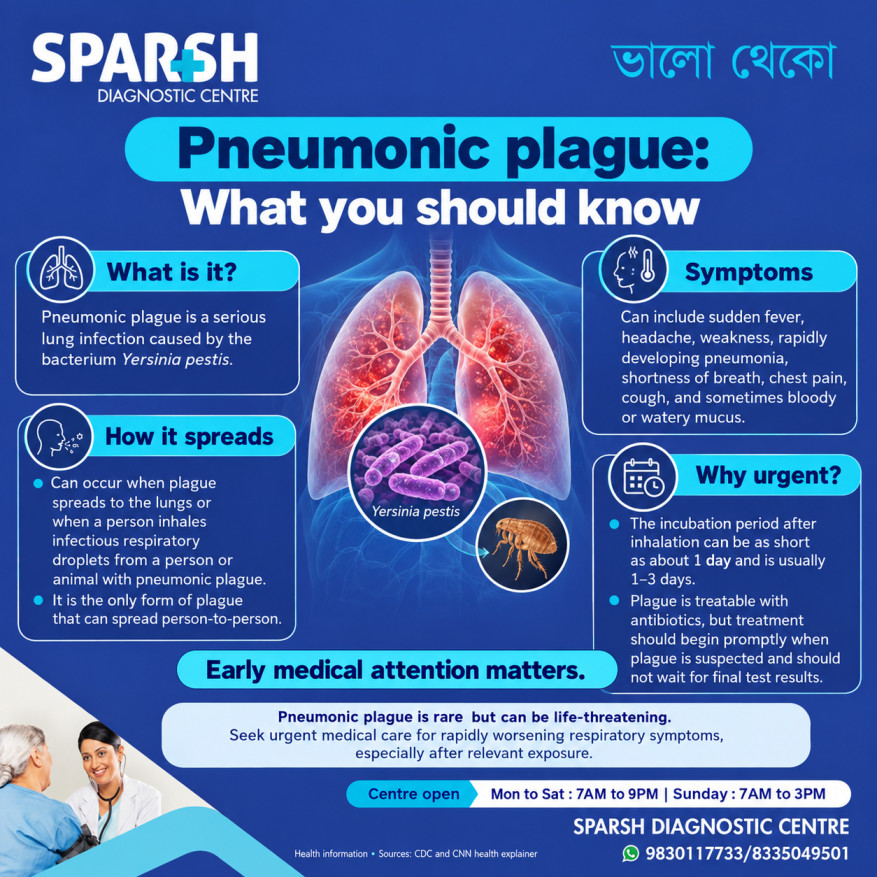
Pneumonic plague is a form of plague in which Yersinia pestis infects the lungs. It is considered the most severe and potentially contagious form of plague.
There are three major clinical forms of plague:
- Bubonic plague: primarily affects the lymph nodes and commonly causes painful swollen lymph nodes called buboes.
- Septicaemic plague: occurs when the bacteria spread through the bloodstream.
- Pneumonic plague: occurs when the bacteria infect the lungs.
Pneumonic plague can develop in two ways.
Primary pneumonic plague occurs when a person directly inhales infectious respiratory droplets containing Yersinia pestis. This can happen after close contact with a person or animal with pneumonic plague.
Secondary pneumonic plague occurs when plague that initially developed elsewhere in the body, such as bubonic or septicaemic plague, spreads to the lungs.
Because pneumonic plague can deteriorate rapidly and may be transmitted through respiratory droplets, suspected cases require urgent medical assessment and appropriate infection-control measures.
What is pneumonic plague caused by?
Pneumonic plague is caused by the bacterium Yersinia pestis.
The bacterium is naturally maintained in populations of certain small mammals and their fleas. Humans can become infected through several routes, including infected flea bites, contact with infected animal tissues or inhalation of infectious respiratory droplets.
Pneumonic plague specifically involves infection of the lungs. When Yersinia pestis reaches the respiratory system, it can cause a rapidly developing and potentially severe pneumonia.
How is pneumonic plague transmitted?
Transmission depends on how the infection develops.
A person can develop primary pneumonic plague by inhaling respiratory droplets from someone or an animal with pneumonic plague. Close and direct exposure is particularly important.
Person-to-person transmission is possible but uncommon and generally requires close contact with a person who has pneumonic plague, particularly when that person is coughing.
Plague can also reach the lungs after another form of plague has already developed. For example, untreated bubonic plague can spread through the bloodstream and eventually infect the lungs, resulting in secondary pneumonic plague.
It is important to understand that ordinary casual contact does not automatically mean that someone will develop pneumonic plague. Transmission generally involves exposure to infectious respiratory droplets and close contact.
What are the symptoms of pneumonic plague?
Pneumonic plague can begin suddenly and progress rapidly.
Common symptoms may include:
- Sudden fever
- Chills
- Headache
- Weakness and fatigue
- Muscle or body aches
- Cough
- Shortness of breath
- Chest pain
- Rapid or difficult breathing
- Watery or bloody mucus
- Coughing up blood in some cases
Some people may also experience nausea, vomiting or other general symptoms of severe infection.
One of the concerning features of pneumonic plague is the speed at which respiratory symptoms can worsen. A person may initially appear to have a serious respiratory infection and then develop rapidly increasing breathing difficulty.
Anyone with severe respiratory symptoms following a relevant exposure to plague should seek urgent medical attention rather than waiting for symptoms to settle on their own.
How quickly does pneumonic plague develop?
Pneumonic plague has a relatively short incubation period.
Symptoms can develop within a few days of exposure and, in some cases, may begin as soon as around one day after infection. This is considerably faster than many common respiratory infections.
The short incubation period, combined with the potentially rapid progression of the disease, is one reason early medical evaluation is so important.
Is pneumonic plague the same as pneumonia?
No. Pneumonic plague and pneumonia are not the same disease.
Pneumonia is a general term for inflammation and infection of the lungs. It can be caused by many different organisms, including bacteria, viruses and fungi.
Pneumonic plague is specifically a lung infection caused by Yersinia pestis.
The symptoms can overlap considerably. Both conditions can cause fever, cough, chest discomfort and difficulty breathing. This means that doctors need to consider a person’s symptoms, exposure history and other clinical information when determining the likely cause.
Pneumonic plague is particularly concerning because of its rapid progression and its potential for person-to-person transmission.
How is pneumonic plague diagnosed?
Diagnosing pneumonic plague can be challenging because its early symptoms can resemble other severe respiratory infections.
Doctors may consider plague when a patient has compatible symptoms together with a relevant exposure history, such as:
- Recent travel to or residence in an area where plague occurs
- Contact with potentially infected animals
- Exposure to infected animal tissues
- Close contact with a person suspected of having pneumonic plague
- A known plague outbreak
Laboratory testing is required to confirm the infection.
Depending on the clinical presentation, samples may include blood, sputum or material from an affected lymph node. Laboratory testing can be used to identify Yersinia pestis.
When pneumonic plague is strongly suspected, treatment should not necessarily be delayed until all laboratory results are available. Because the disease can progress so quickly, doctors may begin appropriate antibiotic treatment while diagnostic testing is underway.
How is pneumonic plague treated?
Pneumonic plague is treated with antibiotics.
The specific antibiotic and method of administration depend on factors such as the patient’s age, severity of illness, medical history, allergies and clinical condition.
People who are seriously ill may require hospitalisation and supportive treatment, including management of breathing difficulties and other complications.
Because pneumonic plague can become life-threatening very quickly, the most important factor is starting effective treatment as soon as possible.
People who have had significant exposure to a confirmed or suspected case may also be assessed by public health or medical professionals. In certain situations, preventive antibiotics may be recommended for close contacts.
Patients suspected of having pneumonic plague may need to be isolated and managed with appropriate infection-control precautions to reduce the possibility of transmission.
Can you cure pneumonic plague?
Yes. Pneumonic plague is curable when diagnosed and treated promptly.
The disease has a very high fatality rate when it is left untreated, but this should not be confused with saying that every person who develops pneumonic plague will die.
Modern antibiotics have dramatically changed the outcome of plague infections.
The key is timing. Because pneumonic plague can deteriorate rapidly, delaying treatment can significantly increase the risk of serious complications and death.
Is pneumonic plague 100% fatal?
No.
Pneumonic plague is not 100% fatal when treated appropriately.
However, untreated pneumonic plague can be fatal and may progress to death very quickly. The World Health Organization describes untreated pneumonic plague as invariably fatal, while also emphasising that early diagnosis and antibiotic treatment can save lives.
This distinction is extremely important.
The historical reputation of plague comes largely from periods when effective antibiotics were unavailable. Today, early recognition, antibiotics, supportive medical care and infection-control measures have transformed the prognosis.
How bad is pneumonic plague?
Pneumonic plague is considered the most dangerous clinical form of plague because it can:
- Progress extremely rapidly.
- Cause severe respiratory failure.
- Spread through respiratory droplets from infected patients.
- Become fatal if effective treatment is delayed.
The disease can cause severe pneumonia, low oxygen levels, respiratory distress, bloodstream infection and shock.
However, the word “plague” can create unnecessary panic. Pneumonic plague is rare, and modern medicine can treat it.
The greatest danger is not simply exposure to the word “plague”; it is a genuine infection that goes unrecognised or untreated.
Which is worse, bubonic or pneumonic plague?
Pneumonic plague is generally considered more dangerous than bubonic plague.
Bubonic plague primarily affects the lymphatic system and typically causes painful swollen lymph nodes. It is usually acquired through the bite of an infected flea.
Pneumonic plague affects the lungs and can progress very quickly. It can also be transmitted from person to person through infectious respiratory droplets.
Bubonic plague can sometimes progress into pneumonic plague if the infection spreads to the lungs.
Both forms require prompt medical treatment, but pneumonic plague is particularly urgent because of its rapid progression and transmission potential.
Does the pneumonic plague still exist?
Yes. Pneumonic plague still exists, although it is rare.
Plague has not disappeared from the world. Yersinia pestis continues to circulate among certain animal and flea populations, and human cases are reported periodically.
The majority of modern human plague cases occur in parts of Africa, particularly in countries where plague remains endemic. Cases can also occur in parts of Asia and the Americas.
Modern outbreaks are very different from the historical plague pandemics that caused enormous loss of life. Antibiotics, laboratory diagnosis, surveillance, public-health measures and improved medical care have made plague a treatable disease.
Did anyone survive the pneumonic plague?
Yes. People have survived pneumonic plague, particularly when appropriate antibiotic treatment is started early.
Historical outbreaks before modern antibiotics had extremely high mortality. However, modern medical care has changed the outlook considerably.
Survival depends on several factors, including how quickly the disease is recognised, how soon appropriate antibiotics are administered, the severity of infection and the patient’s overall health.
This is why pneumonic plague should be regarded as a medical emergency rather than an automatically fatal disease.
Is there a vaccine for pneumonic plague?
There is no routinely recommended plague vaccination for the general population.
The World Health Organization does not recommend routine plague vaccination, although vaccination may be considered for certain high-risk groups, such as laboratory personnel or healthcare workers with occupational exposure.
Older plague vaccines have also had limitations, particularly regarding protection against pneumonic infection.
For most people, prevention focuses on reducing exposure to infected animals and fleas, avoiding contact with infected tissues and taking appropriate precautions around suspected pneumonic plague cases.
How to prevent pneumonic plague?
Prevention involves reducing opportunities for exposure to Yersinia pestis.
Important precautions include:
- Avoid touching sick or dead wild animals.
- Avoid handling animal carcasses without appropriate protective equipment.
- Take measures to prevent flea bites in areas where plague occurs.
- Keep pets protected against fleas.
- Seek veterinary care if a pet becomes unexpectedly ill after potential exposure to rodents or wild animals.
- Avoid close contact with someone suspected or confirmed to have pneumonic plague.
- Follow public-health and healthcare advice during a confirmed outbreak.
- Healthcare workers should use appropriate infection-control precautions when managing suspected cases.
People who have had a significant exposure to a confirmed case may be advised to receive preventive antibiotic treatment.
Can you survive pneumonic plague?
Yes, survival is possible, particularly when treatment begins quickly.
The most important message is that pneumonic plague is a medical emergency, not an automatically fatal diagnosis.
If a person develops sudden fever, cough, chest pain or rapidly worsening shortness of breath after a relevant exposure, urgent medical assessment is essential.
Do not wait for symptoms to become severe before seeking help. Do not self-medicate with leftover antibiotics. Diagnosis and treatment should be guided by a qualified medical professional.
Pneumonic plague vs pneumonia: key differences
Although the names sound similar, these conditions have important differences.
| Feature | Pneumonic plague | Ordinary pneumonia |
|---|---|---|
| Cause | Yersinia pestis | Many bacteria, viruses and fungi |
| Main organ affected | Lungs | Lungs |
| Onset | Often sudden and rapid | Depends on the cause |
| Transmission | Can spread through infectious respiratory droplets in close contact | Depends on the organism |
| Severity | Can become life-threatening very quickly | Ranges from mild to severe |
| Treatment | Specific antibiotics for plague | Treatment depends on the cause |
| Public-health concern | Requires urgent infection-control measures | Depends on the cause |
Because symptoms can overlap, a healthcare professional may need laboratory testing and a detailed exposure history to distinguish pneumonic plague from other causes of pneumonia.
When should you seek medical attention?
Pneumonic plague is rare, but if there has been a credible exposure, symptoms should not be ignored.
Seek urgent medical care for symptoms such as:
- Sudden high fever
- Severe weakness or chills
- Rapidly worsening cough
- Difficulty breathing
- Chest pain
- Bloody or unusual sputum
- Rapid deterioration after contact with a suspected plague patient or infected animal
Tell the healthcare professional about any recent travel, animal exposure, flea exposure or contact with someone who may have had pneumonic plague.
Early information can help clinicians make the right diagnosis and begin appropriate treatment without unnecessary delay.
The bottom line
Pneumonic plague is a rare but serious infection caused by Yersinia pestis. It is different from bubonic plague because it directly affects the lungs and, in certain circumstances, can spread between people through respiratory droplets.
Its symptoms can include sudden fever, headache, weakness, cough, chest pain, shortness of breath and sometimes bloody or watery mucus. The illness can progress rapidly, which makes early diagnosis and treatment extremely important.
The most reassuring fact is that pneumonic plague is treatable and can be cured when appropriate antibiotics are given promptly. It is not 100% fatal when treated.
Although plague remains present in parts of the world, it is rare in most populations. Awareness, appropriate precautions, early diagnosis and timely medical care remain the most effective ways to prevent severe outcomes.
Suspected pneumonic plague in Russia: what we know about the Siberia incident
Reports of a possible pneumonic plague infection in Siberia, Russia, have raised international concern after a laboratory worker at an anti-plague research institute died following severe pneumonia.
The situation is being closely monitored by Russian and international health authorities. However, it is important to distinguish between confirmed facts and unverified reports. As of 6 October 2026, Russian health authorities have not confirmed that the woman died from pneumonic plague, and there is no confirmed evidence of a wider community outbreak.
The incident began attracting attention after a 28-year-old employee of the Irkutsk Anti-Plague Research Institute of Siberia and the Far East became seriously ill and subsequently died at a hospital in Shelekhov, near Irkutsk.
Her death prompted precautionary measures, including medical observation and isolation of people who had been in contact with her. Reports indicate that around 200 people were placed under observation, although the exact number and nature of the measures have varied between reports.
What happened in Siberia?
The incident centres on the Irkutsk region of southeastern Siberia.
The deceased woman, identified by multiple media reports as Darya Shipilova, worked at the Irkutsk Anti-Plague Research Institute, a facility specialising in research and surveillance of plague and other infectious diseases.
She was reportedly hospitalised on 29 September after developing severe pneumonia and died on 2 October.
Soon after her death, reports began circulating that she might have been infected with Yersinia pestis, the bacterium that causes plague. Some reports also alleged that a laboratory accident involving a tube containing plague bacteria had occurred.
However, Russian health authorities have not confirmed either of these claims.
Rospotrebnadzor, Russia’s public-health watchdog, said that testing found no microorganisms associated with the woman’s professional activities and reported that no accident involving pathogenic microorganisms had been identified at the institute. Authorities described the illness as pneumonia of unknown aetiology and said the epidemiological situation in the region remained stable.
Frequently asked questions about pneumonic plague
Does the pneumonic plague still exist?
Yes. Plague caused by Yersinia pestis still occurs, particularly in certain regions of Africa, Asia and the Americas. Pneumonic plague remains rare but can occur either as a primary lung infection or when another form of plague spreads to the lungs.
Is bubonic plague the same as pneumonic plague?
No. Both are caused by Yersinia pestis, but they affect the body differently. Bubonic plague primarily affects the lymph nodes and causes painful swollen lymph nodes. Pneumonic plague affects the lungs and can potentially spread through respiratory droplets.
What is pneumonic plague caused by?
Pneumonic plague is caused by infection with the bacterium Yersinia pestis. The infection can reach the lungs through inhalation of infectious droplets or by spreading from another form of plague.
Is pneumonic plague 100% fatal?
No, not when treated. Untreated pneumonic plague can be rapidly fatal, but early antibiotic treatment can lead to recovery.
Can you cure pneumonic plague?
Yes. Pneumonic plague can be cured with appropriate antibiotic treatment when it is diagnosed and treated promptly.
Did anyone survive the pneumonic plague?
Yes. People have survived pneumonic plague, particularly when effective antibiotic treatment was started early. Survival is much less likely when treatment is delayed.
How bad is pneumonic plague?
It is the most severe form of plague because it can progress rapidly, cause serious respiratory illness and potentially spread through respiratory droplets. However, it is treatable with modern antibiotics.
Is there a vaccine for pneumonic plague?
Routine vaccination is not recommended for the general population. WHO recommends considering vaccination only for certain high-risk occupational groups. Prevention mainly relies on avoiding exposure and following public-health precautions.
Which is worse, bubonic or pneumonic plague?
Pneumonic plague is generally considered more dangerous because it can progress rapidly and can be transmitted between people through respiratory droplets. Bubonic plague is more common and primarily affects the lymph nodes.
How can pneumonic plague be prevented?
Avoid contact with sick or dead animals in plague-endemic areas, prevent flea bites, protect pets against fleas and avoid close contact with someone suspected of having pneumonic plague. People with significant exposure may require preventive antibiotics under medical guidance.
How is pneumonic plague transmitted?
It can be transmitted by inhaling infectious respiratory droplets from a person or animal with pneumonic plague. Person-to-person transmission generally requires close contact. Pneumonic plague can also develop when bubonic or septicaemic plague spreads to the lungs.
What is the difference between pneumonic plague and pneumonia?
Pneumonic plague is pneumonia caused specifically by Yersinia pestis. Pneumonia itself is a broad term covering lung infections caused by many different bacteria, viruses and fungi.
What are the symptoms of pneumonic plague?
Symptoms can include sudden fever, chills, headache, weakness, cough, chest pain, shortness of breath and rapidly worsening pneumonia. Some patients may develop bloody or watery sputum.
How is pneumonic plague treated?
It is treated with appropriate antibiotics, often alongside supportive hospital care when the illness is severe. Treatment should begin as quickly as possible when pneumonic plague is suspected.
Is pneumonic plague curable?
Yes. Early diagnosis and appropriate antibiotic treatment can cure pneumonic plague. Delayed treatment significantly increases the risk of severe complications and death.
Is pneumonic plague 100% fatal?
No. It is potentially fatal if untreated, but people can and do survive when appropriate treatment is started promptly.
#BhaloTheko
Disclaimer:
No content on this site, regardless of date, should ever be used as a substitute for direct medical advice from your doctor or other qualified clinician.

Sources and further reading
The information in this article has been reviewed against the following medical, public-health and scientific sources:
- World Health Organization (WHO) — Plague fact sheet: Provides current information on the causes, forms, symptoms, transmission, diagnosis, treatment, prevention and vaccination of plague. WHO — Plague fact sheet
- World Health Organization (WHO) — Facts about plague: Additional information about bubonic, pneumonic and septicaemic plague, including transmission, treatment and prevention. WHO — Facts about plague
- World Health Organization — Guidelines for plague management: Clinical guidance covering diagnosis, antimicrobial treatment and infection-prevention measures for plague. WHO guidelines for plague management
- Centers for Disease Control and Prevention (CDC) — Clinical care of plague: Information on antibiotic treatment, treatment timing and the importance of beginning therapy when plague is suspected rather than waiting for laboratory confirmation. CDC — Clinical care of plague
- CDC — Clinical testing and diagnosis for plague: Information on diagnostic testing, incubation periods, symptoms and the clinical management of suspected pneumonic plague. CDC — Clinical testing and diagnosis for plague
- CDC — How plague spreads: Details on flea transmission, exposure to infected animals and person-to-person transmission through infectious respiratory droplets in pneumonic plague. CDC — How plague spreads
- CDC — Preventing plague: Practical advice on reducing exposure to infected animals, fleas and rodent habitats. CDC — Preventing plague
- Washington State Department of Health — Plague: Information about the different forms of plague, symptoms, transmission and the seriousness of pneumonic plague. Washington State Department of Health — Plague
- Centers for Disease Control and Prevention — Antimicrobial treatment and prophylaxis of plague: Clinical guidance covering antimicrobial treatment and person-to-person transmission of pneumonic plague. CDC — Antimicrobial treatment and prophylaxis of plague
- Emerging Infectious Diseases / PubMed Central — Deaths associated with pneumonic plague, 1946–2017: A systematic review and meta-analysis examining mortality associated with pneumonic plague. Deaths associated with pneumonic plague, 1946–2017
- ScienceDirect — Pneumonic plague: Medical reference material covering the clinical and pharmacological aspects of pneumonic plague. ScienceDirect — Pneumonic plague
- CNN Health — Pneumonic plague explained: Background information on pneumonic plague, including its symptoms, transmission and treatment. CNN Health — Pneumonic plague explained
- NBC News — Pneumonic plague: Background reporting and medical information concerning pneumonic plague, its symptoms and treatment. NBC News — Pneumonic plague