A heart attack does not always arrive with crushing chest pain or an obvious medical emergency. Sometimes, the symptoms are so mild that a person may mistake them for acidity, tiredness, stress, muscle strain or simply getting older. In some cases, there may be virtually no noticeable symptoms at all. This is known as a silent heart attack or silent myocardial infarction (MI).
The word “silent” can be misleading. A silent heart attack is still a genuine heart attack. Reduced or blocked blood flow can injure the heart muscle, and the resulting damage may increase the risk of future heart problems.
Some people discover that they have had a silent heart attack weeks, months or even years later, when an ECG, echocardiogram or cardiac MRI is performed for another reason.
This detailed guide explains the subtle warning signs, causes, risk factors, diagnostic tests, treatment options and long-term outlook after a silent heart attack.
Important: If you are currently experiencing unexplained chest pressure, breathlessness, sweating, nausea, dizziness, unusual weakness or pain/discomfort in your arm, jaw, neck or back, do not wait to see whether it goes away. Seek emergency medical attention immediately.
What is a silent heart attack?
A silent heart attack is a myocardial infarction that occurs with no symptoms, very mild symptoms, or symptoms that the person does not recognise as being related to the heart.
Like any other heart attack, it occurs when part of the heart muscle does not receive enough oxygen-rich blood. Atherosclerosis and coronary artery disease are common underlying causes. A plaque inside a coronary artery can rupture, allowing a blood clot to form and obstruct blood flow.
The important difference is not necessarily the amount of heart damage. It is the way the event presents.
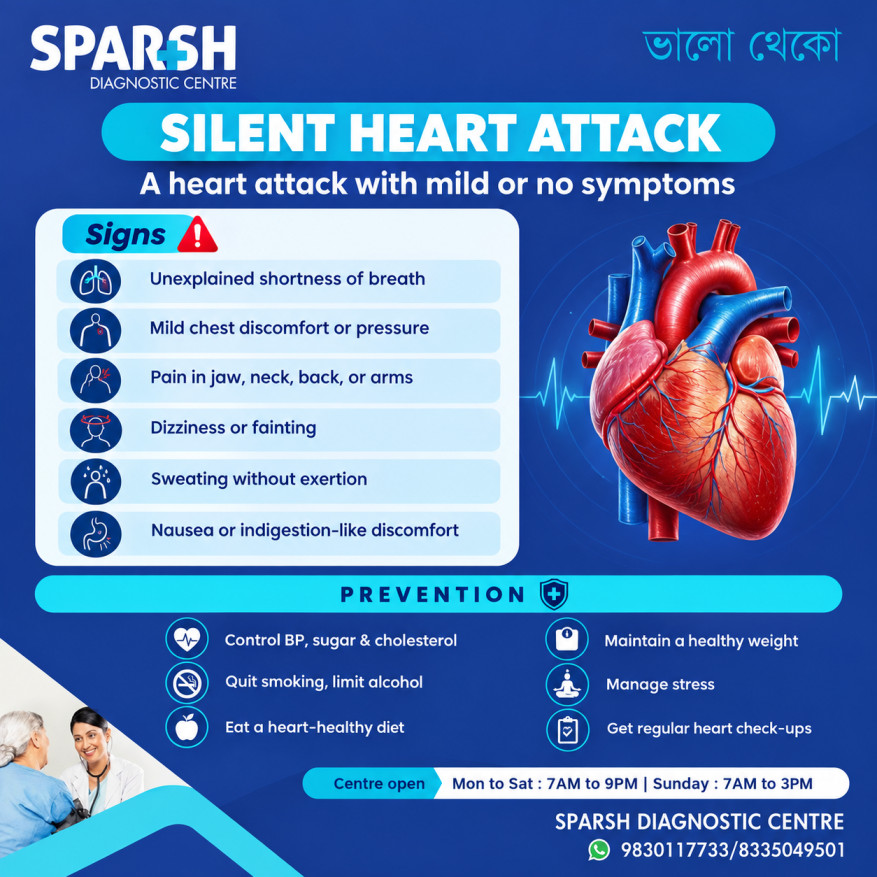
Someone might experience:
- Unusual tiredness
- Mild chest pressure
- Breathlessness
- Indigestion-like discomfort
- Nausea
- Dizziness
- Sweating
- Discomfort in the jaw, neck, back or arm
Or they may experience no symptoms they recognise as cardiac.
How do you know if you have a silent heart attack?
You cannot reliably diagnose a silent heart attack based on symptoms alone. In fact, the defining problem is that the symptoms may be absent or so subtle that they are easily dismissed.
A silent heart attack may eventually be suspected because of:
- Changes on an ECG
- Evidence of previous heart muscle damage on an echocardiogram
- Findings on cardiac MRI
- A history of unexplained symptoms
- Abnormalities discovered during a stress test
- Evidence of coronary artery disease on cardiac imaging
A healthcare professional will consider your symptoms, medical history and cardiovascular risk factors before deciding which tests are appropriate.
What are the 7 signs before a heart attack?
There is no medically established list of exactly seven symptoms that occurs before every heart attack. Some heart attacks occur suddenly, while others develop gradually.
However, the following seven warning symptoms deserve attention, particularly when they are new, unexplained or unusual for you:
- Chest pressure or discomfort – It may feel like heaviness, squeezing, fullness or mild pressure rather than severe pain.
- Unexplained shortness of breath – Breathlessness can occur with or without chest discomfort.
- Unusual fatigue or weakness – Especially when it is out of proportion to your activity.
- Discomfort in the arm, back, neck or jaw – Heart-related discomfort does not necessarily remain in the chest.
- Nausea or indigestion-like discomfort – It may be mistaken for acidity or a stomach problem.
- Cold sweating – Sweating without exercise, heat or another obvious explanation can be a warning sign.
- Dizziness or lightheadedness – Particularly when accompanied by other symptoms.
The American Heart Association notes that symptoms can vary considerably, particularly among women, older adults and people with diabetes.
How do I know if I am having a silent heart attack?
This is one of the most difficult questions because you may not know while it is happening.
If you suddenly develop unexplained breathlessness, mild chest pressure, unusual sweating, nausea, dizziness, extreme fatigue or discomfort in the jaw, arm, back or neck, do not assume that the symptoms are simply acidity, anxiety or tiredness.
A silent heart attack is still an emergency. If symptoms are happening now, seek emergency medical care rather than waiting for them to become severe.
This is especially important if you have diabetes, high blood pressure, high cholesterol, smoke, have obesity, have a family history of heart disease or have previously had a heart attack.
How long does a silent heart attack last?
There is no single duration for a silent heart attack.
The underlying interruption of blood flow and the resulting heart muscle injury can vary considerably depending on the artery involved, the degree of blockage and how quickly blood flow is restored.
Because symptoms may be absent or intermittent, a person may not realise that a heart attack is occurring. Some people only discover evidence of the previous heart attack much later.
This is why the absence of severe symptoms does not mean that the heart attack is harmless or that it has safely passed.
What causes a silent heart attack?
The most common underlying cause is coronary artery disease (CAD).
In CAD, cholesterol-containing plaque gradually builds up inside the coronary arteries. If a plaque ruptures, a blood clot can form and reduce or block blood flow to the heart muscle.
A silent heart attack can therefore develop for essentially the same reasons as a recognised heart attack.
Other, less common mechanisms can include coronary artery spasm, coronary artery dissection or other conditions that interfere with blood flow.
Why are people getting silent heart attacks?
There isn’t one new or separate disease responsible for silent heart attacks. They generally arise from the same cardiovascular risk factors that cause other heart attacks.
What makes an event “silent” is often the way the symptoms are experienced or perceived.
For example, a person may have:
- Reduced awareness of cardiac pain
- Diabetes-related nerve damage
- Mild or atypical symptoms
- Symptoms resembling indigestion or muscle pain
- Fatigue or breathlessness that is attributed to another cause
Diabetes deserves particular attention because nerve damage associated with diabetes can reduce the perception of pain.
What are the risk factors for silent heart attacks?
The risk factors are broadly similar to those for other heart attacks.
Important risk factors include:
- Diabetes
- High blood pressure
- High LDL cholesterol
- Smoking or tobacco use
- Excess weight or obesity
- Physical inactivity
- Unhealthy diet
- Family history of heart disease
- Increasing age
- Previous heart attack
- Chronic kidney disease
The risk tends to increase as several risk factors occur together.
What age do silent heart attacks occur?
There is no specific age at which a silent heart attack starts.
They can occur in younger adults, particularly when significant risk factors such as diabetes, smoking, high cholesterol, high blood pressure or a strong family history are present.
However, the prevalence of silent myocardial infarction generally increases with age. Research has also found a substantial association with diabetes and established cardiovascular disease.
So, being relatively young does not automatically rule out a heart attack.
How many people have silent heart attacks?
The exact number varies depending on how a silent heart attack is defined and how it is detected.
The American Heart Association reported in September 2026 that approximately 170,000 of the 805,000 heart attacks occurring each year in the United States are silent, based on its cited U.S. estimates. That is roughly one in five heart attacks.
Research estimates have varied widely because silent myocardial infarction can be identified in different ways, including ECG and cardiac imaging.
These figures should not be directly applied to India because population characteristics and study methods differ.
What tests can detect a silent heart attack?
Several tests may help identify a current or previous heart attack.
ECG
An electrocardiogram (ECG/EKG) records the heart’s electrical activity. It may show changes associated with a current or previous myocardial infarction.
However, an ECG does not detect every silent heart attack. Some ECG findings, such as pathological Q waves, can suggest an old infarction but are not specific enough on their own to establish the diagnosis in every case. Current expert guidance notes that imaging may be needed to confirm an unrecognised previous myocardial infarction.
Blood tests
Cardiac troponin is an important blood marker of heart muscle injury and is commonly used when a recent or ongoing heart attack is suspected.
Troponin levels change over time, so doctors may repeat the test rather than relying on one result.
For an old silent heart attack, however, troponin may no longer be elevated.
Echocardiogram
An echocardiogram uses ultrasound to examine heart structure and function. It can show abnormalities in the movement of part of the heart muscle or reduced pumping function.
Cardiac MRI
Cardiac MRI can provide detailed information about heart muscle damage and scarring. It is particularly useful when doctors need to determine whether an area of damaged heart muscle represents a previous myocardial infarction.
Stress testing
An exercise or other stress test can help identify abnormal blood flow or evidence of coronary artery disease in appropriate patients.
CT coronary angiography or coronary angiography
These tests can assess the coronary arteries and identify significant narrowing or blockage. Conventional coronary angiography may also be used when an invasive assessment or treatment is required.
No single test is appropriate for everyone. The choice depends on whether doctors suspect a current event, a previous heart attack or underlying coronary artery disease.
How does silent heart attack show on ECG?
A silent heart attack can sometimes leave characteristic ECG changes.
One possible finding is a pathological Q wave, which can indicate previous damage to the heart muscle. Other changes may also suggest myocardial injury depending on when the event occurred and which part of the heart was affected.
However, an ECG has limitations. Not every previous heart attack produces obvious ECG abnormalities, and some abnormal ECG findings are not proof of a previous heart attack.
For this reason, suspected old silent myocardial infarction may need confirmation with cardiac imaging, particularly cardiac MRI when clinically appropriate.
Can a silent heart attack be fatal?
Yes.
“Silent” describes the symptoms, not the seriousness of the heart attack.
A silent heart attack can damage heart muscle and may contribute to complications such as abnormal heart rhythms, heart failure and future cardiovascular events.
Because people may not recognise what is happening, treatment can also be delayed.
If symptoms that could indicate a heart attack are happening now, do not wait for severe pain to develop.
What is cardiac anxiety?
Cardiac anxiety is not a specific diagnosis in the same way as coronary artery disease or myocardial infarction. The term is often used to describe persistent worry about having a heart problem, particularly after experiencing cardiac symptoms or a heart attack.
Someone may become highly alert to normal sensations such as a faster heartbeat, chest awareness or occasional palpitations and worry that they indicate another heart attack.
This can create a difficult cycle:
physical sensation → worry → increased stress response → stronger awareness of heartbeat or chest sensations → more worry.
At the same time, genuine cardiac symptoms should never automatically be dismissed as anxiety.
If you have new or unexplained symptoms, particularly if you have cardiovascular risk factors, medical assessment should come first.
Can you have multiple silent heart attacks?
Yes. A person can have more than one myocardial infarction, and more than one event may go unrecognised.
Having already experienced a heart attack increases the risk of another one. This is one reason why discovering an old silent heart attack should prompt a proper assessment of cardiovascular risk and appropriate preventive treatment.
Repeated episodes of silent myocardial ischemia can also occur, although silent ischemia and a silent heart attack are not exactly the same thing. Ischemia refers to inadequate blood supply, whereas a myocardial infarction involves actual heart muscle injury.
What are the treatment options for silent heart attacks?
Treatment depends on whether the heart attack is happening now, has recently occurred or happened in the past.
Possible treatment may include:
- Antiplatelet medicines
- Cholesterol-lowering medicines such as statins
- Medicines for blood pressure
- Medicines that reduce the workload on the heart
- Diabetes management
- Angioplasty and stent placement when indicated
- Coronary artery bypass surgery in selected patients
- Cardiac rehabilitation
- Lifestyle changes and ongoing cardiovascular risk management
The exact combination depends on the coronary anatomy, heart function, bleeding risk, other medical conditions and whether a stent or surgery is required.
A stent, for example, may be placed during angioplasty to open a significantly narrowed or blocked coronary artery. Antiplatelet medication is commonly prescribed afterward to reduce the risk of clot formation in the treated artery.
What to do after you have a silent heart attack?
Discovering that you have had a silent heart attack should not be treated as an incidental finding that can simply be ignored.
Your doctor may recommend:
- A cardiovascular assessment to determine why the heart attack occurred.
- Evaluation of the coronary arteries when appropriate.
- Blood pressure monitoring and treatment.
- Cholesterol testing and management.
- Blood sugar testing, particularly if diabetes is suspected or already present.
- Appropriate medicines to reduce the risk of another cardiovascular event.
- Cardiac rehabilitation where appropriate.
- Regular follow-up with your healthcare team.
- Stopping tobacco use.
- A heart-healthy diet and regular physical activity appropriate for your medical condition.
Cardiac rehabilitation can combine supervised exercise, risk-factor modification, education and psychological support and is recommended for many people recovering from myocardial infarction.
What is the life expectancy after a silent heart attack?
There is no single life-expectancy figure that applies to everyone after a silent heart attack.
Long-term outlook depends on factors such as:
- How much heart muscle was damaged
- The location and severity of coronary artery disease
- Heart pumping function
- Age
- Diabetes
- Blood pressure
- Cholesterol
- Smoking
- Kidney function
- Whether treatment was provided
- Whether another heart attack occurs
Research has found that silent myocardial infarction is associated with an increased risk of adverse cardiovascular outcomes, which is why discovering one should lead to active risk-factor assessment and management rather than reassurance that “nothing happened.”
How long after a silent heart attack can it be detected?
A silent heart attack may be detected during the event, shortly afterward, or much later.
A recent heart attack may be investigated using symptoms, ECG and serial troponin measurements.
An older silent heart attack may leave evidence that remains visible on an ECG or cardiac imaging. The American Heart Association notes that evidence of an old silent heart attack can sometimes be identified months or even years later.
This explains why someone may be told during a routine examination that their ECG or imaging suggests they have previously had a heart attack despite never remembering a typical cardiac episode.
Do people survive silent heart attacks?
Yes. Many people survive silent heart attacks, sometimes without initially knowing that one occurred.
However, survival does not mean that the event had no consequences. A silent heart attack can leave permanent damage and increase the risk of future heart attack, heart failure and other cardiovascular complications.
The important step after discovering one is to determine what caused it and reduce the risk of another event.
How can you reduce the risk of a silent heart attack?
You cannot eliminate every risk, but many important cardiovascular risk factors can be modified.
Focus on:
- Keeping blood pressure under control
- Managing cholesterol
- Keeping blood sugar within the target range
- Avoiding tobacco
- Maintaining a healthy body weight
- Being physically active according to your doctor’s advice
- Eating more vegetables, fruits, whole grains and other minimally processed foods
- Limiting foods high in saturated and trans fats
- Limiting excess salt
- Getting adequate sleep
- Managing chronic stress
- Taking prescribed medicines consistently
The CDC identifies high blood pressure, high cholesterol and smoking as major heart disease risk factors, while diabetes, excess weight, physical inactivity and unhealthy dietary patterns can also contribute.
Frequently asked questions about silent heart attacks
Is a silent heart attack the same as a normal heart attack?
Yes, in terms of the underlying injury to the heart muscle. The difference is that a silent heart attack produces no symptoms, mild symptoms or symptoms that are not recognised as being related to the heart.
Can a silent heart attack happen without chest pain?
Yes. Chest pain or pressure may be absent. Breathlessness, fatigue, nausea, indigestion-like discomfort, sweating, dizziness or discomfort in the jaw, back or arm may occur instead. Some people have no recognised symptoms at all.
Is indigestion ever a sign of a silent heart attack?
It can be. Heart-related discomfort may feel like indigestion or heartburn. This does not mean that every episode of acidity is cardiac, but new or unexplained indigestion-like symptoms accompanied by breathlessness, sweating, weakness or other cardiac symptoms should be assessed urgently.
Are silent heart attacks more common in people with diabetes?
Diabetes is an important risk factor. Diabetes can also cause nerve damage that reduces the perception of pain, potentially making a heart attack less noticeable.
Can women have a silent heart attack?
Yes. Women can have silent heart attacks, and they may experience symptoms such as unusual fatigue, nausea, shortness of breath or discomfort in the back, shoulder or jaw.
Can a healthy-looking person have a silent heart attack?
Yes. Appearance alone cannot determine cardiovascular health. A person can have underlying high blood pressure, high cholesterol, diabetes or coronary artery disease without obvious symptoms.
Can an ECG alone confirm a silent heart attack?
Not always. An ECG can provide important evidence, but some findings are nonspecific. Depending on the circumstances, doctors may use blood tests, echocardiography, stress testing, coronary imaging or cardiac MRI to establish the diagnosis.
Can a silent heart attack be prevented?
Many of the risk factors can be reduced through tobacco cessation, physical activity, healthy eating, weight management and appropriate control of blood pressure, cholesterol and blood sugar. However, prevention cannot guarantee that a heart attack will never occur.
When should you seek emergency medical help?
Do not wait for a silent heart attack to become “obvious.”
Seek emergency medical attention if you develop new or unexplained chest pressure, shortness of breath, cold sweating, nausea, dizziness, unusual weakness or discomfort spreading to the arm, back, neck or jaw, particularly when several symptoms occur together.
Heart attacks can begin gradually and symptoms can come and go. Prompt assessment is important because treatment can limit heart muscle damage.
A silent heart attack may not announce itself dramatically, but it should never be considered harmless. Understanding your risk factors, recognising unusual symptoms and getting appropriate cardiac evaluation can make a meaningful difference to long-term heart health.
If you have concerns about your heart health or have experienced unexplained symptoms, speak with a qualified healthcare professional rather than trying to diagnose a silent heart attack yourself.
#BhaloTheko
Disclaimer:
No content on this site, regardless of date, should ever be used as a substitute for direct medical advice from your doctor or other qualified clinician.