
When someone has fever, suspected pneumonia, or a serious infection, doctors may order several blood tests to understand what is happening inside the body. One of these tests is procalcitonin (PCT).
Procalcitonin is particularly useful because its levels tend to increase during significant bacterial infections, especially when the infection becomes systemic. It can therefore provide useful information when doctors are assessing conditions such as sepsis, severe pneumonia and other serious infections.
However, a PCT result should never be interpreted in isolation. A high result does not automatically mean sepsis, and a low result does not completely rule out an infection. The patient’s symptoms, examination, medical history, cultures, imaging and other laboratory tests all matter.
Here is a detailed guide to understanding the procalcitonin test, including normal levels, high PCT, PCT and sepsis, PCT versus CRP, and answers to common questions about the test.
What is procalcitonin?
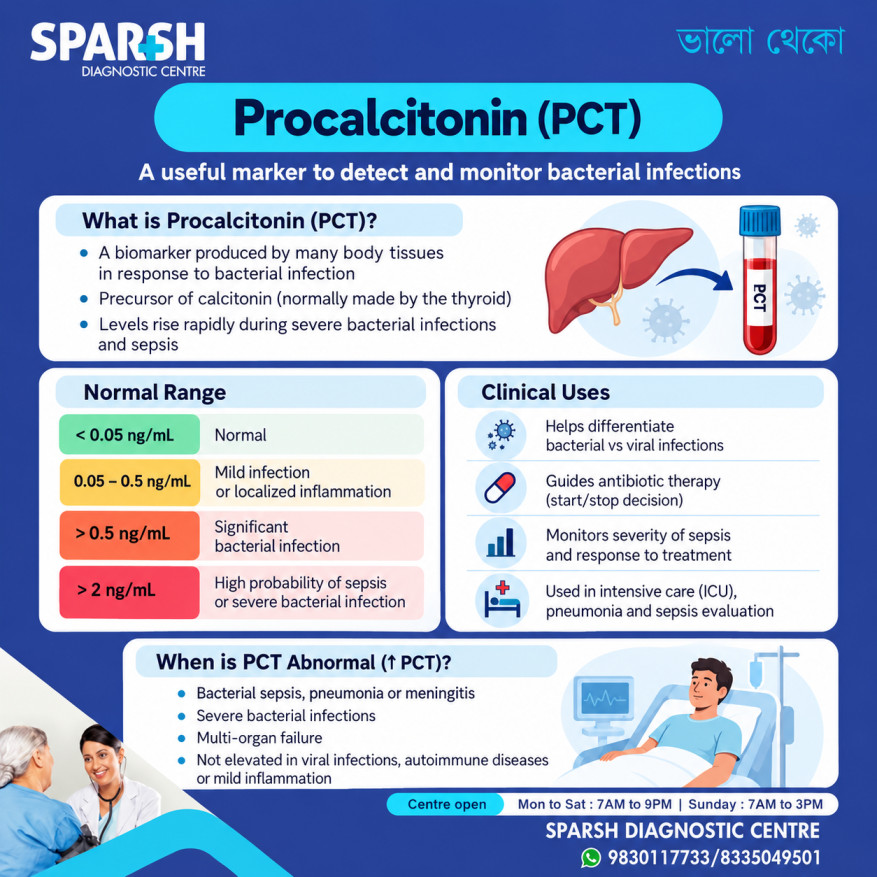
Procalcitonin is a peptide that normally exists in the blood at very low concentrations. It is the precursor of the hormone calcitonin, which is normally produced by thyroid C cells.
During a significant bacterial infection, however, many tissues throughout the body can begin producing and releasing procalcitonin. This causes blood PCT levels to rise.
The response is particularly associated with systemic bacterial infection. Viral infections tend to stimulate interferon-gamma, which suppresses procalcitonin production compared with many bacterial infections.
PCT can therefore be useful when doctors are trying to distinguish a bacterial infection from a viral illness, assess the severity of infection and monitor a patient’s response to treatment.
Why is the procalcitonin test done?
A procalcitonin test is generally ordered when a healthcare professional is concerned about a significant bacterial infection.
It may be used to:
- Support the assessment of suspected sepsis
- Assess the likelihood of a serious bacterial infection
- Help differentiate bacterial and viral respiratory infections
- Assess the severity of infection
- Monitor changes during treatment
- Support decisions about antibiotic discontinuation in selected patients
- Monitor critically ill patients in hospital or intensive care
PCT is particularly useful as a trend. A falling PCT level, when accompanied by clinical improvement, can suggest that the infection is responding to treatment.
Importantly, current sepsis guidelines emphasise that sepsis is a clinical diagnosis and should not be ruled in or ruled out using a single biomarker or laboratory test.
What are normal PCT levels?
In healthy adults, procalcitonin is usually extremely low. Many references consider a PCT concentration of less than 0.05 ng/mL to be within the healthy range, while other laboratory methods may use a reference limit of less than 0.1 ng/mL.
This difference is important because reference ranges can vary according to the laboratory, assay and clinical setting.
A commonly used interpretation is:
| PCT level | General interpretation |
|---|---|
| <0.05 ng/mL | Typical healthy adult level |
| 0.05 to <0.5 ng/mL | Systemic bacterial infection less likely; localised infection may still be possible |
| 0.5 to <2 ng/mL | Systemic infection may be possible; clinical context is important |
| 2 to <10 ng/mL | Systemic bacterial infection is more likely |
| ≥10 ng/mL | Strongly concerning for severe bacterial infection/sepsis or septic shock in the appropriate clinical setting |
These are general interpretive ranges, not diagnostic rules. A patient’s age, kidney function, recent surgery, trauma, burns, clinical condition and timing of the test can all influence PCT.
Is a procalcitonin level of 0.05 normal?
Yes. A PCT of 0.05 ng/mL is generally considered within the normal or very low range for an adult.
However, the exact interpretation depends on the laboratory’s reference range and the patient’s clinical situation.
A very low PCT is reassuring when evaluating for a significant systemic bacterial infection, but it does not guarantee that there is no infection. PCT may remain low during the early stages of infection or in some localised infections.
Therefore, symptoms and other investigations still matter.
Is procalcitonin an inflammatory marker?
Procalcitonin can be described as a biomarker associated with systemic inflammation and infection, but it is more useful as a marker associated with bacterial infection than as a general inflammation marker.
This distinction is important.
CRP, for example, can increase in many different inflammatory conditions. PCT tends to be more closely associated with significant bacterial infection, although it is not perfectly specific.
PCT can also rise because of non-infectious conditions such as major trauma, extensive burns, recent major surgery and severe cardiogenic shock.
Is procalcitonin a marker of sepsis?
Procalcitonin can be a useful marker when evaluating suspected sepsis, but it is not a standalone test for diagnosing sepsis.
Higher PCT levels are associated with a greater likelihood of significant systemic bacterial infection, and very high levels can occur in severe sepsis and septic shock.
However, sepsis is defined by infection-associated organ dysfunction, not simply by an elevated PCT result.
The 2026 Surviving Sepsis Campaign guidelines specifically state that sepsis should not be ruled in or ruled out using a single biomarker or diagnostic test. They also suggest using clinical evaluation rather than PCT plus clinical evaluation when deciding whether to start antibiotics in patients with possible or probable sepsis. PCT can have a role in selected situations when deciding when to discontinue antibiotics.
How high is procalcitonin in sepsis?
There is no single PCT number that defines sepsis.
As PCT rises, the probability of a significant bacterial systemic infection generally increases. Values above 2 ng/mL are often considered concerning for systemic infection, while levels of 10 ng/mL or higher are associated with a high likelihood of severe bacterial sepsis or septic shock in appropriate clinical circumstances.
But a person with sepsis can have a lower PCT, particularly early in the illness. Conversely, a person without sepsis can occasionally have a high PCT because of major surgery, trauma, burns or other non-infectious conditions.
The overall clinical picture is therefore more important than one number.
What are the four markers of sepsis?
There is no universally accepted set of exactly four blood markers that diagnoses sepsis.
Doctors may consider several laboratory and clinical indicators, including:
- Procalcitonin (PCT) – can support assessment of bacterial infection.
- C-reactive protein (CRP) – indicates inflammation but is not specific to bacterial infection.
- Lactate – can provide information about tissue hypoperfusion and severity of critical illness.
- White blood cell count (WBC) – may increase or decrease during infection and systemic illness.
Other important investigations include blood cultures, kidney and liver function tests, platelet count, blood pressure, oxygenation and measurements used to assess organ dysfunction.
Therefore, it is better to think of these as pieces of the sepsis assessment, rather than four tests that independently diagnose sepsis.
What is the difference between CRP and procalcitonin?
CRP and PCT are both blood biomarkers, but they provide somewhat different information.
CRP (C-reactive protein) is an acute-phase protein produced primarily by the liver in response to inflammatory signals. It can rise with bacterial infections, viral infections, autoimmune diseases, tissue injury and many other inflammatory conditions.
Procalcitonin, on the other hand, is more closely associated with significant bacterial infection and systemic bacterial inflammation.
PCT also tends to rise and fall relatively quickly. CRP begins increasing within several hours after an inflammatory stimulus and generally peaks later than PCT.
| Feature | Procalcitonin | CRP |
|---|---|---|
| Main clinical use | Bacterial infection assessment | General inflammation/infection assessment |
| Specificity for bacterial infection | Generally higher | Lower |
| Useful in sepsis assessment | Yes | Yes |
| Can increase without infection | Yes | Yes |
| Useful for monitoring trends | Yes | Yes |
| Can help with antibiotic decisions | In selected situations | Sometimes |
| A standalone diagnostic test? | No | No |
Which is better, procalcitonin or CRP?
There is no universal answer.
PCT may provide more specific information about bacterial infection, particularly in some patients with suspected sepsis or respiratory infections. CRP is inexpensive, widely available and useful for assessing inflammation and following disease trends.
Research has found situations in which PCT performs better than CRP and other situations where the difference is small. The best test depends on the clinical question and patient.
In many cases, doctors use both results alongside the clinical examination and other investigations rather than choosing one test as universally superior.
What CRP level indicates sepsis?
There is no CRP level that by itself indicates sepsis.
CRP can become substantially elevated during severe infections, but it can also rise because of non-infectious inflammation, surgery, trauma and other conditions.
Even a very high CRP should therefore not be interpreted as proof of sepsis.
Similarly, a relatively low CRP does not necessarily exclude serious infection, particularly if the illness is early.
For comparison, MedlinePlus notes that healthy people generally have low CRP concentrations, with values of approximately 0.8–1.0 mg/dL or lower considered healthy in its general interpretation. Laboratory reference ranges can differ.
What level of procalcitonin indicates pneumonia?
There is no single PCT value that diagnoses pneumonia.
PCT can be helpful when determining whether pneumonia is more likely to have a bacterial component, particularly when combined with symptoms, physical examination and chest imaging.
Lower PCT levels make a significant systemic bacterial infection less likely, but bacterial pneumonia can still occur with a low PCT, especially when the infection is localised or early.
Higher PCT levels increase concern for bacterial infection, particularly when accompanied by fever, respiratory symptoms, abnormal imaging or signs of systemic illness.
The decision to treat pneumonia should therefore never be based solely on the PCT number.
Is procalcitonin high in viral infections?
Usually, PCT is much less elevated in uncomplicated viral infections than in significant bacterial infections.
This is one reason the test can be useful when assessing bacterial versus viral respiratory infections.
However, viral infection does not guarantee a normal PCT. Severe viral illness, complications, coexisting bacterial infection and certain inflammatory conditions can produce elevated results.
So, a raised PCT should not automatically be interpreted as proof that bacteria are responsible.
What causes high levels of procalcitonin?
Bacterial infection is an important cause of elevated PCT, particularly when infection is systemic or severe.
Other possible causes include:
- Severe bacterial pneumonia
- Sepsis
- Septic shock
- Major trauma
- Severe burns
- Recent major surgery
- Severe cardiogenic shock
- Some fungal or parasitic infections
- Advanced kidney disease
- Certain rare malignancy-associated conditions
- Some medications or treatments that stimulate cytokine release
Chronic kidney disease is particularly important when interpreting PCT because baseline concentrations can be higher even without infection.
Can procalcitonin be elevated without infection?
Yes.
This is one of the most important limitations of the PCT test.
A high PCT can occur after major surgery, severe trauma, extensive burns and prolonged cardiogenic shock. Kidney dysfunction can also be associated with higher baseline PCT.
Therefore, a high PCT does not automatically mean that someone has sepsis.
The trend can sometimes be particularly informative. If PCT is elevated after surgery or trauma but subsequently falls while the patient remains clinically stable, that pattern may be different from a persistently rising level accompanied by worsening signs of infection.
What causes a false positive procalcitonin test result?
A “false positive” generally means that PCT is elevated even though bacterial infection is not the underlying cause.
Possible explanations include:
- Major surgery
- Severe physical trauma
- Extensive burns
- Severe cardiogenic shock
- Kidney dysfunction
- Certain fungal or parasitic infections
- Some malignancy-related conditions
- Certain immune-stimulating medications
This is why doctors interpret PCT alongside the patient’s history, examination and other investigations rather than treating the result as definitive.
Is procalcitonin a tumor marker?
No. Procalcitonin is not routinely used as a tumor marker.
PCT is primarily used as a biomarker associated with bacterial infection and systemic inflammation.
Rarely, elevated PCT can occur in association with certain malignancies or paraneoplastic syndromes. This does not mean that a high PCT result should be interpreted as evidence of cancer.
If cancer is suspected, doctors use appropriate imaging, pathology, tumour-specific markers where relevant and other investigations.
How do you read a procalcitonin test result?
Start by checking three things:
1. Look at the number and unit
PCT is commonly reported in ng/mL or an equivalent unit such as µg/L.
For PCT, 1 ng/mL is numerically equivalent to 1 µg/L.
2. Compare it with the laboratory’s reference range
A result below 0.05 ng/mL is generally very low. Results between 0.05 and 0.5 ng/mL are usually less concerning for systemic bacterial infection, although localised infection remains possible.
Higher values warrant greater clinical attention, particularly when symptoms suggest serious infection.
3. Consider the trend
A single PCT value provides less information than a series of results in many clinical situations.
A falling PCT can accompany recovery, whereas a persistently high or rising level may prompt further assessment.
The timing of the test also matters because PCT takes several hours to rise after the onset of a bacterial infection.
How long does procalcitonin take to result?
The time depends on the laboratory and the type of analyser being used.
Rapid PCT testing can produce results relatively quickly, and published laboratory literature describes quantitative testing being available within approximately 1–3 hours in settings equipped for rapid analysis.
Routine laboratory turnaround may be longer, depending on sample transport, workload and the laboratory’s testing schedule.
If PCT is being ordered as part of an urgent assessment for suspected sepsis, clinicians generally use whatever rapid diagnostic information is available rather than waiting for a single test before treating a critically ill patient.
How does procalcitonin change during infection?
PCT has a useful pattern over time.
It can become detectable within several hours following an infectious stimulus, rises during significant bacterial infection and can peak within roughly the first day.
Its biological half-life is approximately 20–24 hours.
When the underlying infection is controlled and treatment is effective, PCT generally falls over time. A falling concentration can therefore be useful when monitoring recovery.
This is one reason doctors may order repeat PCT measurements rather than relying on a single result.
How can PCT be reduced in the blood?
There is no medicine that should be taken simply to “lower” PCT.
The appropriate approach is to identify and treat the underlying cause.
If a bacterial infection is responsible, appropriate antimicrobial treatment and control of the infection source can lead to falling PCT levels.
For example, if a patient has a bacterial infection that requires antibiotics, the appropriate antibiotic should be prescribed by a healthcare professional. If there is an infection that requires drainage or another form of source control, that underlying problem may also need to be addressed.
PCT should therefore be viewed as a marker of what is happening, rather than the disease itself.
Importantly, antibiotics should not be started, stopped or changed based only on a PCT result. Current 2026 sepsis guidelines recommend clinical assessment when deciding whether to start antimicrobials, while PCT combined with clinical evaluation may be useful in selected situations when deciding when to discontinue therapy.
When should you be concerned about a high PCT?
A high PCT deserves greater attention when it occurs alongside symptoms such as:
- High fever or chills
- Rapid breathing
- Shortness of breath
- Low blood pressure
- Confusion
- Very rapid heart rate
- Reduced urine output
- Severe weakness
- Signs of organ dysfunction
These symptoms can occur in serious infections and sepsis.
If someone with a suspected infection develops confusion, breathing difficulty, very low blood pressure, severe weakness, bluish or clammy skin, or rapidly worsening symptoms, urgent medical assessment is needed. Sepsis is a medical emergency.
What are the limitations of the procalcitonin test?
Although PCT is useful, it is not perfect.
A low PCT can occur despite bacterial infection, particularly:
- Very early in infection
- With some localised infections
- In certain subacute infections
A high PCT can occur without bacterial infection, particularly after major surgery, trauma, burns or severe shock.
Kidney disease can also complicate interpretation.
For these reasons, PCT should be considered alongside the patient’s symptoms, examination, cultures, imaging, CRP, blood counts, lactate and other relevant investigations.
Frequently asked questions about procalcitonin
What is the normal range for procalcitonin in adults?
A commonly cited healthy adult level is below 0.05 ng/mL, although some laboratories use a reference limit below 0.1 ng/mL. Always check the reference range printed on your laboratory report.
Is procalcitonin a marker of sepsis?
PCT is a useful biomarker in the assessment and monitoring of suspected bacterial infection and sepsis, but it does not diagnose sepsis by itself.
Is a PCT of 0.05 ng/mL normal?
Yes. A PCT of 0.05 ng/mL is generally considered a very low or normal adult result.
What level of PCT indicates pneumonia?
There is no PCT value that independently diagnoses pneumonia. PCT can support assessment of whether pneumonia is likely to have a bacterial component, but symptoms, examination and chest imaging are also important.
Is PCT an inflammatory marker?
PCT is associated with systemic inflammatory responses, particularly those related to bacterial infection. It is more specific for bacterial infection than general inflammatory markers such as CRP.
What CRP level indicates sepsis?
No CRP level alone indicates sepsis. CRP can be high in many infectious and non-infectious inflammatory conditions.
Is procalcitonin high in viral infections?
PCT is generally lower in uncomplicated viral infections than in significant bacterial infections. However, severe viral disease or a bacterial co-infection can result in elevated PCT.
Can procalcitonin be elevated without infection?
Yes. Major surgery, trauma, burns, cardiogenic shock, kidney dysfunction and several other conditions can increase PCT.
Is procalcitonin a tumor marker?
No. PCT is not routinely used as a cancer or tumour marker, although rare tumour-associated conditions can produce elevated PCT.
Which is better, PCT or CRP?
Neither is universally better. PCT is generally more closely associated with bacterial infection, while CRP is a broad marker of inflammation. Doctors may use one or both depending on the clinical situation.
How high can PCT become in sepsis?
PCT can become very high in severe bacterial infection and septic shock. Values above 10 ng/mL are associated with a high likelihood of severe bacterial sepsis or septic shock in the appropriate clinical context, but the number alone does not diagnose sepsis.
How can PCT be reduced?
PCT usually falls when the underlying cause is controlled. Treatment should target the underlying infection or other cause rather than trying to lower PCT directly.
How quickly does PCT rise?
PCT can begin increasing within several hours of a significant bacterial infection and typically reaches a peak within approximately the first day. Timing varies according to the illness and patient.
How long does a PCT test take?
Rapid quantitative testing can sometimes be available within around 1–3 hours, but routine turnaround varies between laboratories.
What are the four markers of sepsis?
There is no official group of exactly four sepsis markers. PCT, CRP, lactate and WBC are commonly discussed laboratory indicators, but sepsis assessment also depends on clinical findings and evidence of organ dysfunction.
Final takeaway
Procalcitonin is a valuable blood biomarker, particularly when doctors are evaluating serious bacterial infection, pneumonia and suspected sepsis. Very low PCT levels are generally reassuring, while increasing concentrations can raise concern for systemic bacterial infection.
But the most important point is this: PCT is not a standalone diagnosis.
A PCT of 0.05 ng/mL does not guarantee that there is no infection, just as a PCT of 10 ng/mL does not independently prove sepsis. The result must be interpreted according to the patient’s symptoms, examination, timing of illness, kidney function, recent surgery or trauma and other investigations.
PCT can be particularly valuable when doctors look at how the level changes over time, rather than focusing on one isolated result.
If your PCT is elevated, discuss the result with your doctor rather than trying to interpret the number alone. In someone who is acutely unwell, especially with confusion, breathing difficulty, low blood pressure or rapidly worsening symptoms, urgent medical evaluation is essential.
To consult a Doctor or get full body check-up done at Sparsh Diagnostic Centre, call our helpline numbers 9830117733/ 8335049501.
#BhaloTheko
Disclaimer:
No content on this site, regardless of date, should ever be used as a substitute for direct medical advice from your doctor or other qualified clinician.

Sources
- MedlinePlus – Procalcitonin Test: Overview, uses, interpretation and limitations of the PCT test. MedlinePlus: Procalcitonin Test
- Samsudin I, Vasikaran SD. Clinical Utility and Measurement of Procalcitonin. Clinical Biochemist Reviews. 2017;38(2):59–68. Detailed review of PCT physiology, reference ranges, kinetics, clinical applications, limitations and comparison with CRP. Clinical Utility and Measurement of Procalcitonin – PMC
- StatPearls – Procalcitonin: Information on PCT kinetics, half-life and clinical interpretation. Procalcitonin – NCBI Bookshelf
- Surviving Sepsis Campaign 2026 – Society of Critical Care Medicine: Current recommendations concerning diagnosis, antimicrobial therapy and the role of procalcitonin in sepsis management. Surviving Sepsis Campaign 2026 Guidelines
- MedlinePlus – C-reactive protein (CRP) Test: Background on CRP, inflammation and interpretation of CRP results. MedlinePlus: CRP Test