


Guyon’s canal syndrome is a condition that occurs when the ulnar nerve becomes compressed or irritated as it passes through a narrow passage in the wrist called Guyon’s canal. This nerve plays an important role in providing sensation to the little finger and part of the ring finger, as well as controlling several small muscles responsible for hand movements.
People with this condition may experience tingling, numbness, pain or weakness in their hands and fingers. In some cases, symptoms develop gradually due to repeated pressure on the wrist, while in others, they may result from an injury, a ganglion cyst or another structural abnormality.
Also known as ulnar tunnel syndrome, Guyon’s canal syndrome is particularly associated with activities that place prolonged pressure on the palm, such as cycling, weightlifting and certain repetitive occupational tasks.
Early recognition is important because prolonged compression of the ulnar nerve can affect hand strength, coordination and everyday activities.
Understanding the causes, symptoms, diagnostic procedures and available treatment options can help individuals seek appropriate medical attention and prevent long-term complications.
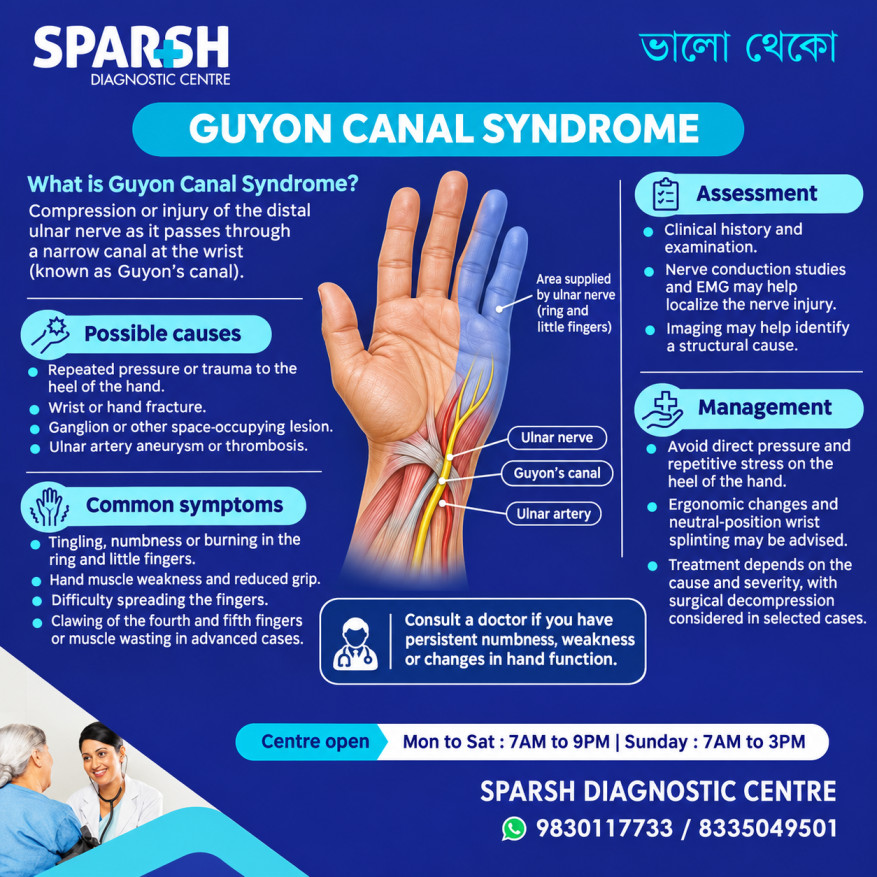
What is Guyon’s canal syndrome?
Guyon’s canal syndrome is a type of peripheral nerve compression disorder in which the ulnar nerve gets compressed as it travels through Guyon’s canal at the wrist.
Guyon’s canal is a small anatomical tunnel located on the palm side of the wrist, towards the little finger. It is formed by surrounding bones, ligaments and soft tissues. The ulnar nerve and ulnar artery pass through this narrow space before entering the hand.
The ulnar nerve is responsible for:
- Providing sensation to the little finger and the little-finger side of the ring finger.
- Controlling several small muscles within the hand.
- Supporting finger coordination and movements.
- Helping with grip strength and precise hand movements.
When the nerve becomes compressed within Guyon’s canal, its normal functioning may be affected. Depending on the location and severity of compression, a person may develop sensory symptoms, muscle weakness or a combination of both.
The condition is sometimes called handlebar palsy because prolonged pressure on the palm while cycling can irritate or compress the ulnar nerve.
Understanding the anatomy of Guyon’s canal
Guyon’s canal is located on the ulnar side of the wrist, close to the base of the palm.
Its boundaries are formed by:
- The pisiform bone on the inner side of the wrist.
- The hook of the hamate bone on the outer side.
- Ligaments and connective tissues forming its roof.
- The transverse carpal ligament and deeper hypothenar structures forming its floor.
As the ulnar nerve passes through this canal, it divides into two main branches:
Superficial sensory branch: This branch provides sensation to the little finger and the adjacent half of the ring finger.
Deep motor branch: This branch supplies several small muscles of the hand that help control finger movements, coordination and grip.
The location of nerve compression determines the symptoms a person experiences. Some individuals may have predominantly sensory problems, while others may develop muscle weakness without significant numbness.

What are the causes of Guyon’s canal syndrome?
Guyon’s canal syndrome develops when pressure or irritation affects the ulnar nerve within the wrist. Several factors can contribute to this compression.
1. Repeated pressure on the palm
Prolonged pressure on the heel of the hand can irritate the ulnar nerve as it passes through Guyon’s canal.
This is particularly common among:
- Long-distance cyclists who put continuous pressure on their palms while holding handlebars.
- Weightlifters who repeatedly apply pressure to their wrists.
- Individuals who use vibrating machinery.
- Workers involved in repetitive hand and wrist activities.
2. Ganglion cysts
Ganglion cysts are fluid-filled lumps that commonly develop near joints and tendons. When a cyst develops close to Guyon’s canal, it may occupy additional space and compress the ulnar nerve.
Ganglion cysts are an important structural cause of ulnar nerve compression at the wrist.
3. Wrist injuries and fractures
Trauma involving the wrist can cause swelling, inflammation or structural changes that place pressure on the nerve.
A fracture involving the hook of the hamate bone is particularly relevant because of its proximity to Guyon’s canal.
4. Ulnar artery abnormalities
The ulnar artery travels alongside the ulnar nerve through Guyon’s canal.
An aneurysm or thrombosis involving this artery can contribute to compression of the neighbouring nerve. This may occur in a condition known as hypothenar hammer syndrome, which is associated with repeated trauma to the heel of the hand.
5. Anatomical abnormalities
Some individuals have anatomical variations, abnormal muscle structures or fibrous bands that reduce the available space within Guyon’s canal.
These abnormalities may increase the likelihood of nerve compression.
6. Inflammatory conditions
Inflammation involving the wrist joints and surrounding tissues may contribute to narrowing of the canal and irritation of the ulnar nerve.
What are the symptoms of Guyon’s canal syndrome?
The symptoms depend on the extent and exact location of nerve compression. They may develop gradually or become noticeable following an injury or repetitive pressure on the wrist.
Common symptoms include:
1. Tingling in the fingers: A pins-and-needles sensation may develop in the little finger and the adjacent half of the ring finger.
2. Numbness: Reduced sensation in these fingers is one of the characteristic symptoms of ulnar nerve compression.
3. Pain in the wrist and palm: Some individuals experience discomfort along the little-finger side of the wrist or heel of the palm.
4. Hand weakness: Compression affecting the motor branch of the ulnar nerve may weaken the small muscles of the hand.
5. Reduced grip strength: Activities such as holding objects, opening jars, writing or gripping tools may become difficult.
6. Difficulty spreading the fingers: The small muscles supplied by the ulnar nerve help move the fingers apart and bring them together. Nerve compression can interfere with these movements.
7. Muscle wasting: In advanced or prolonged cases, the muscles between the hand bones may become visibly smaller due to loss of nerve supply.
8. Clawing of the fingers: Severe, longstanding nerve damage may cause an abnormal bending posture involving the ring and little fingers.
Symptoms should not be ignored if they persist, worsen or are accompanied by progressive weakness.
Different zones of Guyon’s canal syndrome
Guyon’s canal is commonly divided into three anatomical zones based on the location of nerve compression. This classification helps doctors understand the pattern of symptoms.
Zone 1 – Compression before the nerve divides
Compression occurs before the ulnar nerve separates into its sensory and motor branches. Patients may experience both sensory disturbances and muscle weakness.
Zone 2 – Compression of the deep motor branch
This zone involves the deep motor branch of the ulnar nerve. Patients may develop weakness in the small muscles of the hand, reduced grip strength and difficulty coordinating finger movements. Sensation may remain normal.
Zone 3 – Compression of the superficial sensory branch
Compression affects the superficial sensory branch. Symptoms are predominantly sensory, including numbness, tingling and altered sensation in the little finger and the adjacent side of the ring finger.
Understanding these zones is important because treatment and expected recovery can vary depending on the affected nerve branch.
How is Guyon’s canal syndrome diagnosed?
Diagnosis involves a combination of medical history, physical examination and investigations to identify the location and cause of nerve compression.
1. Clinical examination
The doctor will ask about symptoms, previous wrist injuries, occupation, recreational activities and repetitive movements involving the hands.
A physical examination may include:
- Checking sensation in the little and ring fingers.
- Assessing grip strength and finger coordination.
- Examining the wrist for swelling or a ganglion cyst.
- Checking for muscle wasting or finger deformities.
- Tapping over Guyon’s canal to determine whether it reproduces tingling or other nerve-related symptoms.
Specific clinical tests, such as Tinel’s sign, Froment’s sign and Wartenberg’s sign, may help assess ulnar nerve involvement.
2. Nerve conduction studies and electromyography (EMG)
Nerve conduction studies evaluate how electrical signals travel through the ulnar nerve.
Electromyography (EMG) assesses the electrical activity of muscles and can help identify abnormalities associated with nerve damage.
These investigations are particularly useful for confirming nerve compression, assessing its severity and distinguishing Guyon’s canal syndrome from compression at other locations.
3. Ultrasound examination
Ultrasound can help identify structural abnormalities such as ganglion cysts, swelling or other masses that may compress the nerve.
It can also help assess the surrounding soft tissues and ulnar artery.
4. Magnetic resonance imaging (MRI)
MRI provides detailed images of the wrist’s soft tissues and can help identify ganglion cysts, tumours, anatomical abnormalities and other potential causes of nerve compression.
5. X-ray and CT scan
X-rays may be recommended when a wrist fracture or bony abnormality is suspected.
A CT scan may provide more detailed information about fractures, particularly those involving the hook of the hamate.
6. Doppler ultrasound
When a vascular problem is suspected, Doppler ultrasound can help evaluate blood flow through the ulnar artery and identify abnormalities such as thrombosis or an aneurysm.
The choice of investigations depends on the patient’s symptoms and the suspected cause.
What is the difference between Guyon’s canal syndrome and cubital tunnel syndrome?
Both conditions involve compression of the ulnar nerve. However, they occur at different anatomical locations.
Guyon’s canal syndrome develops when the nerve is compressed at the wrist, whereas cubital tunnel syndrome occurs when the nerve is compressed near the elbow.
| Feature | Guyon’s canal syndrome | Cubital tunnel syndrome |
|---|---|---|
| Location | Wrist | Elbow |
| Nerve affected | Ulnar nerve | Ulnar nerve |
| Common symptoms | Tingling and numbness in the little and ring fingers | Tingling and numbness in the little and ring fingers |
| Muscle weakness | Mainly small muscles within the hand | May involve hand muscles and other ulnar-innervated muscles in the forearm |
| Dorsal hand sensation | Often preserved | May be affected |
| Common triggers | Pressure on the palm and repetitive wrist loading | Prolonged elbow bending or pressure on the inner elbow |
| Treatment | Activity modification, wrist splinting and possible surgical decompression | Activity modification, elbow positioning, splinting and possible surgical decompression |
A useful clinical distinction is that sensation over the back of the ulnar side of the hand is often preserved in Guyon’s canal syndrome but may be affected in cubital tunnel syndrome.
However, symptoms can overlap, and a proper clinical examination with electrodiagnostic testing may be needed to establish the exact location of nerve compression.
What are the treatment options for Guyon’s canal syndrome?
Treatment depends on the cause, duration and severity of nerve compression. Mild cases may improve with conservative treatment, while persistent or severe compression may require surgery.
The main objective is to reduce pressure on the ulnar nerve and prevent permanent damage.
1. Activity modification
Reducing activities that put pressure on Guyon’s canal is an important part of treatment.
Patients may be advised to:
- Avoid leaning on the heel of the hand for prolonged periods.
- Reduce repetitive wrist movements that trigger symptoms.
- Take regular breaks during activities involving sustained gripping.
- Avoid excessive pressure while cycling or using exercise equipment.
- Modify workstations and hand positions to reduce wrist strain.
Cyclists may benefit from adjusting handlebar positions, improving padding and changing hand positions regularly.
2. Wrist splinting
A wrist splint may help keep the wrist in a neutral position and reduce mechanical stress on the ulnar nerve.
A resting wrist splint that does not excessively restrict finger movement is commonly recommended.
It may be worn at night or during activities that aggravate symptoms, depending on medical advice.
3. Medications
Doctors may recommend appropriate pain-relieving or anti-inflammatory medications to manage discomfort.
However, medications mainly address symptoms and do not necessarily remove the underlying mechanical compression.
The choice of medication should depend on individual health conditions and medical advice.
4. Physiotherapy and rehabilitation
Physiotherapy may be considered as part of conservative management, particularly when symptoms are related to repetitive strain or poor wrist positioning.
A rehabilitation programme may include:
- Education about avoiding pressure over Guyon’s canal.
- Ergonomic and activity modifications.
- Gentle wrist and hand mobility exercises.
- Carefully selected ulnar nerve gliding exercises.
- Gradual strengthening once symptoms improve.
Nerve gliding exercises may be useful in selected patients, although evidence specifically supporting their effectiveness in Guyon’s canal syndrome remains limited.
Exercises should be supervised by a qualified physiotherapist, particularly when numbness or weakness is present.
5. Surgical treatment
Surgery may be considered when symptoms persist despite conservative treatment, when muscle weakness progresses, when muscle wasting develops or when investigations identify a structural cause such as a ganglion cyst.
The procedure generally involves surgical decompression of Guyon’s canal to relieve pressure on the ulnar nerve.
What is the surgical procedure for Guyon’s canal syndrome?
The surgical procedure is generally known as Guyon’s canal release or ulnar nerve decompression.
It aims to create sufficient space for the ulnar nerve to pass through the wrist without being compressed.
The procedure generally involves the following steps:
1. Anaesthesia: The patient receives appropriate anaesthesia, which may be regional or general depending on the surgical plan.
2. Surgical incision: The surgeon makes an incision over the palm-side of the wrist to access Guyon’s canal.
3. Identification of the nerve: The ulnar nerve and surrounding structures are carefully identified and protected.
4. Decompression: The surgeon releases the constricting tissues forming the roof of Guyon’s canal to relieve pressure on the nerve.
5. Removal of the underlying cause: If a ganglion cyst or another space-occupying lesion is responsible for compression, it may be removed. Additional treatment may be required for fractures or vascular abnormalities.
6. Closure and recovery: Once adequate decompression has been achieved, the incision is closed and the hand is dressed appropriately.
After surgery, patients may be advised to elevate the hand, perform gentle finger movements and gradually begin rehabilitation under medical supervision.
The recovery period varies depending on the severity of nerve damage before surgery and the underlying cause. Sensory symptoms may improve before muscle strength fully returns.
What type of splint is recommended for Guyon’s canal syndrome?
A resting wrist splint that maintains the wrist in a neutral position is commonly recommended for Guyon’s canal syndrome.
The purpose of the splint is to prevent excessive wrist bending and reduce pressure on the ulnar nerve.
An appropriate splint should:
- Keep the wrist straight or in a comfortable neutral position.
- Avoid excessive pressure over the heel of the hand.
- Allow normal finger movement.
- Fit comfortably without restricting circulation.
- Be used at night or during aggravating activities as advised by a healthcare professional.
A hand therapist or orthopaedic specialist can recommend an appropriate splint based on the location and severity of nerve compression.
A poorly fitted or overly tight splint may increase discomfort, so professional guidance is important.
What sleeping position is best for the ulnar nerve?
For individuals with Guyon’s canal syndrome, the main objective during sleep is to avoid putting pressure on the palm and wrist.
The following precautions may help:
- Keep the wrist in a neutral, straight position rather than bending it excessively.
- Avoid sleeping with your hand trapped beneath your head or body.
- Avoid placing your wrist against a hard surface.
- Support your forearm comfortably with a pillow if required.
- Consider wearing a neutral-position wrist splint at night if recommended by your doctor.
Sleeping on your back or on your side can both be comfortable, provided the affected wrist is not compressed.
It is also important to remember that prolonged elbow bending may aggravate cubital tunnel syndrome, a different form of ulnar nerve compression. Therefore, the best sleeping position depends on the actual location of the nerve problem.
What exercises can help relieve pain caused by Guyon’s canal syndrome?
Exercises may form part of a rehabilitation programme, but they should be selected according to the severity and location of nerve compression.
The following movements may be considered under the guidance of a physiotherapist.
1. Gentle wrist movements
Slowly move the wrist up and down within a comfortable range without applying resistance.
This helps maintain wrist mobility without placing excessive strain on the affected area.
2. Finger opening and closing
Gently spread the fingers apart and bring them together.
Repeat the movement slowly without forcing the fingers or causing pain.
3. Gentle fist formation
Make a relaxed fist and slowly straighten the fingers again.
This helps maintain finger mobility and coordination.
4. Ulnar nerve gliding exercises
A physiotherapist may teach specific nerve-gliding movements designed to encourage the ulnar nerve to move smoothly through surrounding tissues.
These exercises should be performed gently and without forcing the wrist, elbow or shoulder into uncomfortable positions.
5. Gradual hand strengthening
Once symptoms have improved, a therapist may introduce gentle strengthening exercises using soft therapy putty or other appropriate resistance.
Strengthening should not begin aggressively when active nerve compression, significant numbness or muscle weakness is present.
Important: Exercises are not a substitute for medical assessment. Stop any movement that increases tingling, numbness, pain or weakness. Nerve-gliding exercises have limited condition-specific evidence and should be prescribed individually.
How long does it take for ulnar nerve compression to go away?
The recovery time depends on the severity of compression, how long the nerve has been affected and whether there is an identifiable structural problem.
In mild cases, symptoms may improve over several weeks with activity modification, appropriate splinting and other conservative measures.
Some patients may notice improvement within four to six weeks, although this is not a guaranteed recovery period for everyone.
More severe or prolonged nerve compression may take several months to improve, even after the underlying cause has been treated.
When there is significant nerve fibre damage or muscle wasting, complete recovery may not always be possible.
Early diagnosis and appropriate treatment generally improve the chances of a better outcome.
Can Guyon’s canal syndrome cause permanent nerve damage?
Yes. Prolonged or severe compression of the ulnar nerve can cause lasting nerve damage.
Initially, compression may interfere with the normal transmission of nerve signals. If the pressure continues, more significant nerve fibre damage can develop.
Potential complications include:
- Persistent numbness in the ring and little fingers.
- Reduced grip and pinch strength.
- Weakness of the small muscles within the hand.
- Muscle wasting.
- Clawing of the ring and little fingers.
- Difficulty performing fine motor activities.
This is why persistent symptoms, progressive weakness or visible muscle wasting should be evaluated promptly by a healthcare professional.
How can Guyon’s canal syndrome be prevented?
Although not all causes can be prevented, certain lifestyle and workplace modifications may reduce the risk of ulnar nerve compression.
Some useful precautions include:
- Avoid prolonged pressure on the heel of the palm.
- Use padded gloves or appropriate handlebar cushioning while cycling.
- Maintain a neutral wrist position during work and exercise.
- Take regular breaks during repetitive hand activities.
- Avoid excessive gripping and unnecessary wrist strain.
- Use appropriate protective equipment when operating vibrating machinery.
- Seek medical advice following wrist injuries or persistent hand symptoms.
People who regularly perform activities involving pressure on the palm should pay particular attention to early symptoms such as tingling, numbness or reduced grip strength.
When should you consult a doctor?
Occasional tingling may occur after temporary pressure on a nerve. However, persistent or recurring symptoms should not be ignored.
Consult a healthcare professional if you experience:
- Repeated numbness or tingling in the ring and little fingers.
- Persistent pain along the little-finger side of the wrist.
- Weakness while gripping or holding objects.
- Difficulty spreading or coordinating your fingers.
- Visible muscle wasting in the hand.
- Symptoms that continue despite reducing pressure on the wrist.
Progressive weakness, significant muscle wasting or a suspected wrist mass warrants timely specialist assessment.
A doctor may recommend a clinical examination, nerve conduction studies, EMG or appropriate imaging to identify the cause.
Frequently asked questions about Guyon’s canal syndrome
1. What are the symptoms of Guyon’s canal syndrome?
The most common symptoms include numbness, tingling, burning sensations and pain in the little finger and the adjacent half of the ring finger. Some individuals also experience reduced grip strength, difficulty spreading their fingers and weakness of the small hand muscles.
2. Is Guyon’s canal syndrome the same as carpal tunnel syndrome?
No. Both are nerve compression conditions affecting the wrist, but they involve different nerves. Guyon’s canal syndrome affects the ulnar nerve, whereas carpal tunnel syndrome affects the median nerve.
3. What is the difference between cubital tunnel syndrome and Guyon’s canal syndrome?
Guyon’s canal syndrome involves compression of the ulnar nerve at the wrist, while cubital tunnel syndrome involves compression of the same nerve near the elbow. Both may cause numbness in the little and ring fingers, but their clinical findings and treatment approaches differ.
4. What type of splint is recommended for Guyon’s canal syndrome?
A neutral-position resting wrist splint is commonly recommended. It helps maintain proper wrist alignment and reduces mechanical stress on the ulnar nerve. The splint should not be too tight or place additional pressure on the heel of the hand.
5. What is the surgical procedure for Guyon’s canal syndrome?
Surgery generally involves releasing the tissues that compress the ulnar nerve within Guyon’s canal. The surgeon may also remove a ganglion cyst or treat another structural abnormality responsible for the compression.
6. What sleeping position is best for the ulnar nerve?
Sleeping on your back or side can be comfortable as long as the affected wrist remains in a neutral position and is not trapped beneath your body or head. A neutral wrist splint may be recommended for use at night.
7. What exercises can relieve pain caused by Guyon’s canal syndrome?
Gentle wrist mobility, finger opening and closing, relaxed fist formation and carefully selected ulnar nerve gliding exercises may be included in rehabilitation. These should be performed under professional guidance, as excessive or inappropriate movements may aggravate symptoms.
8. How long does it take for ulnar nerve compression to go away?
Mild compression may improve over several weeks with appropriate treatment. More severe nerve injuries can take several months to recover, and longstanding compression associated with muscle wasting may cause permanent deficits.
9. Can cycling cause Guyon’s canal syndrome?
Yes. Prolonged pressure from bicycle handlebars on the heel of the palm can compress or irritate the ulnar nerve within Guyon’s canal. This is sometimes called handlebar palsy.
10. Is Guyon’s canal syndrome curable?
Many patients improve with appropriate treatment, particularly when the condition is identified early. Some cases require surgical decompression to relieve persistent nerve pressure or remove an underlying structural abnormality. Recovery depends on the severity and duration of nerve damage.
Guyon’s canal syndrome is a condition caused by compression of the ulnar nerve at the wrist. It can produce numbness, tingling, pain and weakness affecting the little finger, ring finger and small muscles of the hand.
Repetitive pressure on the palm, wrist injuries, ganglion cysts and vascular abnormalities are among the important causes.
Early diagnosis is essential to prevent prolonged nerve damage and preserve normal hand function. Clinical examination, nerve conduction studies, EMG and appropriate imaging help identify the location and underlying cause of compression.
While mild cases may respond to activity modification, neutral-position wrist splinting and appropriate rehabilitation, persistent or severe cases may require surgical decompression.
If you experience recurring numbness, reduced grip strength or difficulty coordinating your fingers, consult a healthcare professional for an appropriate evaluation.
At Sparsh Diagnostic Centre, we believe that timely investigation and appropriate medical guidance are important steps towards better health.
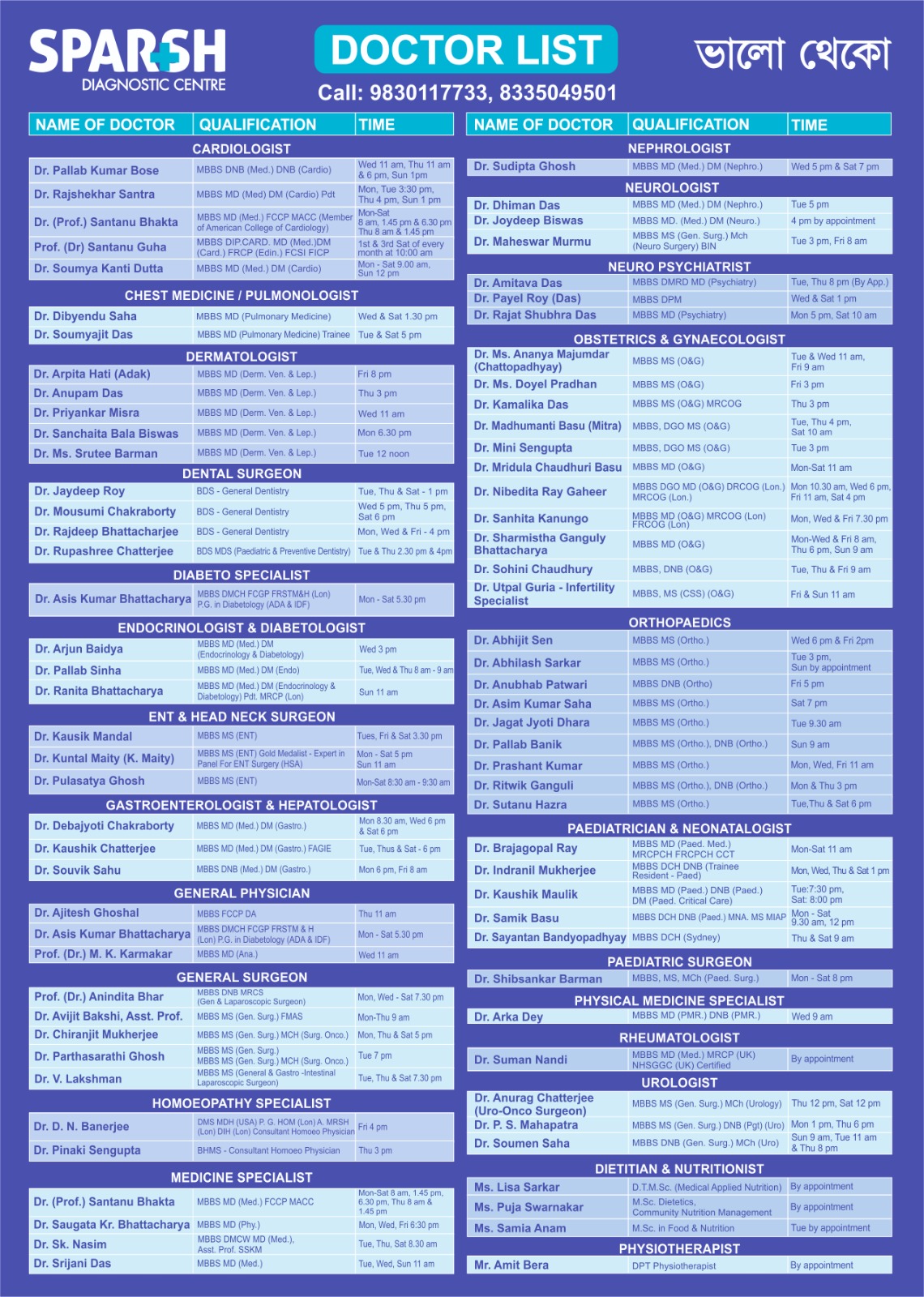
To consult a Doctor at Sparsh Diagnostic Centre, call our helpline numbers +91 98301 17733 and +91 83350 49501.
#BhaloTheko
Disclaimer:
No content on this site, regardless of date, should ever be used as a substitute for direct medical advice from your doctor or other qualified clinician.
Sources and further reading
The following medical and educational resources were consulted while preparing this article:
- Dua A, Gillespie E. Guyon Canal Syndrome. StatPearls, NCBI Bookshelf. Updated September 13, 2026.
https://www.ncbi.nlm.nih.gov/books/NBK431063/ - Physiopedia. Guyon Canal Syndrome.
https://www.physio-pedia.com/Guyon_Canal_Syndrome - Orthobullets. Ulnar Tunnel Syndrome.
https://www.orthobullets.com/hand/6022/ulnar-tunnel-syndrome - Daradia. Guyon’s Canal Syndrome: What You Need to Know.
https://daradia.com/guyons-canal-syndrome-what-you-need-to-know/ - Radiopaedia. Guyon’s Canal Syndrome.
https://radiopaedia.org/articles/guyons-canal-syndrome - PhysioPartners. Guyon’s Canal Syndrome.
https://www.physiopartners.com/Injuries-Conditions/Hand/Hand-Issues/Guyon-s-Canal-Syndrome/a~286/article.html - Orthogate. Guyon’s Canal Syndrome.
https://www.orthogate.org/patient-education/hand/149-guyons-canal-syndrome
Medical disclaimer: This article is intended for general educational purposes and should not be considered a substitute for professional medical advice, diagnosis or treatment. Individual treatment and rehabilitation plans should be determined by a qualified healthcare professional.
Medically reviewed by Dr. Shubhayu Som
Medical reviewer: Dr. Shubhayu Som
Qualification: MBBS
Specialisation: General Physician
Medical registration: West Bengal Medical Council
WBMC Registration Number: 81060
Date reviewed on: 14th November 2026


