


Sunscreen is one of those skincare products that is easy to underestimate. Some people use it only when going to the beach, some apply it once in the morning and forget about it, while others skip it because they have oily or darker skin. There are also plenty of home remedies and myths around sunscreen, including the idea that coconut oil can replace it or that sunscreen causes vitamin D deficiency.
The reality is much simpler: regular sun protection is an important part of protecting your skin from ultraviolet (UV) radiation, sunburn, premature skin ageing, hyperpigmentation and skin cancer. Dermatologists generally recommend a sunscreen that offers broad-spectrum protection, SPF 30 or higher and water resistance.
But choosing the right sunscreen is not simply about buying the product with the highest SPF. Your skin type, lifestyle, tendency to develop dark spots, amount of outdoor exposure and personal preference all matter.
This guide explains what sunscreen does, which type may be best for you, how much to use, how often to reapply and answers some of the most common sunscreen questions.
What is sunscreen and what does it do?
Sunscreen is a topical product designed to help protect the skin from the sun’s ultraviolet radiation.
Sunlight contains different types of radiation, including UVA and UVB rays that can damage the skin.
- UVA rays are strongly associated with premature skin ageing, wrinkles and pigmentation. They can also pass through window glass.
- UVB rays are the main cause of sunburn and contribute to skin cancer.
A broad-spectrum sunscreen helps protect against both UVA and UVB radiation.
Sunscreen is therefore not just a cosmetic product. Used correctly, it can form an important part of a broader sun-protection routine that includes shade, protective clothing, hats and sunglasses.
Is sunscreen good for our skin?
Yes. For most people, sunscreen is beneficial when used correctly.
Regular sun protection can help reduce:
- Sunburn
- UV-related skin damage
- Premature skin ageing
- Wrinkles and age spots
- Hyperpigmentation and some dark spots
- The risk of skin cancer
The American Academy of Dermatology recommends broad-spectrum sunscreen with SPF 30 or higher and water resistance as part of a comprehensive sun-protection strategy.
That does not mean sunscreen makes the skin completely immune to sunlight. No sunscreen blocks 100% of UV radiation, and sunscreen works best when combined with other protective measures.
Which type of sunscreen is best?
For most people, a good starting point is:
Broad-spectrum + SPF 30 or higher + water resistant.
The AAD describes these as the three essential features to look for when choosing sunscreen.
Beyond those basics, the “best” sunscreen depends on your skin and lifestyle.
For oily or acne-prone skin
Look for:
- Oil-free formulas
- Non-comedogenic products
- Lightweight gel, fluid or lotion textures
- Products designed for oily or acne-prone skin
If a sunscreen makes your face excessively greasy or causes breakouts, you may simply stop using it. A sunscreen you can comfortably use every day is more useful than an expensive product that sits unopened in your bathroom.
The AAD recommends looking for “non-comedogenic” or “won’t clog pores” on sunscreen products for acne-prone skin.
For dry skin
Cream or lotion-based sunscreens can be more comfortable. Some formulations also contain moisturising ingredients.
For sensitive skin
A fragrance-free product with a simple formulation may be easier to tolerate. Mineral sunscreens containing ingredients such as zinc oxide or titanium dioxide are options some people with sensitive skin prefer.
For people concerned about dark spots
A tinted, broad-spectrum sunscreen containing iron oxide can be particularly useful.
Why? UV radiation isn’t the only sunlight-related factor that can worsen pigmentation. Visible light can also contribute to skin darkening, especially in people with darker skin tones. Tinted sunscreens containing iron oxide can provide additional protection against visible light.
Which sunscreen is actually best?
There isn’t one brand or formulation that is universally best.
The best sunscreen is the one that:
- Provides broad-spectrum protection.
- Has an SPF of at least 30.
- Is water resistant if you will sweat or swim.
- Suits your skin type.
- Doesn’t irritate your skin.
- Is comfortable enough that you will use it consistently.
- You can apply in a sufficient amount.
The AAD makes a particularly practical point: the best sunscreen is one that you will use repeatedly, provided it meets the basic protection requirements.
So don’t get too caught up in choosing between dozens of brands. Consistency matters enormously.
How do I know which sunscreen is best for me?
Start with the label rather than the marketing claims.
Look for:
Broad spectrum: Protects against both UVA and UVB.
SPF 30 or higher: Provides strong protection against sunburn when used as directed.
Water resistant: Useful if you exercise, sweat or swim. Remember that “water resistant” does not mean waterproof.
Non-comedogenic: Particularly useful if you have oily or acne-prone skin.
Tinted with iron oxide: Worth considering if pigmentation, melasma or dark spots are major concerns.
You should also consider the texture. A lightweight gel may suit oily skin, while a cream may feel better on dry skin.
Is sunscreen ok to use daily?
Yes. Sunscreen can be part of your everyday skincare routine.
If you are going outdoors during daylight hours, applying sunscreen to exposed skin is especially important. UV exposure occurs throughout the year, not only during summer or holidays. Even cloudy weather does not eliminate UV exposure.
For someone who works indoors most of the day and has minimal exposure to direct sunlight, the need for frequent reapplication may be different from someone who works outdoors.
Your routine should therefore match your actual exposure.
Is sunscreen important every day?
If you will be exposed to daylight outdoors, yes.
Think about your routine. Walking to work, driving, sitting outside at a café, exercising outdoors or simply spending time in the garden can all expose your skin to UV radiation.
UVA rays can also pass through window glass, so people who spend significant time near windows may receive some exposure even indoors.
That said, you don’t need to turn sunscreen into an anxiety-inducing ritual. The goal is consistent, sensible sun protection, not avoiding every ray of sunlight.
Can I skip sunscreen for a day?
Missing sunscreen for one day is unlikely to undo your entire skincare routine.
However, that doesn’t make skipping it a good habit, particularly if you are going to spend substantial time outdoors.
Think of sunscreen like brushing your teeth. One missed day is not a disaster, but doing something consistently gives you better long-term results.
If you know you will be outside, make sunscreen part of your morning routine rather than deciding at the last minute.
Does oily skin need sunscreen?
Absolutely.
Having oily skin does not protect you from UV radiation.
In fact, people with oily or acne-prone skin sometimes avoid sunscreen because they dislike the greasy feeling. The better solution is to choose a sunscreen formulated for your skin type.
Look for terms such as:
- Oil-free
- Non-comedogenic
- Gel
- Lightweight
- Matte finish
The AAD specifically recommends non-comedogenic sunscreen for acne-prone skin.
Can sunscreen remove dark spots?
Sunscreen does not work like a bleaching or pigmentation-removing cream.
However, it can help prevent dark spots from becoming darker and can support the fading of existing pigmentation by reducing ongoing sun exposure.
This is especially important for conditions such as melasma and post-inflammatory hyperpigmentation.
For people concerned about dark spots, a tinted sunscreen containing iron oxide may provide an additional benefit because visible light can worsen hyperpigmentation.
If you already have persistent or worsening pigmentation, sunscreen alone may not be enough. A dermatologist can determine the cause and recommend appropriate treatment.
Can coconut oil be used as sunscreen?
No. Coconut oil should not be used as a replacement for sunscreen.
Although coconut oil may have some limited ability to absorb UV radiation, it does not provide the reliable, tested broad-spectrum protection required from a sunscreen.
Research evaluating vegetable oils has found very low SPF values for coconut oil compared with commercial sunscreen products.
You can use coconut oil for other cosmetic purposes if it suits your skin, but don’t rely on it to protect your skin from the sun.
The same caution applies to homemade sunscreen recipes. Their SPF, stability, coverage and water resistance cannot be assumed to be reliable. A commercially tested sunscreen is a much safer choice for sun protection.
Which sunscreen is safest?
For everyday use, look for a commercially formulated sunscreen from a reputable manufacturer that provides broad-spectrum SPF 30 or higher and is appropriate for your skin.
If you have sensitive skin, choosing a fragrance-free product and considering mineral sunscreen may be helpful.
The important point is not to assume that “natural” automatically means safer or that “chemical” automatically means dangerous. Sunscreen ingredients are extensively evaluated, and the product needs to provide dependable protection.
If a particular sunscreen causes burning, itching, rash or persistent irritation, stop using it and consider discussing alternatives with a dermatologist.
Why wait 20 minutes after applying sunscreen?
You may have heard that you must wait exactly 20 minutes after applying sunscreen before going outside.
The practical advice is to apply sunscreen before you go outdoors rather than waiting until you are already in the sun.
The AAD recommends applying sunscreen approximately 15 minutes before going outdoors.
So where does the “20-minute rule” come from? It is essentially a safety margin commonly used in sun-protection advice. The exact timing can vary according to the product and its instructions.
Rather than obsessing over whether it was 15 or 20 minutes, apply your sunscreen before leaving home and follow the directions on the product.
How to apply sunscreen correctly
Using sunscreen is only half the job. Applying enough and covering the right areas matters.
Step 1: Apply it before going outdoors
Apply sunscreen to dry skin before leaving home. The AAD recommends approximately 15 minutes before outdoor exposure.
Step 2: Use enough
A common mistake is applying a very thin layer because too much sunscreen feels heavy.
For the entire exposed body of an adult, dermatologists commonly recommend around 1 ounce, approximately enough to fill a shot glass.
For the face, neck and other exposed areas, use enough to provide an even layer. A practical facial measurement is often described as approximately two finger lengths of sunscreen, although the exact amount depends on the product and area being covered.
Step 3: Don’t forget commonly missed areas
Remember your:
- Ears
- Neck
- Hairline
- Forehead
- Nose
- Cheeks
- Tops of your feet
- Hands
- Scalp if it is exposed
Lips can also be protected with an SPF lip balm.
Step 4: Reapply
When outdoors, reapply approximately every two hours, or sooner after swimming or sweating, according to the product directions.
This is one of the most commonly missed steps in sunscreen use.
How much sunscreen should I apply?
For the exposed body, around 1 ounce is a useful general guideline for an average adult.
For the face, neck and other exposed areas, the amount should be sufficient to create an even layer rather than a barely visible smear.
The exact quantity may vary depending on the size of the person and the area being protected.
A simple rule is:
If you are consistently applying a tiny amount because you dislike the texture, choose a sunscreen you find comfortable enough to apply generously.
What is better than sunscreen?
There isn’t one product that is simply “better than sunscreen.”
However, shade and protective clothing can provide valuable protection that sunscreen cannot provide on its own.
For example, a wide-brimmed hat, long sleeves, sunglasses, shade and avoiding intense midday sun can significantly reduce direct UV exposure.
The best strategy is therefore not sunscreen versus clothing.
It is:
Sunscreen + shade + protective clothing + sensible sun exposure.
The AAD recommends combining these approaches because sunscreen alone cannot provide complete protection.
Common sunscreen myths and facts
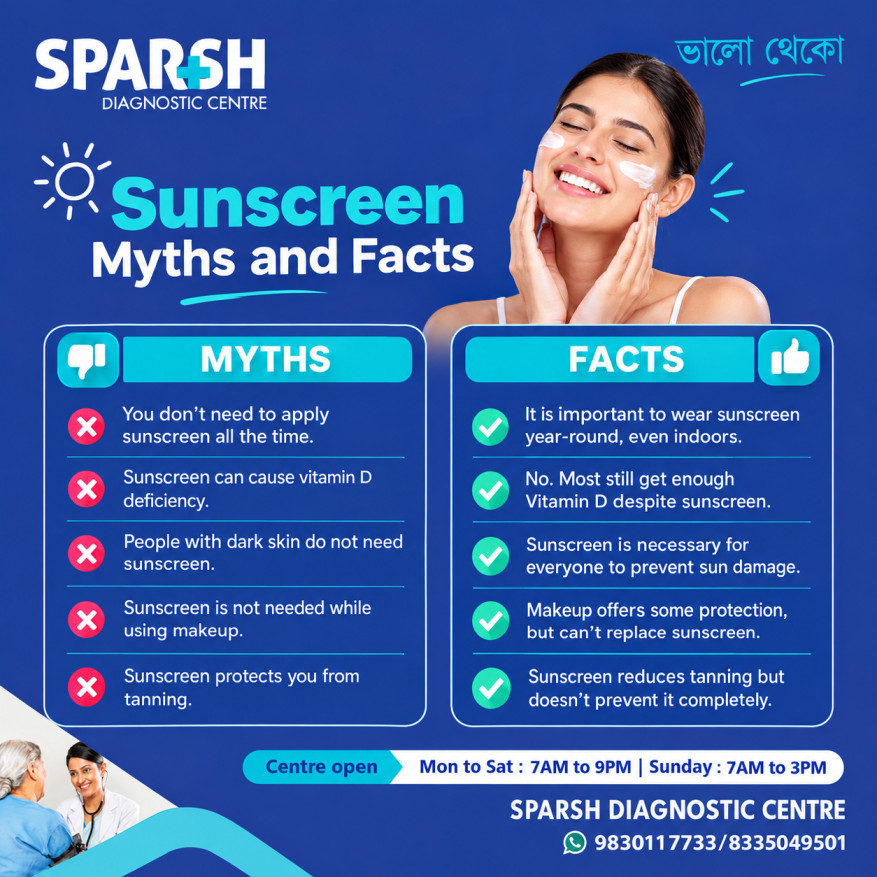
The infographic accompanying this article highlights several common misconceptions. Here’s what the evidence tells us.
Myth: You don’t need sunscreen all the time
Fact: UV exposure occurs throughout the year. If you will be outdoors, sunscreen can help protect exposed skin even on cloudy days.
Myth: Sunscreen causes vitamin D deficiency
This is an oversimplification. Sunscreen reduces UV exposure, but that does not mean people should deliberately skip sun protection to obtain vitamin D.
If you are concerned about vitamin D levels, speak with a healthcare professional about your diet, risk factors and whether testing or supplementation is appropriate.
Myth: People with dark skin don’t need sunscreen
Fact: People with darker skin can still experience UV-related skin ageing, skin cancer and hyperpigmentation.
Visible light can be particularly relevant to pigmentation in darker skin tones. Tinted sunscreen containing iron oxide may therefore be useful for people prone to dark spots.
Myth: Makeup means you don’t need sunscreen
Fact: Some makeup and moisturisers contain SPF, but they may not be applied in sufficient quantities or reapplied often enough to provide the same protection expected from a dedicated sunscreen.
If you are outdoors, use sunscreen as directed.
Myth: Sunscreen completely prevents tanning
Fact: Sunscreen reduces UV exposure but does not guarantee that you will never tan. A tan itself is a sign that the skin has responded to UV exposure. There is no completely safe way to tan through UV exposure.
Sunscreen and makeup: which goes first?
For a typical morning skincare routine, sunscreen should be applied after your other skincare products and before makeup.
A simple order can be:
Cleanser → treatment/serum → moisturiser → sunscreen → makeup
Allow the sunscreen to settle before applying makeup.
If you are outdoors for extended periods, remember that makeup containing SPF does not eliminate the need to reapply sunscreen.
Does a higher SPF mean I can stay in the sun longer?
No.
SPF is not a timer.
For example, SPF 30 does not mean you can stay in the sun 30 times longer than you normally could without burning. The FDA specifically warns against interpreting SPF as a measure of time.
Higher SPF products can provide greater protection against sunburn, but correct application, adequate quantity and reapplication remain important.
When should you see a dermatologist about sun damage?
Consider seeing a dermatologist if you notice:
- A new or changing mole
- A spot that bleeds repeatedly
- A sore that does not heal
- Persistent or worsening pigmentation
- New patches of unusual skin colour
- Significant sun damage
- A rash or irritation after using sunscreen
A dermatologist can identify whether pigmentation is caused by sun exposure, melasma, acne-related changes or another skin condition and recommend appropriate treatment.
Frequently asked questions about sunscreen
Which type of sunscreen is best?
Choose a broad-spectrum, water-resistant sunscreen with SPF 30 or higher. Then select a texture and formulation that suits your skin type and that you can use consistently.
Is sunscreen good for our skin?
Yes. Sunscreen helps protect the skin from UV-related damage, including sunburn, premature ageing, pigmentation and skin cancer.
Which sunscreen is actually best?
There is no single best brand for everyone. The best sunscreen is one that provides broad-spectrum SPF 30+ protection, suits your skin and is comfortable enough for regular use.
What is sunscreen and what does it do?
Sunscreen is a topical product that helps protect skin from harmful UV radiation. Broad-spectrum sunscreen protects against both UVA and UVB rays.
Is sunscreen ok to use daily?
Yes. Daily sunscreen is appropriate for most people, particularly when exposed skin will be outdoors during daylight.
Is sunscreen able to remove dark spots?
Sunscreen does not directly remove pigmentation. However, it can prevent sun exposure from worsening dark spots and can support their gradual fading. Tinted sunscreen containing iron oxide may be particularly helpful for hyperpigmentation.
Can coconut oil be used as sunscreen?
No. Coconut oil does not provide reliable, tested broad-spectrum protection and should not replace sunscreen.
Which is better than sunscreen?
Shade, protective clothing and hats are not replacements for sunscreen, but they add another layer of protection. The most effective approach combines multiple sun-protection measures.
Which sunscreen is safest?
Choose a reputable, appropriately formulated sunscreen with broad-spectrum protection. If you have sensitive or acne-prone skin, choose a formulation designed for your skin type.
How do I know which sunscreen is best?
Check the label for broad spectrum, SPF 30 or higher and water resistance. Then consider your skin type, pigmentation concerns, lifestyle and preferred texture.
Can I skip sunscreen for a day?
If you are staying indoors and have minimal sunlight exposure, your need may be lower. But if you’re going outdoors, particularly for prolonged periods, skipping sunscreen removes an important layer of protection.
How to apply sunscreen?
Apply generously to dry, exposed skin before going outdoors. Cover the face, ears, neck, hands and other exposed areas. Reapply approximately every two hours when outdoors and after swimming or sweating, following the product directions.
Is sunscreen important every day?
If you regularly spend time outdoors during daylight, yes. UV radiation is not limited to hot summer days.
Does oily skin need sunscreen?
Yes. Oily skin still needs protection from UV radiation. Choose an oil-free or non-comedogenic formula if you are concerned about shine or breakouts.
Why wait 20 minutes after applying sunscreen?
The AAD recommends applying sunscreen approximately 15 minutes before going outdoors. The commonly mentioned 20-minute wait is simply a practical precaution.
How much sunscreen should I apply?
For an adult’s exposed body, approximately 1 ounce is a commonly recommended amount. For the face, use enough to create a thorough, even layer rather than applying only a small dab.
The bottom line: make sunscreen a habit, not a chore
Sunscreen doesn’t need to be complicated.
For most people, the basics are straightforward: choose broad-spectrum SPF 30 or higher, use enough, apply it before going outdoors, cover all exposed skin and reapply when needed.
If you have oily skin, find a non-comedogenic formula. If pigmentation is your main concern, consider a tinted sunscreen containing iron oxide. If you have sensitive skin, choose a gentle formulation that you can tolerate comfortably.
And remember that sunscreen is only one part of sun protection. Shade, protective clothing, hats and sunglasses can all reduce your exposure to UV radiation.
The biggest sunscreen mistake is often not choosing the “wrong” brand. It is using too little, forgetting exposed areas or failing to reapply when needed.
A sunscreen that fits naturally into your everyday routine is therefore likely to be far more useful than the theoretically perfect product that you rarely use.
Medical note: This article is for general health education and does not replace an individual assessment by a dermatologist or other qualified healthcare professional. If you have persistent pigmentation, unusual skin changes, a suspicious mole or a reaction to sunscreen, seek professional medical advice.
#BhaloTheko
Disclaimer:
No content on this site, regardless of date, should ever be used as a substitute for direct medical advice from your doctor or other qualified clinician.




[…] Using sun protection daily […]
[…] Limit sun exposure and use sunscreen daily. […]
[…] 4. Use Sunscreen […]
[…] Use sunscreen on scars to prevent discoloration and darkening. […]