Amblyopia, commonly known as lazy eye, is one of the leading causes of reduced vision in children. Despite the name, there is nothing “lazy” about the eye itself. Instead, the problem lies in how the brain processes visual information from the affected eye. If left untreated during childhood, amblyopia can lead to permanent vision impairment.
The encouraging news is that early diagnosis and timely treatment can significantly improve vision, especially when intervention begins during childhood. Even adults with amblyopia may experience improvement with modern treatment approaches, although outcomes vary.
In this comprehensive guide, we’ll explain everything you need to know about amblyopia, including its causes, symptoms, diagnosis, treatment options, long-term outlook, and answers to the most frequently asked questions.
What Is Amblyopia?
Amblyopia is a condition in which one eye develops weaker vision because the brain favors the other eye. Since the brain receives a clearer image from one eye, it gradually ignores signals coming from the weaker eye.
Over time, this lack of stimulation prevents the visual pathways from developing normally. Even if the eye itself appears healthy, vision remains reduced because the brain has learned to suppress input from that eye.
Although amblyopia most commonly affects one eye, it can occasionally affect both eyes if both receive poor visual input during early childhood.
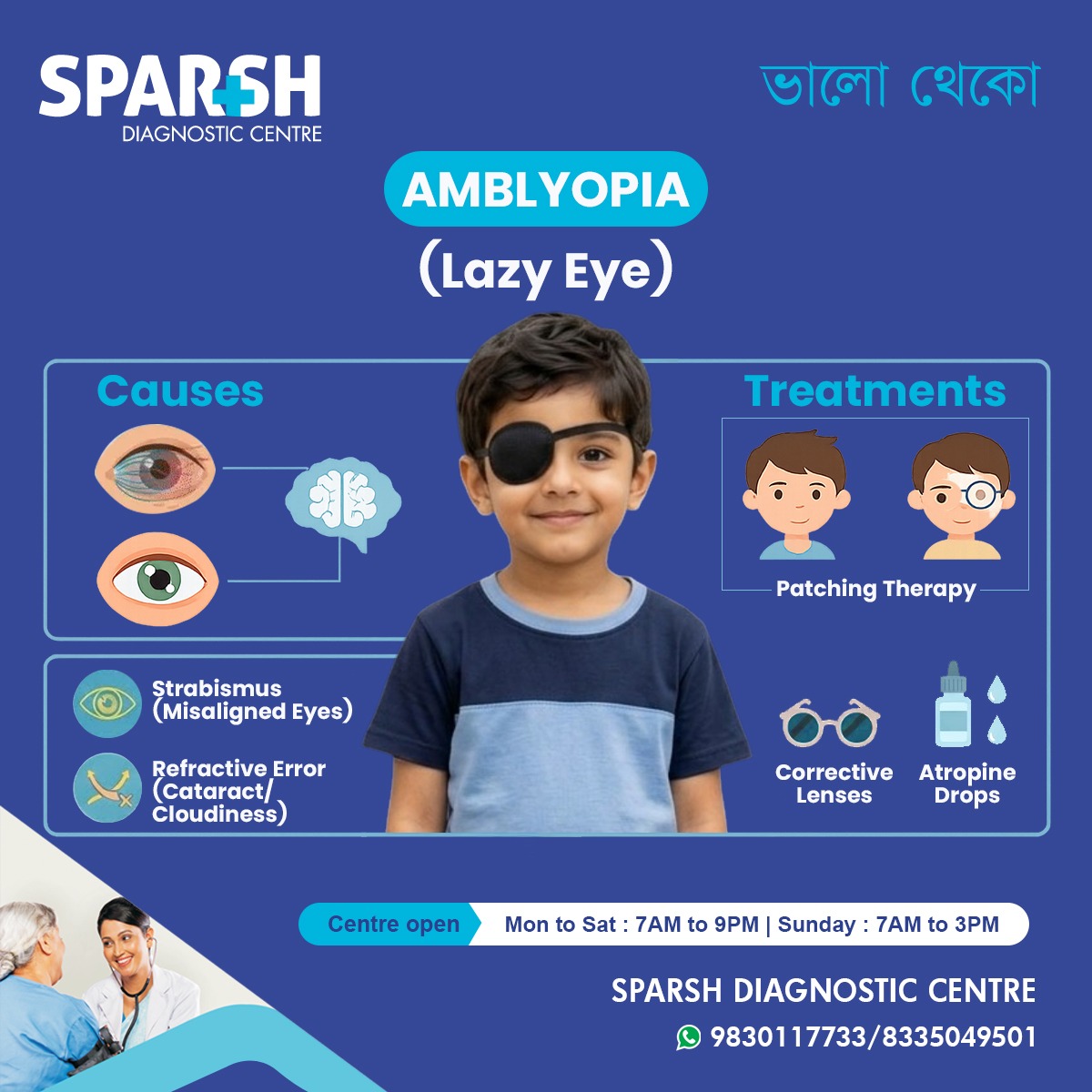
Why Is It Called “Lazy Eye”?
The term lazy eye can be misleading.
The eye is not actually lazy or inactive. Instead, the communication between the brain and the eye doesn’t develop properly. The brain essentially “switches off” the blurry image coming from one eye in favor of the clearer one.
Without treatment, the weaker eye becomes progressively less useful for vision.
What Causes Amblyopia?
Amblyopia develops when normal visual development is interrupted during infancy or early childhood. The brain requires clear and equal images from both eyes to develop proper vision.
Several conditions can interfere with this process.
1. Strabismus (Eye Misalignment)
Strabismus is one of the most common causes of amblyopia.
When the eyes point in different directions, the brain receives two different images. To avoid double vision, it suppresses the image from one eye, eventually leading to amblyopia.
2. Refractive Errors
A significant difference in prescription between the two eyes can also cause amblyopia.
Examples include:
- Severe farsightedness
- Nearsightedness
- Astigmatism
- Unequal refractive error between the eyes (anisometropia)
The brain relies on the clearer eye while ignoring the blurrier one.
3. Visual Deprivation
Anything that blocks light from entering the eye during early childhood can interfere with normal vision development.
Examples include:
- Congenital cataracts
- Droopy eyelids (ptosis)
- Corneal scarring
- Eye injuries
This type is known as deprivation amblyopia and usually requires urgent treatment.
Risk Factors for Amblyopia
Certain children have a higher risk of developing amblyopia.
Risk factors include:
- Family history of amblyopia
- Premature birth
- Low birth weight
- Developmental delays
- Congenital eye disorders
- Strabismus
- Significant refractive errors
Children with these risk factors should undergo comprehensive eye examinations early in life.
At What Age Does Amblyopia Start?
Amblyopia usually develops from birth up to around seven years of age, when the visual system is still developing.
The condition often begins between birth and five years, although it may not be noticed immediately because children rarely realize that one eye sees poorly.
This is why routine eye screening is extremely important before children begin school.
Symptoms of Amblyopia
Many children show no obvious symptoms.
Possible signs include:
- Poor vision in one eye
- Frequent squinting
- Tilting the head while looking at objects
- Closing one eye in bright sunlight
- Difficulty judging distances
- Poor depth perception
- Eyes that appear crossed or misaligned
Infants cannot describe blurred vision, making regular pediatric eye examinations essential.
How Is Amblyopia Diagnosed?
Diagnosis involves a comprehensive eye examination by an ophthalmologist or pediatric eye specialist.
Tests may include:
- Visual acuity testing
- Eye alignment assessment
- Refraction test for glasses
- Examination of eye structures
- Dilated eye examination
- Depth perception testing
Early diagnosis offers the best chance for successful treatment.
How Do You Fix Amblyopia?
Treating amblyopia involves addressing the underlying cause while encouraging the brain to use the weaker eye.
Treatment often combines several approaches.
Prescription Glasses
If refractive error is responsible, properly prescribed glasses may significantly improve vision.
Some children respond remarkably well to glasses alone.
Eye Patching Therapy
Eye patching remains one of the most effective treatments.
A patch is placed over the stronger eye for several hours each day, forcing the brain to rely on the weaker eye.
The exact duration depends on:
- Child’s age
- Severity of amblyopia
- Response to treatment
Consistency is the key to success.
Atropine Eye Drops
Instead of patching, atropine drops may be used in the stronger eye.
The drops temporarily blur near vision in the stronger eye, encouraging greater use of the weaker eye.
Many children find this treatment easier than wearing a patch.
Vision Therapy
Some patients benefit from structured visual exercises that improve:
- Eye coordination
- Focusing ability
- Binocular vision
- Visual processing
Vision therapy is usually combined with other treatments rather than used alone.
Surgery
Surgery is not performed to cure amblyopia directly.
Instead, it may be recommended to correct conditions causing amblyopia, such as:
- Strabismus
- Congenital cataracts
- Severe drooping eyelids
Following surgery, additional treatments like patching are often still necessary.
Can Glasses Fix Amblyopia?
Yes—but not always.
Glasses correct refractive errors that contribute to amblyopia. In mild cases, vision may improve considerably with glasses alone.
However, many children also require:
- Eye patching
- Atropine therapy
- Vision exercises
The treatment plan depends on the cause and severity.
What Is the Golden Period of Amblyopia Treatment?
The golden period is generally considered before the age of seven, when the brain’s visual pathways remain highly adaptable.
Treatment started during this period offers the greatest chance of restoring normal vision.
Nevertheless, newer research shows that improvement remains possible beyond childhood.
What Age Is Too Late for Amblyopia Treatment?
There is no absolute age cutoff.
While younger children respond most rapidly, treatment may still help:
- Older children
- Teenagers
- Adults
Although improvements may be smaller and slower, many adults achieve meaningful gains with modern therapy.
Therefore, it is never too late to seek evaluation.
Can Amblyopia Be Fully Corrected?
Many children achieve excellent or even normal vision when treatment begins early.
The chances of full correction depend on:
- Age at diagnosis
- Cause of amblyopia
- Severity
- Consistency of treatment
Delayed treatment may result in permanent vision reduction.
Can Amblyopia Be Cured in Adults?
Adults can experience improvement, although treatment outcomes are generally less dramatic than in young children.
Recent research suggests the adult brain retains more visual plasticity than previously believed.
Treatment may include:
- Updated glasses
- Vision therapy
- Perceptual learning
- Digital visual training
- Occasionally patching
While complete recovery is less common, meaningful improvement is possible.
Does Amblyopia Get Worse With Age?
The condition itself usually does not progressively worsen after visual development is complete.
However, untreated amblyopia leaves one eye permanently weaker.
If the stronger eye later develops disease, injury, or age-related vision loss, dependence on the amblyopic eye may become a significant problem.
Is Amblyopia a Serious Problem?
Yes.
Although amblyopia is not life-threatening, untreated cases can result in:
- Permanent reduced vision
- Poor depth perception
- Difficulty with certain occupations
- Increased vulnerability if the healthy eye becomes injured
Fortunately, early treatment greatly reduces these risks.
Does Amblyopia Affect IQ?
No.
Amblyopia does not affect intelligence, learning ability, or IQ.
Children with amblyopia have normal intellectual potential.
However, untreated vision problems may temporarily interfere with reading, classroom participation, and academic performance if not recognized.
Is Amblyopia a Permanent Disability?
Not necessarily.
Many children recover excellent vision after treatment.
If left untreated during childhood, however, reduced vision may become permanent.
The degree of disability varies depending on how much vision remains in the affected eye.
Is Amblyopia Genetic?
There is evidence that genetics can play a role.
Children with family members who have:
- Strabismus
- Significant refractive errors
- Amblyopia
may have a higher risk.
However, genetics alone does not guarantee that a child will develop amblyopia.
Is Amblyopia a Birth Defect?
Not exactly.
Some babies are born with conditions—such as congenital cataracts—that can lead to amblyopia.
Others develop amblyopia during infancy because of eye misalignment or refractive errors.
So while amblyopia itself is not usually considered a birth defect, congenital eye problems can contribute to its development.
Living With Amblyopia
With early treatment, most children lead completely normal lives.
Parents can improve treatment success by:
- Following patching schedules consistently
- Ensuring children wear prescribed glasses
- Attending regular follow-up appointments
- Encouraging visually engaging activities during patching
- Avoiding missed treatment days
Patience is essential, as improvement often occurs gradually over months.
Can Amblyopia Be Prevented?
Not every case can be prevented, but early detection makes a tremendous difference.
Parents should schedule routine eye examinations if:
- Eyes appear crossed
- One eyelid droops
- A child squints frequently
- Vision seems poor
- There is a family history of amblyopia
Routine vision screening before school age is one of the best ways to detect amblyopia early.
When Should You See an Eye Specialist?
Seek prompt evaluation if your child:
- Has crossed eyes
- Frequently covers one eye
- Tilts the head to see
- Complains of blurred vision
- Has difficulty reading
- Shows poor hand-eye coordination
- Fails a school vision screening
Early intervention offers the best chance of restoring vision.
Amblyopia is one of the most common childhood vision disorders, but it is also one of the most treatable when detected early. Because the brain learns to rely on the stronger eye, timely intervention is essential to help the weaker eye develop normally.
Treatment may involve glasses, eye patching, atropine drops, vision therapy, or surgery to address underlying eye conditions. While the best outcomes are achieved during early childhood, older children and even adults may still benefit from treatment.
Regular eye examinations, especially during the first few years of life, are the most effective way to detect amblyopia before permanent vision loss occurs. If you notice signs of poor vision or eye misalignment in your child, don’t delay seeking professional advice. Early action can make a lifelong difference.
Frequently Asked Questions (FAQs)
1. Can amblyopia be fully corrected?
Yes. Many children achieve normal or near-normal vision if treatment begins early. The earlier treatment starts, the better the chances of complete correction.
2. How do you fix amblyopia?
Treatment focuses on correcting the underlying cause and encouraging the weaker eye to work. This may include glasses, eye patching, atropine eye drops, vision therapy, and sometimes surgery for associated conditions like strabismus or cataracts.
3. What is the cause of amblyopia?
The most common causes are strabismus (misaligned eyes), unequal refractive errors between the eyes, and visual deprivation from conditions such as congenital cataracts or drooping eyelids.
4. Does amblyopia get worse with age?
The condition usually stabilizes after childhood, but untreated amblyopia can leave permanent vision loss. If the stronger eye becomes damaged later in life, vision problems may become more noticeable.
5. What age is too late for amblyopia treatment?
There is no strict age limit. While treatment is most effective before age seven, older children, teenagers, and adults can still experience improvement with appropriate therapy.
6. Does amblyopia affect IQ?
No. Amblyopia affects vision only and has no impact on intelligence or IQ.
7. Can glasses fix amblyopia?
Glasses can significantly improve vision when refractive error is the cause. However, many patients also require patching, atropine drops, or vision therapy for the best results.
8. Is amblyopia a permanent disability?
Not necessarily. Early treatment often restores good vision. Untreated amblyopia can lead to permanent vision impairment in the affected eye.
9. Is amblyopia (lazy eye) genetic?
A family history of amblyopia, strabismus, or significant refractive errors increases the risk, but genetics is only one of several contributing factors.
10. Is lazy eye a serious problem?
Yes. Without treatment, it can cause lifelong reduced vision and poor depth perception. Fortunately, early diagnosis greatly improves the outcome.
11. Is lazy eye a birth defect?
Amblyopia itself is usually not a birth defect, but congenital eye conditions such as cataracts or ptosis can cause it if not treated early.
12. At what age does amblyopia start?
It typically develops from birth to around seven years of age, most often during infancy and the preschool years.
13. Can lazy eye be cured in adults?
Adults may experience meaningful improvement with modern treatment approaches, although complete recovery is generally less common than in children.
14. What is the golden period of amblyopia treatment?
The golden period is before the age of seven, when the brain’s visual system is most adaptable. Starting treatment during this window provides the best chance of restoring normal vision.
#BhaloTheko
Disclaimer:
No content on this site, regardless of date, should ever be used as a substitute for direct medical advice from your doctor or other qualified clinician.