Trying to conceive can sometimes feel like a guessing game. You may know roughly when your period is due, track your cycle on an app and even use ovulation kits, yet still not know exactly when ovulation is happening.
A follicular study, also called follicular monitoring or folliculometry, can make that process much clearer. It uses a series of ultrasound scans to monitor the growth of ovarian follicles and determine whether and when ovulation is taking place.
For couples trying to conceive naturally, the information can help identify the most fertile time for intercourse. For women undergoing ovulation induction, IUI or IVF, follicular monitoring can help doctors decide when treatment should be adjusted or when a procedure should be scheduled.
If you are looking for a follicular study in Kolkata, understanding what the test actually shows, how many scans you may need and how to interpret the results can help you feel much more prepared.
What is a follicular study?
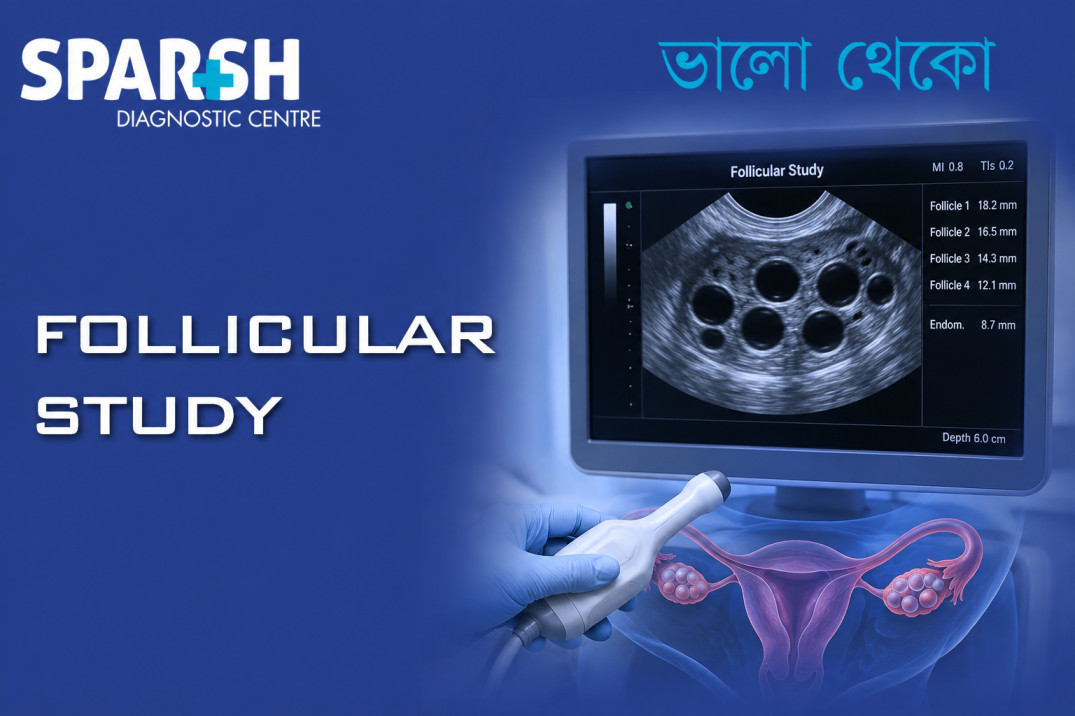
A follicular study is a series of ultrasound examinations performed during the menstrual cycle to monitor ovarian follicles.
A follicle is a small fluid-filled structure inside the ovary that contains an immature egg. During a typical menstrual cycle, several follicles may begin developing, but usually one becomes the dominant follicle. This follicle continues growing and eventually releases an egg during ovulation.
A follicular study follows this process over several days.
The ultrasound can help the doctor assess:
- The number and size of developing follicles
- Which follicle is becoming dominant
- How quickly the dominant follicle is growing
- The thickness and appearance of the uterine lining
- Whether the follicle has ruptured
- Whether ovulation has occurred
- Whether the ovaries are responding appropriately to fertility medicines
Most follicular studies involve several scans rather than one isolated ultrasound. The exact number depends on the menstrual cycle, follicle growth and whether fertility medication is being used. Three to six scans in a cycle are common, although some women may need fewer or more.
Why is a follicular study done?
The main purpose is to monitor ovulation.
Ovulation is the point in the menstrual cycle when a mature egg is released from the ovary. Since the egg remains viable for only a relatively short period after release, knowing when ovulation is likely to occur can be particularly useful when trying to conceive.
A follicular study may be recommended when:
- You are trying to conceive naturally
- Your periods are irregular
- Ovulation is suspected to be irregular or absent
- You have PCOS and unpredictable ovulation
- You are taking medicines to induce ovulation
- You are undergoing IUI
- You are undergoing IVF
- Previous attempts at conception have not been successful
- Your doctor wants to assess how your ovaries respond to fertility treatment
It can also help identify situations in which a follicle grows but does not rupture as expected.
How does a follicular study work?
The process is fairly straightforward.
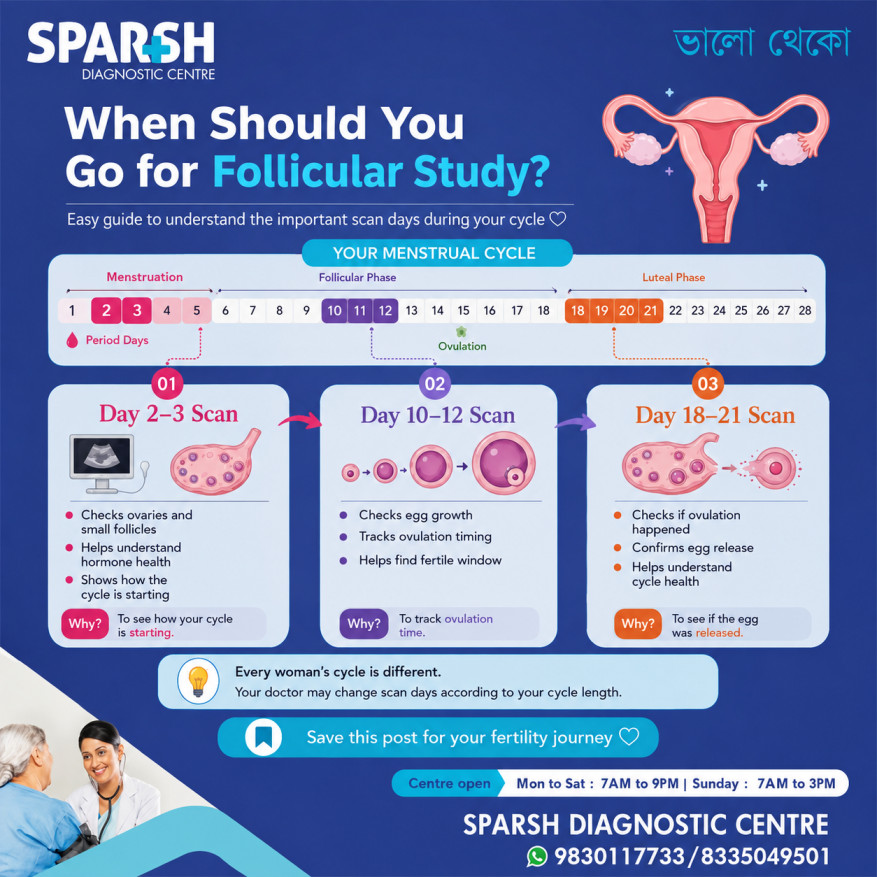
The first scan is scheduled according to your menstrual cycle. Depending on your doctor’s approach and your individual situation, monitoring may begin early in the cycle, followed by repeat scans as the follicles grow.
For women with regular cycles, monitoring commonly begins around the middle of the follicular phase, often around days 8–10. Women with irregular cycles may require a more individualised schedule.
During each scan, the doctor measures the follicles and compares their size with previous scans.
As ovulation approaches, one follicle usually becomes dominant. It continues growing until it reaches a size considered appropriate for ovulation.
After ovulation, the previously dominant follicle typically appears collapsed or disappears, and fluid may be visible in the pelvis. These findings can help confirm that ovulation has occurred.
Which time is best for follicular study?
There is no single best day for every woman because follicle development differs from person to person.
For someone with a regular 28-day cycle, the first monitoring scan is often performed around day 8 to day 10, followed by repeat scans depending on follicular growth. In some cases, a baseline scan may be performed earlier.
For women with irregular periods, the timing may be different. Your doctor may start monitoring earlier and continue until a dominant follicle develops and ovulation is confirmed.
The important point is that a follicular study is a series of scans, not simply one scan performed on a particular day.
What size follicle is ready for ovulation?
A dominant follicle is commonly considered mature and ready for ovulation when it reaches approximately 18–24 mm in diameter, although the exact size can vary depending on the individual and the treatment cycle.
Some fertility protocols may use slightly different measurements when deciding on an hCG trigger or egg retrieval.
Follicles generally grow gradually during the latter part of the follicular phase. Monitoring the rate of growth is therefore just as important as looking at one measurement in isolation.
For example, a follicle measuring 14 mm may not mean that anything is wrong. It may simply need another day or two to mature.
What are the normal results of a follicular study?
A normal follicular study generally shows a follicle developing in an expected pattern, with one follicle becoming dominant and eventually reaching an appropriate pre-ovulatory size.
A typical sequence might look something like this:
| Stage | Approximate follicle size | What it may indicate |
|---|---|---|
| Early follicle | 4–6 mm | Small developing follicle |
| Growing follicle | 8–12 mm | Continued follicular development |
| Developing dominant follicle | 14–17 mm | One follicle becoming dominant |
| Mature follicle | 18–24 mm | Usually approaching ovulation |
| After ovulation | Collapsed/changed appearance | Follicular rupture may have occurred |
These figures are approximate, not rigid cut-offs. Cycle length, medication, hormone levels and individual ovarian function can all influence follicular development.
A normal report should therefore be interpreted based on the whole series of scans, rather than one number.
The doctor may also assess the endometrium, because the uterine lining needs to be appropriately developed for implantation.
How to get pregnant with a follicular study?
A follicular study does not itself cause pregnancy. Instead, it helps identify when pregnancy is most likely to occur.
If you are trying to conceive naturally, your doctor can use the scan findings to estimate when ovulation is approaching. You may then be advised to have intercourse during the fertile window.
For example, if a dominant follicle is growing appropriately and appears close to ovulation, your doctor may recommend intercourse around the expected ovulation period.
In cycles where an ovulation-trigger injection is prescribed, the timing of intercourse may be based on the expected response to the injection.
Follicular monitoring can also be used to time IUI. In IVF, it has a different role because multiple follicles are intentionally stimulated and monitored before egg retrieval.
It is important to remember that follicular study is only one part of fertility assessment. Pregnancy also depends on factors such as sperm quality, fallopian-tube patency, egg quality, uterine health, hormones and age.
Does 4 follicles mean 4 eggs?
Not necessarily.
Each ovarian follicle generally contains an immature egg, but seeing four follicles on ultrasound does not guarantee that four mature or usable eggs will be obtained.
This distinction becomes especially important during IVF.
A follicular scan measures follicles, not the eggs themselves. The egg is microscopic and cannot normally be seen directly on a routine ultrasound.
During IVF, follicles are aspirated during egg retrieval and the embryology team determines how many eggs were actually collected.
So, four visible follicles should not automatically be interpreted as four mature eggs.
How many follicles are normal at 35?
There is no single follicle number that is considered normal for every 35-year-old woman.
The number of antral follicles seen on an ultrasound is influenced by ovarian reserve, age and individual biology. Antral follicle count is useful when assessing ovarian reserve, but it should not be interpreted alone.
A lower count may suggest reduced ovarian reserve, while a high number of small follicles may be seen in conditions such as PCOS. Neither finding, by itself, tells you whether you will or will not become pregnant.
Your doctor may consider the antral follicle count together with other information such as AMH, menstrual history, age and previous fertility treatment response.
This is why comparing your follicle count directly with someone else’s can be misleading.
Is 2 follicles enough for IVF?
Two follicles can potentially be enough to proceed with IVF, but whether they are considered sufficient depends on the individual treatment plan.
In IVF, the objective is generally to develop multiple follicles so that several eggs may potentially be retrieved. However, follicle number is not the only factor that matters.
The outcome also depends on:
- The woman’s age
- Egg maturity and quality
- Sperm quality
- Embryo development
- Ovarian reserve
- Response to stimulation medicines
- Previous IVF history
A woman with two follicles may still have a chance of obtaining eggs and creating an embryo. However, the expected outcome may differ from a cycle in which more follicles develop.
Your fertility specialist will decide whether to continue stimulation, adjust medication or consider another approach based on the complete clinical picture.
Does follicular study show PCOS?
A follicular study can provide ultrasound information that may support the evaluation of PCOS, but a follicular study alone does not diagnose PCOS.
Women with PCOS may have numerous small follicles and may experience irregular or absent ovulation. Serial ultrasound can also show whether a dominant follicle is developing and whether ovulation is occurring.
However, PCOS diagnosis usually involves consideration of symptoms, menstrual history, clinical findings, hormone tests and ultrasound findings together.
Therefore, if your follicular scan shows multiple small follicles, it does not automatically mean that you have PCOS.
Is a follicular study test painful?
For most women, follicular monitoring is not considered painful.
When a transvaginal ultrasound is used, a covered and lubricated ultrasound probe is gently inserted into the vagina. You may feel pressure or mild discomfort, but many women tolerate the examination well.
The scan itself generally takes only a few minutes.
If you experience significant pain, tell the person performing the scan. They can often adjust the position or technique to make you more comfortable.
A transabdominal ultrasound may sometimes be used instead, although transvaginal ultrasound usually provides clearer images of the ovaries and developing follicles.
Is sperm visible in a follicular study?
No.
A follicular study does not show sperm.
The purpose of the ultrasound is to monitor the ovaries, follicles, uterus and related pelvic structures. Sperm cells are far too small to be visualised on a routine ultrasound examination.
If sperm quality needs to be evaluated, a semen analysis is used. This test examines characteristics such as sperm concentration, movement and morphology.
So, a follicular study and semen analysis answer completely different fertility questions.
What happens if the follicle does not rupture?
Sometimes a follicle may grow appropriately but fail to rupture and release the egg.
This may be associated with a condition called luteinised unruptured follicle syndrome (LUFS).
Serial ultrasound can be useful in identifying this because the doctor can see that the follicle developed but did not show the expected changes associated with ovulation.
Depending on the situation, your fertility specialist may recommend further evaluation or treatment.
This is one reason why follicular monitoring can provide more useful information than simply predicting ovulation based on the calendar.
Follicular study for IUI and IVF
Follicular monitoring has an important role in assisted reproductive treatments.
Follicular study for IUI
During an IUI cycle, fertility medicines may be used to stimulate follicular growth. Ultrasound monitoring helps determine whether follicles are developing appropriately and when ovulation is likely to occur.
If a trigger injection is used, the timing of IUI can then be planned around the expected ovulation window.
Follicular study for IVF
IVF monitoring is more intensive because several follicles may be stimulated simultaneously.
Repeated ultrasounds measure follicle size and number while the doctor adjusts medication according to the ovarian response. Egg retrieval is then planned when the follicles have reached an appropriate stage of development.
How should you prepare for a follicular study?
Preparation is usually simple.
If you are having a transvaginal scan, you may generally be asked to empty your bladder before the examination. If a transabdominal scan is planned, a full bladder may be required.
It is helpful to know the first day of your period because the scan schedule is based on your menstrual cycle.
Wear comfortable clothing and follow any specific instructions provided by the diagnostic centre or your doctor.
What is the cost of a follicular study?
The cost of a follicular study in Kolkata varies depending on the diagnostic centre, whether the scan is transvaginal or transabdominal, whether you are paying for an individual scan or a complete study, and how many follow-up scans are required.
Current Kolkata listings show individual follicular-study prices ranging from several hundred rupees to around ₹2,000–₹3,000 at different centres, while complete studies involving multiple visits can cost more. For example, published listings currently show individual prices around ₹600–₹1,700 at some centres, while other providers list approximately ₹2,000–₹3,200 depending on location and service.
Therefore, when comparing the follicular study cost in Kolkata, ask whether the quoted price is:
- For one scan only
- For a complete follicular study
- Inclusive of additional scans
- Inclusive of transvaginal scanning
- Inclusive of the radiologist’s report
A lower price per scan does not necessarily mean a lower total cost if additional monitoring visits are billed separately.
Why choose Sparsh Diagnostic Centre for follicular study scan?
When you are undergoing a follicular study, accurate ultrasound measurements and timely repeat scans matter. Sparsh Diagnostic Centre provides follicular study scans in Kolkata with a focus on accurate imaging, clear reporting and patient-friendly care.
Here are some reasons patients may consider Sparsh Diagnostic Centre for follicular monitoring:
- Experienced imaging professionals: Follicular studies require careful assessment of follicle size, growth and changes between scans.
- Advanced ultrasound technology: Good-quality imaging helps provide clear visualisation of the ovaries, developing follicles and uterine lining.
- Serial monitoring: Follicular studies often require multiple scans during the same menstrual cycle. Convenient scheduling can make it easier to complete the monitoring process.
- Clear and detailed reports: Measurements and relevant ultrasound findings are documented to help your gynaecologist or fertility specialist assess follicular development.
- Convenient location in Kolkata: Easy access can be particularly helpful when repeat scans are required over several days.
- Patient-focused approach: The team aims to make the examination as comfortable and straightforward as possible, particularly for patients who may be undergoing fertility investigations for the first time.
If you are searching for follicular study in Kolkata, choosing a diagnostic centre that understands the importance of sequential monitoring can help ensure that your scans provide useful information throughout the cycle. Sparsh Diagnostic Centre offers follicular study services as part of its diagnostic and imaging facilities.
Frequently asked questions about follicular study
Is follicular study done every day?
Not necessarily. Many women have scans every one to two days as ovulation approaches, while others may require fewer scans. The schedule depends on follicle growth and the treatment being followed.
Can a follicular study confirm ovulation?
Yes. A series of scans can often confirm ovulation by showing changes such as rupture or collapse of the dominant follicle and, in some cases, fluid in the pelvis.
Can follicular study detect pregnancy?
No. Follicular study is designed to monitor follicular development and ovulation. A pregnancy test or appropriately timed pregnancy ultrasound is used to confirm pregnancy.
Does follicular study show the quality of an egg?
No. Ultrasound can monitor the follicle in which the egg is developing, but it cannot directly assess the microscopic egg’s quality.
Egg quality is influenced by several factors, particularly age, and cannot be determined simply from follicle size.
Is one mature follicle enough to get pregnant naturally?
Yes, one mature follicle can release one egg, and pregnancy can occur if the egg is fertilised and other fertility factors are favourable. In fact, natural cycles commonly involve one dominant follicle.
What does a good follicular study report look like?
A reassuring report generally documents follicular growth, identifies the dominant follicle, records its measurements across scans and comments on ovulation and the uterine lining where appropriate.
The exact interpretation depends on the woman’s cycle and the reason for monitoring.
Does a follicular study guarantee pregnancy?
No. A follicular study can help identify ovulation and improve timing, but it cannot guarantee conception.
Fertility involves both partners and depends on several factors, including egg and sperm quality, fallopian tubes, uterus, hormones and age.
Final thoughts
A follicular study can take much of the uncertainty out of understanding ovulation.
Instead of relying entirely on calendar calculations, the scan allows doctors to watch follicular development as it happens. It can help identify the dominant follicle, estimate the fertile window, confirm ovulation and guide treatments such as ovulation induction, IUI and IVF.
For couples trying to conceive, that information can be extremely useful. But it is equally important not to become overly focused on one number, such as follicle size or follicle count. A 20 mm follicle, for example, is only one piece of the fertility picture.
If you are considering a follicular study in Kolkata, speak with your gynaecologist or fertility specialist about when monitoring should begin and how many scans are likely to be needed. Choosing a diagnostic centre with experienced professionals, appropriate ultrasound equipment and clear reporting can make the monitoring process simpler and more reliable.
To consult a Doctor or get full body check-up done at Sparsh Diagnostic Centre, call our helpline numbers 9830117733/ 8335049501.
#BhaloTheko
Disclaimer:
No content on this site, regardless of date, should ever be used as a substitute for direct medical advice from your doctor or other qualified clinician.