

An ACL tear can be a major setback, whether it happens during sports, exercise, a sudden twist, or an everyday accident. For many patients, ACL reconstruction surgery is an important step towards restoring knee stability. But surgery itself is not the end of treatment. What happens after surgery can have a major influence on how well the knee eventually functions.
This is where physiotherapy after ACL surgery becomes so important.
A structured ACL rehabilitation programme helps control pain and swelling, restore knee movement, rebuild the quadriceps and hamstrings, improve balance and coordination, and gradually prepare the knee for normal daily activities or sport. Current rehabilitation guidance considers exercise-based rehabilitation the mainstay of recovery after ACL reconstruction, with progression based increasingly on functional milestones rather than simply counting weeks after surgery.
The goal is not simply to make the knee “feel better.” A successful ACL rehabilitation programme aims to help you develop a strong, stable and confident knee while reducing the risk of problems associated with returning to activity too quickly.
Why is physiotherapy important after ACL surgery?
ACL reconstruction replaces the torn ligament with a graft, but surgery does not automatically restore the strength, movement, coordination and confidence you had before the injury.
After surgery, it is common for the knee to become swollen and stiff. The quadriceps can also become surprisingly weak, sometimes very quickly. Walking may feel unnatural, and movements that once required no thought—such as climbing stairs, getting up from a chair or balancing on one leg—can suddenly feel difficult.
Physiotherapy addresses these problems progressively.
A physiotherapist can help you:
- Reduce postoperative pain and swelling
- Restore full knee extension and flexion
- Reactivate and strengthen the quadriceps
- Strengthen the hamstrings, glutes and calf muscles
- Improve walking and movement patterns
- Restore balance and proprioception
- Develop knee control during functional movements
- Progress from basic strengthening to more demanding exercises
- Assess readiness for running, recreational activities or sport
- Reduce the risk of returning to demanding activity before the knee is ready
Early rehabilitation is particularly important for restoring knee movement and preventing prolonged muscle weakness. Evidence-based ACL rehabilitation guidance recommends beginning active knee movement early and progressing weight-bearing in a controlled manner when appropriate for the individual surgery and surgeon’s instructions.
Is physiotherapy necessary after ACL surgery?
Yes, physiotherapy is generally considered an essential part of ACL surgery recovery.
The operation addresses the torn ligament, but rehabilitation helps restore what surgery alone cannot: muscle strength, movement, coordination, balance, functional capacity and confidence.
That does not mean every patient needs exactly the same physiotherapy programme. Someone whose main objective is comfortable everyday mobility may have different rehabilitation goals from a competitive footballer or someone hoping to return to pivoting sports.
Your physiotherapy programme should therefore be individualised according to the type of surgery, graft, associated injuries, age, activity level, symptoms and functional goals.
Skipping rehabilitation or stopping once the knee feels reasonably comfortable can leave important deficits in strength and movement control.
What happens during ACL physiotherapy?
ACL rehabilitation is normally progressive rather than a collection of unrelated exercises.
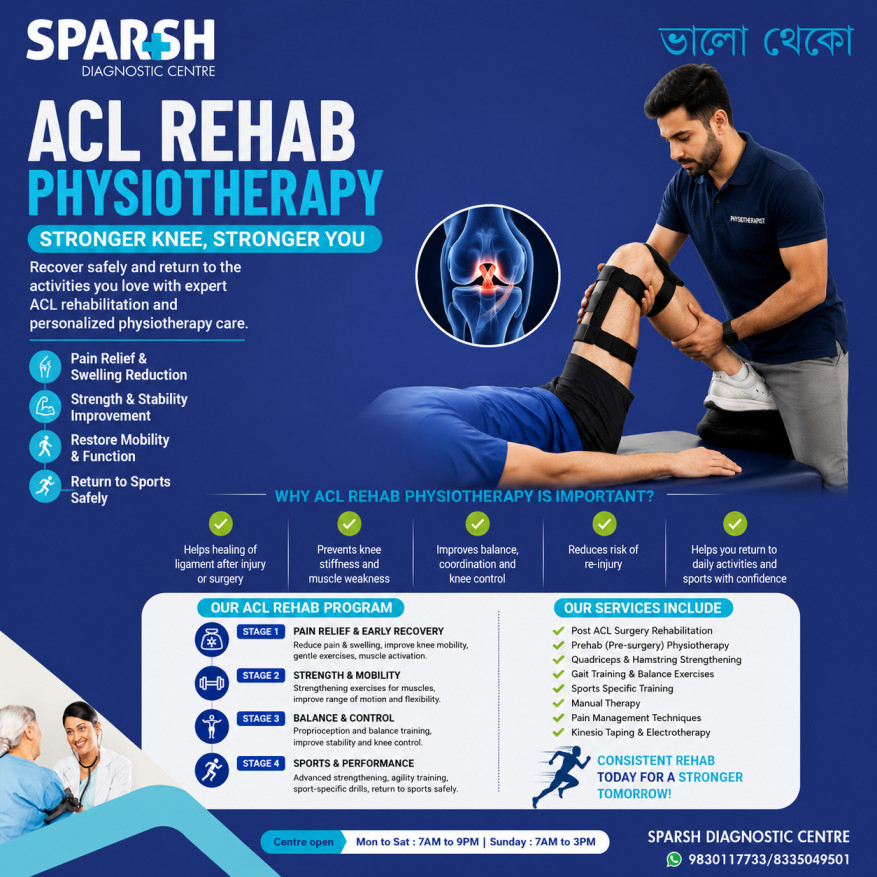
Phase 1: Pain, swelling and movement
The early period focuses on controlling swelling, reducing discomfort and restoring knee movement.
An important early goal is achieving full knee extension—the ability to straighten the knee completely. Early rehabilitation programmes also work on quadriceps activation, gentle knee flexion, circulation and safe walking.
Depending on the individual case, exercises may include:
- Quadriceps sets
- Heel slides
- Ankle pumps
- Straight-leg raises when appropriate
- Gentle knee-extension exercises
- Hamstring activation
- Controlled weight-bearing
The exact exercises and timing should be determined by your surgeon and physiotherapist.
The MOON ACL rehabilitation programme, for example, identifies full extension, reduced swelling, quadriceps control and normal walking as important early goals.
Phase 2: Strength and mobility
Once early movement is established, rehabilitation gradually shifts towards rebuilding strength.
The quadriceps receive particular attention because weakness following ACL reconstruction is common. The hamstrings, gluteal muscles and calf muscles are also important because they contribute to lower-limb control and knee function.
Exercises may progressively include:
- Leg presses
- Controlled squats
- Step-ups
- Hamstring strengthening
- Calf raises
- Hip strengthening
- Stationary cycling
- Resistance exercises
- Controlled single-leg exercises
The important point is progression. Doing more exercise is not necessarily better. Exercises need to be selected and progressed according to how the knee responds.
Phase 3: Balance, coordination and neuromuscular control
An ACL injury can affect proprioception—the body’s awareness of joint position and movement.
Therefore, ACL rehabilitation is not only about making muscles stronger.
You also need to teach your body to control the knee during movement.
Balance exercises, single-leg activities, controlled stepping and progressively more dynamic movements can help develop this control.
This becomes especially important when a person eventually wants to run, jump, change direction or participate in activities involving rapid movements.
Phase 4: Functional strengthening
As strength and movement control improve, rehabilitation becomes increasingly similar to the activities you eventually want to perform.
For one patient, this might mean being able to walk comfortably, climb stairs and perform household activities.
For another, it might involve running, jumping, landing and changing direction.
This is why there is no single ACL rehabilitation programme that is perfect for everyone.
What helps speed up ACL recovery?
There is no safe shortcut that makes an ACL graft heal overnight. Recovery is a biological and functional process, and trying to rush it can sometimes create setbacks.
The best way to support recovery is to follow a structured, progressive rehabilitation programme.
Several factors can help:
1. Start rehabilitation at the appropriate time
Early controlled movement is generally an important part of ACL recovery, provided it follows the surgeon’s postoperative instructions. Prolonged immobilisation can contribute to muscle atrophy and slower functional recovery.
2. Control swelling
Persistent swelling can interfere with movement and muscle activation. Your rehabilitation plan may incorporate elevation, ice, compression or other appropriate strategies alongside exercise.
3. Restore full knee extension
Being able to completely straighten the knee is one of the important early rehabilitation goals.
4. Rebuild muscle strength
Quadriceps weakness is one of the major challenges following ACL reconstruction. Progressive strengthening is therefore a central part of recovery.
5. Follow the home exercise programme
Physiotherapy does not happen only inside the clinic. The exercises prescribed for home are an important part of the overall programme.
6. Progress according to function
Feeling good is encouraging, but it does not necessarily mean that the knee is ready for running, jumping or sport.
Modern rehabilitation increasingly uses criterion-based progression, considering factors such as range of motion, swelling, strength and functional performance rather than relying solely on a calendar.
Can you recover 100% from ACL surgery?
Many people achieve excellent outcomes after ACL reconstruction and return to their normal daily activities. Some also return to running and sport.
However, “100% recovery” means different things to different people.
A person may have a pain-free, stable knee and return comfortably to everyday life without needing to return to competitive sport. An athlete may define complete recovery as returning to the same level of competitive performance.
Recovery also depends on factors such as:
- Severity of the original injury
- Graft type
- Associated meniscus or cartilage injuries
- Surgical technique
- Age and general fitness
- Quality and consistency of rehabilitation
- Muscle strength
- Movement mechanics
- Psychological readiness
- Activity goals
The American Academy of Orthopaedic Surgeons notes that return to sport depends on factors including functional recovery, and functional testing can be considered when determining readiness.
So, yes, a very high level of recovery is possible, but there is no guarantee that every knee will return to exactly its pre-injury state.
Can an ACL tear heal with physiotherapy?
This question needs an important distinction.
Physiotherapy can help a person with an ACL tear improve strength, stability, movement and function, but physiotherapy does not reliably reconnect a completely torn ACL in the same way that surgery reconstructs the ligament.
Some people with ACL injuries can be managed without reconstruction, depending on the nature of the injury, knee stability, associated injuries, activity demands and individual circumstances.
However, rehabilitation is still extremely important whether surgery is performed or not.
If you have an ACL tear, an orthopaedic specialist can determine whether non-operative management or reconstruction is appropriate for you.
How many physio sessions after ACL surgery?
There is no fixed number of physiotherapy sessions that every ACL surgery patient needs.
Some people may require frequent supervised sessions during the early stages and then gradually reduce the frequency as they become more independent with their exercises. Others may need longer supervised rehabilitation because of weakness, stiffness, associated injuries or demanding activity goals.
Rather than asking only, “How many sessions do I need?”, it is more useful to ask:
“Have I achieved the rehabilitation goals required for the next stage?”
Your physiotherapist may assess:
- Knee range of motion
- Swelling
- Quadriceps strength
- Hamstring strength
- Walking pattern
- Balance
- Single-leg control
- Functional performance
- Pain response
- Confidence and readiness
The rehabilitation process can last several months, and recent literature describes ACL recovery as commonly extending around 9–12 months, particularly when higher-level functional or sporting goals are involved.
What are good signs after ACL surgery?
Recovery is not perfectly linear, but several developments are encouraging.
Good signs can include:
- Swelling gradually decreasing
- Knee movement improving
- Full extension returning
- Knee bending progressively improving
- Quadriceps becoming easier to activate
- Walking becoming more natural
- Increasing strength
- Better balance
- Less discomfort during everyday activities
- Improved confidence in the operated leg
- Ability to perform progressively harder exercises without an adverse response
A temporary increase in soreness after increasing activity does not automatically mean something has gone wrong. However, persistent or worsening pain, swelling, instability, locking or other concerning symptoms should be discussed with your surgeon or physiotherapist.
What is the quickest ACL recovery time?
There is no single “quickest” recovery time that applies to everyone.
Some people return to everyday activities relatively quickly, while higher-level activities take considerably longer.
For sports involving running, jumping, cutting and pivoting, returning simply because a certain number of months have passed is not enough. Strength, movement quality, knee stability, swelling, range of motion and functional performance all need to be considered.
AAOS notes that many patients return to full sports participation within approximately 6–12 months, depending on progress, strength and mechanics.
Some modern rehabilitation approaches are deliberately more cautious about high-demand return because returning before adequate physical and psychological readiness may increase risk.
In other words, the fastest safe recovery is better than the fastest possible recovery.
Is it safe to walk too much after ACL surgery?
Walking is an important part of recovery, but more walking is not automatically better.
Your appropriate walking level depends on the stage of rehabilitation, surgical procedure, graft, associated injuries and your surgeon’s instructions.
Early weight-bearing can be progressed in a controlled manner as tolerated in appropriate patients.
A useful principle is to monitor how your knee responds.
If significantly increasing your walking causes increased swelling, pain or a decline in movement, you may be doing more than your knee currently tolerates.
Your physiotherapist can help determine how much walking, standing and exercise is appropriate at each stage.
What is the hardest part of ACL recovery?
For many people, the hardest part is not the surgery itself—it is the long rehabilitation process.
The first few weeks can be challenging because of pain, swelling, limited movement and difficulty walking. Later, the challenge often changes.
You may feel much better but still have significant strength or control deficits.
This is where patience becomes important.
ACL recovery can involve months of repetitive strengthening, gradual progression, reassessment and waiting for the knee to become ready for the next challenge.
Psychological factors can also matter. Fear of reinjury or lack of confidence may remain even after physical function has improved. A good rehabilitation programme therefore addresses both physical capacity and confidence.
Do ACL tears ever fully heal?
A completely torn ACL generally does not heal reliably back to its original structure and function on its own.
However, this should not be confused with saying that someone with an ACL tear cannot have a good functional outcome.
Some patients can function well with an ACL-deficient knee through rehabilitation and activity modification, while others require ACL reconstruction because of instability, activity requirements or associated injuries.
For people who undergo ACL reconstruction, the graft itself goes through a biological healing and remodelling process, while physiotherapy progressively restores strength and function.
The AAOS guideline also emphasises that treatment decisions should consider patient-specific factors, including associated injuries and desired future activity.
When should you return to running or sport?
Running and sport should be treated as rehabilitation milestones, not deadlines.
Before progressing to running, rehabilitation professionals may consider factors such as:
- Near-full knee flexion
- Full knee extension
- Minimal or no swelling
- Adequate quadriceps strength
- Adequate jumping or hopping capacity
- Ability to perform relevant movements without pain
Aspetar’s rehabilitation guideline proposes criteria including full extension, approximately 95% knee flexion, no or trace effusion and more than 80% limb symmetry for quadriceps strength before return to running.
For higher-demand sports, requirements are considerably greater.
This is why an ACL patient should not assume that being six months postoperative automatically means they are ready to return to football, cricket, basketball or other pivoting sports.
Why choosing the right physiotherapy programme matters
ACL rehabilitation is much more than using machines or performing a standard list of exercises.
A good programme should evolve as the knee improves.
For example, early rehabilitation may focus heavily on swelling, range of motion and quadriceps activation. Later, the focus can shift towards progressive resistance training, balance, single-leg control, jumping, running mechanics and activity-specific movements.
At every stage, the physiotherapist should consider how the knee responds to the workload.
The objective is to create a gradual bridge between surgery and real-life function.
For patients in Kolkata looking for structured ACL rehabilitation physiotherapy, an individual assessment can help determine where they currently stand and what they need to work on next.
Frequently Asked Questions About ACL Physiotherapy
Is physiotherapy necessary after ACL surgery?
Yes. Physiotherapy is a key component of recovery after ACL reconstruction. It helps restore movement, reduce swelling, rebuild muscle strength, improve balance and gradually return the patient to normal activities.
What helps speed up ACL recovery?
Consistent rehabilitation, appropriate exercise progression, swelling management, adequate rest, good nutrition, following postoperative instructions and avoiding premature high-impact activity can all support recovery. There is no safe shortcut that replaces proper rehabilitation.
Can you recover 100% from ACL surgery?
Many patients achieve excellent recovery, but outcomes vary. Returning to pain-free daily activities is different from returning to high-level competitive sport. Your recovery should be judged by strength, stability, movement and function rather than appearance or time alone.
Can an ACL tear heal with physio?
Physiotherapy cannot reliably restore a completely torn ACL to its original structure. However, rehabilitation can significantly improve strength, stability and function and may form part of non-operative treatment for selected patients.
How many physio sessions after ACL surgery?
There is no universal number. The frequency and duration depend on the individual patient’s surgery, progress, symptoms, goals and functional requirements. Sessions can become less frequent as the patient becomes more independent.
What are good signs after ACL surgery?
Reduced swelling, improving range of motion, full knee extension, better quadriceps activation, increasingly normal walking, improving strength and better confidence in the operated leg are all encouraging signs.
What is the quickest ACL recovery time?
Every recovery is different. Everyday function can improve much sooner than higher-level activities. Return to demanding sport commonly takes several months, and many patients require around 6–12 months or longer depending on their progress and goals.
Is it safe to walk too much after ACL surgery?
Walking is important, but excessive activity can aggravate swelling or pain. Walking should be increased gradually according to your postoperative instructions and how your knee responds.
What is the hardest part of ACL recovery?
The prolonged rehabilitation process is often the hardest part. Patients may feel better before their strength, movement control and confidence have fully recovered, making patience and consistency particularly important.
Do ACL tears ever fully heal?
A completely torn ACL generally does not reliably heal back to its original structure. However, some people can achieve good function with rehabilitation, while others may require reconstruction depending on knee instability, associated injuries and activity demands.
The Bottom Line
ACL surgery is only one part of ACL recovery. Physiotherapy is what helps turn surgical repair into functional recovery.
From controlling swelling and restoring knee movement in the early weeks to rebuilding strength, balance and movement control later on, rehabilitation provides the structured progression needed to help the knee become stronger and more functional.
Most importantly, ACL recovery should not be treated as a race. A knee that feels good is encouraging, but it still needs adequate strength and control before progressing to demanding activities.
With appropriate surgical care, consistent physiotherapy and a rehabilitation programme tailored to the individual, many people can regain a strong, stable and functional knee and return to the activities that matter to them.
If you have undergone ACL reconstruction or are planning surgery, speak with your orthopaedic surgeon and physiotherapist about a personalised rehabilitation programme rather than following a generic exercise plan from the internet.
Need Help with ACL surgery recovery?
Visit Sparsh Diagnostic Centre for expert consultation and personalized treatment for ACL Tears, arthrofibrosis, and post-surgical rehabilitation.
📍 Open Hours:
Monday to Saturday: 7:00 AM – 9:00 PM
Sunday: 7:00 AM – 3:00 PM
📞 Contact Us:
9830117733 / 8335049501
#BhaloTheko
Medically Reviewed By: Mr. Amit Bera, DPT Physiotherapist
Designation: Physiotherapist (DPT)
Medical Review Date: 5th September 2026
Disclaimer:
No content on this site, regardless of date, should ever be used as a substitute for direct medical advice from your doctor or other qualified clinician.



[…] The first two weeks after surgery focus on controlling swelling, regaining knee extension, and activating quadriceps muscles [6]. Ice, elevation, and gentle exercises form the cornerstone of this phase. By weeks 3-6, you’ll gradually increase weight-bearing and intensify physical therapy to improve range of motion and strength [22]. Weeks 6-12 mark a significant transition as you’ll begin more dynamic exercises, potentially including light jogging [23]. Around months 3-5, power and agility training commence, preparing you for return to sport [24]. […]