


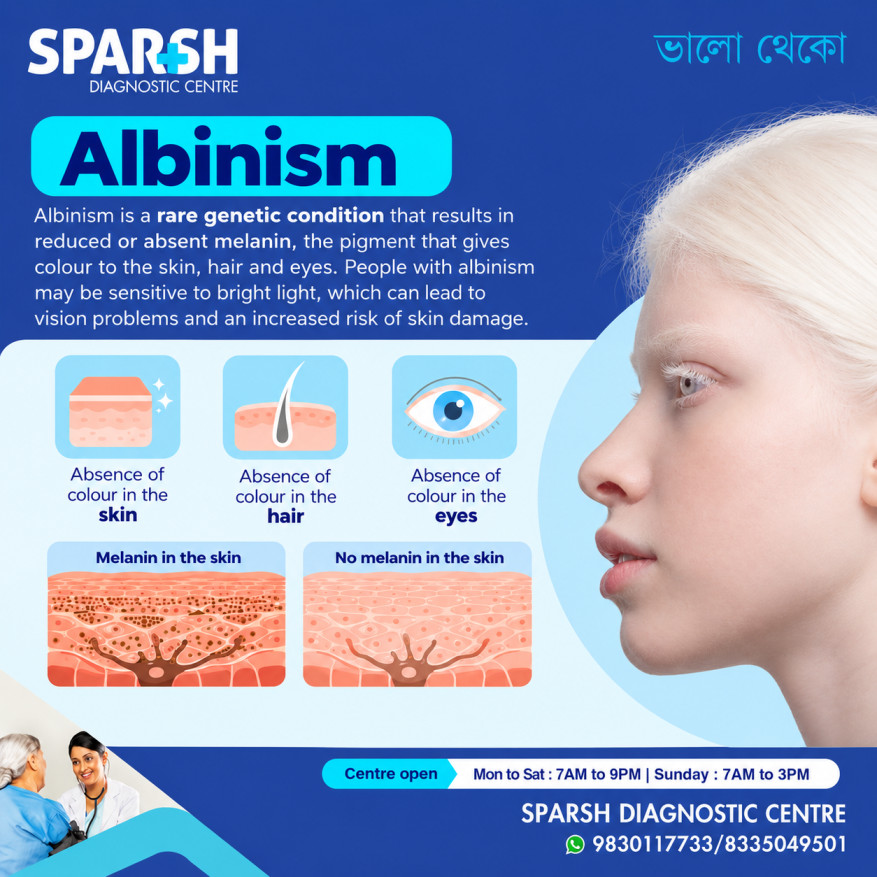
Albinism is a rare genetic condition that affects the production of melanin, the pigment responsible for much of the colour of the skin, hair and eyes. It can affect people of every race and ethnic background. While the most visible features of albinism involve pigmentation, the condition can also affect the development and function of the eyes, often causing reduced vision, sensitivity to light and involuntary eye movements.
Importantly, albinism does not define a person’s abilities, intelligence or potential. Many people with albinism live long, active and fulfilling lives. However, they may need lifelong attention to eye care, sun protection and accessibility.
Albinism is genetically complex, and there are several different forms. The commonly recognised oculocutaneous types include OCA1 through OCA7, while ocular and syndromic forms of albinism also exist.
This guide explains what albinism is, what causes it, its symptoms, the seven recognised OCA types, treatment options, inheritance, fertility and pregnancy, life expectancy, and answers some of the most commonly searched questions about the condition.
What is albinism?
Albinism is a group of inherited genetic conditions in which the body produces less melanin than usual or, in some forms, has problems with how melanin is produced or distributed.
Melanin is important for pigmentation, but its role goes beyond skin and hair colour. Melanin is also involved in the normal development of the visual system. This helps explain why vision problems are such an important feature of many forms of albinism.
There are two broad categories:
- Oculocutaneous albinism (OCA): affects the eyes, skin and hair.
- Ocular albinism (OA): primarily affects the eyes, while skin and hair pigmentation may be relatively normal.
There are also syndromic forms, such as Hermansky-Pudlak syndrome and Chediak-Higashi syndrome, in which albinism occurs along with other medical problems.
Albinism is not contagious and cannot be acquired through contact with another person.
What causes albinism?
Albinism is caused by changes, also called variants or mutations, in genes involved in melanin production, melanosome function or pigment-cell biology.
For example:
- TYR variants cause OCA1.
- OCA2 variants cause OCA2.
- TYRP1 variants cause OCA3.
- SLC45A2 variants cause OCA4.
- SLC24A5 is associated with OCA6.
- C10orf11/LRMDA is associated with OCA7.
OCA5 was identified as a genetic locus on chromosome 4q24, although its precise causative gene remains unresolved.
Research continues to identify additional genes and genetic mechanisms associated with albinism.
What are the 7 types of albinism?
When people ask about the seven types of albinism, they are usually referring to the seven recognised forms of nonsyndromic oculocutaneous albinism: OCA1 to OCA7. The classification is genetic, so the appearance and severity can vary considerably between individuals.
OCA1
OCA1 is caused by variants in the TYR gene, which provides instructions for making the enzyme tyrosinase.
OCA1 is broadly divided into OCA1A and OCA1B. OCA1A causes very little or no melanin production, while OCA1B allows some pigment production.
OCA2
OCA2 is caused by variants in the OCA2 gene. Pigmentation can vary considerably. Hair may range from light blond to light brown, while skin pigmentation may increase somewhat with age.
OCA3
OCA3 results from variants in the TYRP1 gene. It is particularly associated with reddish-brown pigmentation in some affected individuals and is more frequently reported in certain African populations.
OCA4
OCA4 is caused by variants in the SLC45A2 gene. Its clinical features can resemble OCA2, with variable pigmentation and visual problems.
OCA5
OCA5 is an extremely uncommon form associated with a region on chromosome 4q24. Unlike OCA1-4, the specific gene responsible for OCA5 has not been definitively identified.
OCA6
OCA6 is associated with variants in the SLC24A5 gene. It can cause variable hypopigmentation involving the skin, hair and eyes.
OCA7
OCA7 is associated with variants in C10orf11, also known as LRMDA. It is a rare form of OCA and was identified through genetic studies of families with albinism.
The classification of albinism continues to evolve as researchers discover more about the underlying genes. A genetic test may therefore be useful when determining the specific form.
What are the 5 symptoms of albinism?
The symptoms vary depending on the type and severity of albinism, but five common features are:
- Reduced pigmentation of the skin – skin may be significantly lighter than that of other family members.
- Light-coloured hair – hair may be white, blond, yellow, light brown or reddish depending on the type.
- Light-coloured or differently pigmented eyes – the amount of pigment in the iris varies.
- Sensitivity to bright light – known as photophobia.
- Vision problems – these can include reduced visual acuity, nystagmus, strabismus, refractive errors and difficulty with depth perception.
Not everyone has the same combination of symptoms. Someone with ocular albinism, for example, may have relatively typical skin and hair pigmentation but significant eye findings.
Why does albinism affect vision?
This is one of the most important aspects of albinism.
Melanin has a role in the normal development of the retina and visual pathways. People with albinism may have foveal hypoplasia, meaning the central part of the retina responsible for detailed vision does not develop normally.
There can also be abnormal routing of some optic nerve fibres, iris transillumination, nystagmus and refractive errors.
As a result, visual acuity can range from relatively mild impairment to severe low vision. Importantly, the degree of visual impairment differs considerably between individuals.
Can albino eyes be corrected?
Some eye problems associated with albinism can be corrected or improved, but the underlying developmental changes cannot usually be completely reversed.
Prescription glasses or contact lenses can correct refractive errors such as:
- Myopia
- Hyperopia
- Astigmatism
Low-vision aids, magnifiers and telescopic devices can also help some people make better use of their remaining vision.
Strabismus surgery may be considered in selected individuals, and certain eye muscle procedures may help with abnormal eye movements or eye alignment.
However, glasses cannot completely correct vision caused by foveal hypoplasia or abnormal visual pathway development.
Do people with albinism wear glasses?
Yes. Many people with albinism wear glasses, although the prescription and purpose vary.
Glasses may be prescribed to correct myopia, hyperopia or astigmatism. Some people may also benefit from magnification or other low-vision devices.
Tinted lenses or sunglasses can help reduce glare and light sensitivity. Children should have their vision assessed early so that refractive errors and other problems can be identified and managed promptly.
Is albinism serious?
Albinism itself is generally not a life-threatening condition. For most people with nonsyndromic albinism, the major lifelong concerns are vision impairment and protection from ultraviolet radiation.
However, certain rare syndromic forms can affect other organs and may be medically serious. For example, Hermansky-Pudlak syndrome can involve bleeding problems and lung, kidney or bowel disease, while Chediak-Higashi syndrome can cause immune-system problems.
So the answer depends partly on which form of albinism a person has.
How is albinism treated?
There is currently no cure that restores normal melanin production in all forms of albinism. Treatment focuses on managing its effects and preventing complications.
Eye care
Regular ophthalmic assessment is important. Management may include:
- Prescription glasses or contact lenses
- Low-vision aids
- Magnification devices
- Sunglasses or tinted lenses
- Treatment for strabismus where appropriate
- Support for reading, education and workplace accessibility
Sun protection
Because melanin provides natural protection against ultraviolet radiation, people with albinism are particularly vulnerable to sunburn and cumulative UV-related skin damage.
Recommended measures include:
- Broad-spectrum sunscreen
- Protective clothing
- Wide-brimmed hats
- UV-protective sunglasses
- Seeking shade
- Limiting prolonged exposure to intense sunlight
- Regular examination of the skin for suspicious changes
People with albinism have an increased risk of certain skin cancers in sun-exposed areas, making prevention particularly important.
Can people living with albinism have normal children?
Yes. People with albinism can have children.
However, the chance that their children will have albinism depends on the specific genetic type of albinism and the genetic status of their partner.
Most forms of OCA are autosomal recessive. This means a person generally needs two altered copies of the relevant gene to have the condition. A person with OCA has two altered copies of the relevant gene, one inherited from each parent.
If a person with OCA has children with someone who does not carry a pathogenic variant in the same gene, their children would generally be expected to be carriers rather than have OCA.
If their partner is also a carrier of a pathogenic variant in the same gene, there can be a 25% chance in each pregnancy that the child will inherit both altered copies and have OCA.
Because different genes and inheritance patterns are involved, genetic counselling is the best way to determine an individual family’s actual risk.
Is albinism inherited from the mother or father?
For most forms of oculocutaneous albinism, it is inherited from both parents.
A child with autosomal recessive OCA generally receives one altered copy of the relevant gene from each biological parent. The parents are usually carriers and do not themselves have obvious signs of albinism.
Ocular albinism type 1 is different. It is generally X-linked, involving the GPR143 gene on the X chromosome.
Therefore, saying that albinism is inherited only from the mother or only from the father is inaccurate.
Can two normal parents give birth to an albino child?
Yes.
This is actually an important feature of autosomal recessive inheritance.
Two parents can have typical pigmentation and vision but each carry one altered copy of an albinism-associated gene. Because carriers usually have no obvious symptoms, they may not know that they carry the variant.
If both parents carry a pathogenic variant in the same relevant gene, each pregnancy has a:
- 25% chance of producing a child with the condition
- 50% chance of producing a carrier child
- 25% chance of producing a child who inherits neither altered copy
These percentages apply to each pregnancy independently.
How is albinism a disability?
Albinism itself should not be equated automatically with disability. However, vision impairment associated with albinism can constitute a disability, depending on its severity and on the legal definition used in a particular country.
Some people have enough vision to function independently with relatively few adaptations, while others have severe low vision or legal blindness.
The United Nations has highlighted that people with albinism may require reasonable accommodations because of visual impairment, including accessible educational materials, appropriate lighting and other support.
There is also an important social dimension. Stigma, discrimination and lack of accessibility can create additional barriers to education, employment and participation in society. These barriers are not caused by albinism itself, but by the environment and attitudes surrounding the person.
Does albinism affect the brain?
Albinism does not generally cause intellectual disability or mean that a person’s brain is abnormal in the way people sometimes assume.
However, albinism can affect the development and wiring of the visual system. In particular, some people have abnormal crossing of optic nerve fibres at the optic chiasm. This is associated with the way the visual pathways develop.
This should not be confused with a general problem with brain function or intelligence.
Some syndromic forms of albinism can have neurological manifestations. For example, Griscelli syndrome can be associated with neurological problems. Such conditions are distinct from uncomplicated nonsyndromic albinism.
Can albino people tan?
Generally, people with albinism tan poorly or not at all, because they have reduced melanin production.
Instead of developing the protective tanning response seen in people with more typical pigmentation, their skin can burn more easily after UV exposure.
This makes sun protection especially important. Sunscreen, protective clothing, hats and shade are not simply cosmetic precautions; they are an important part of long-term skin health.
What should people with albinism avoid?
People with albinism do not need to avoid normal everyday life. Rather, they should take precautions against situations that increase the risk of UV exposure or visual strain.
They should particularly avoid or minimise:
- Prolonged exposure to intense midday sunlight without protection
- Deliberate tanning
- Going outdoors without sunscreen or protective clothing
- Looking directly at very bright light
- Ignoring persistent changes in vision
- Delaying assessment of new or changing skin lesions
Sun protection should become a routine part of daily life, especially in regions with strong sunlight.
Is it hard to live with albinism?
Living with albinism can present challenges, but the experience is different for every person.
Some of the practical challenges involve:
- Reduced vision
- Bright-light sensitivity
- Reading small print
- Difficulty seeing distant objects
- Needing adaptations at school or work
- Increased need for sun protection
There can also be social challenges. People with albinism may encounter staring, bullying, misconceptions or discrimination. The United Nations has documented how stigma and inadequate accommodation can affect education, employment and access to healthcare.
With appropriate eye care, sun protection, accessibility measures and social support, many people with albinism lead independent and fulfilling lives.
Can albinos live a normal life?
Yes.
People with albinism can study, work, form relationships, have children, participate in exercise and enjoy everyday activities.
The word “normal” can be misleading because everyone’s experience is different, but albinism does not prevent a person from having a meaningful, productive and active life.
Some people need visual aids or workplace and educational accommodations. Others require relatively little support apart from regular eye examinations and strict sun protection.
The key is to manage the medical aspects of the condition while ensuring that visual or environmental barriers do not unnecessarily limit the person’s opportunities.
How long can people with albinism live?
For most people with nonsyndromic albinism, life expectancy is generally normal. Cleveland Clinic notes that albinism is lifelong but typically does not affect lifespan.
Life expectancy can be different when albinism occurs as part of a rare syndrome affecting other organs. Hermansky-Pudlak syndrome, Chediak-Higashi syndrome and Griscelli syndrome, for example, can have complications that affect long-term health.
Therefore, the specific diagnosis matters.
Why is albinism so rare?
Albinism is rare because the genetic variants that cause it are uncommon in many populations, and most forms require a child to inherit pathogenic variants from both parents.
A person can carry an albinism-associated gene without knowing it. If two people carrying variants in the same gene have a child, there is a possibility that the child will inherit both altered copies.
The frequency also varies substantially between populations and geographic regions. Estimates from the National Organization for Albinism and Hypopigmentation put prevalence in the United States at approximately 1 in 18,000 to 20,000, while some populations elsewhere have considerably higher rates.
How many human albinos are there?
There is no reliable exact worldwide count of people with albinism.
A commonly cited estimate is around 1 in 17,000 people globally, although prevalence varies considerably by population and region.
Using a prevalence estimate to calculate a worldwide number would only produce a rough approximation because:
- Population frequencies differ.
- Some people may never receive a formal diagnosis.
- Different studies use different definitions.
- Surveillance systems are not uniform worldwide.
It is therefore more scientifically responsible to discuss prevalence rather than claim an exact number of people with albinism.
What is the rarest albinism?
There is no universally accepted answer to “the rarest albinism” because rarity depends on the population studied and whether one is referring to a genetic subtype, an ocular form or a syndromic condition.
Among the seven OCA categories, OCA5 is exceptionally rare, with the condition initially described as a locus on chromosome 4q24 rather than a fully identified causative gene.
Other rare forms include OCA6 and OCA7, while syndromic forms such as some variants of Hermansky-Pudlak and Chediak-Higashi syndrome are also extremely uncommon.
How is albinism diagnosed?
Diagnosis usually involves a combination of clinical assessment and eye examination.
A healthcare professional may evaluate:
- Skin and hair pigmentation
- Iris pigmentation
- Visual acuity
- Eye alignment
- Nystagmus
- Refractive errors
- Retinal development
- Family history
Genetic testing can help identify the underlying gene and distinguish between different forms of albinism.
Depending on the symptoms, additional evaluation may be appropriate to determine whether the person has a syndromic form of albinism.
When should someone with albinism see a doctor?
Regular medical and eye care is important. A person with albinism should seek medical advice if there is:
- A noticeable change in vision
- New or worsening eye symptoms
- Persistent eye pain or unusual visual disturbance
- A new or changing mole or skin lesion
- A sore or skin wound that does not heal
- Unusual bruising or bleeding
- Recurrent infections or other symptoms suggesting a syndromic form
Regular eye examinations are particularly important because many of the visual effects of albinism begin early in life.
Albinism and daily life: practical tips
A few simple measures can make everyday life considerably easier.
Protect the skin
Make sunscreen, protective clothing, hats and shade part of the daily routine.
Protect the eyes
Sunglasses and appropriate tinted lenses can reduce glare and light sensitivity.
Optimise lighting
Bright glare can make vision more difficult. Adjusting lighting at home, school or work can help.
Use visual aids
Large-print material, magnification and other low-vision devices may improve independence.
Support children early
Children with albinism may need classroom accommodations such as sitting closer to the board, large-print materials or appropriate assistive technology.
Take social wellbeing seriously
Bullying and discrimination should never be dismissed as simply “part of having albinism.” Families, schools and workplaces can play an important role in creating an inclusive environment.
Frequently asked questions about albinism
Is albinism a disease?
Albinism is more accurately described as an inherited genetic condition. It is not contagious and cannot be transmitted from one person to another.
Do all people with albinism have white hair and red eyes?
No. Hair can be white, blond, light brown, reddish or other shades depending on the type and amount of pigmentation. Most people do not have permanently red eyes. The eyes can appear reddish under certain lighting because light may pass through a lightly pigmented iris and reflect from structures inside the eye.
Can albinism be cured?
There is currently no cure that restores normal melanin production in all forms of albinism. Treatment focuses on protecting the skin, managing vision problems and addressing any associated medical complications.
Is albinism inherited?
Yes. Most forms are inherited genetic conditions. OCA is generally autosomal recessive, while ocular albinism type 1 is usually X-linked.
Can two parents without albinism have a child with albinism?
Yes. If both parents are carriers of pathogenic variants in the same relevant gene, their child can inherit both copies and have autosomal recessive OCA.
Can someone with albinism have children?
Yes. People with albinism can have children. Genetic counselling can help determine the likelihood of passing a particular form of albinism to their children.
Does albinism cause blindness?
Albinism can cause significant visual impairment, but the degree varies widely. Some people have moderate low vision, while others have severe visual impairment. Glasses can correct refractive errors but cannot completely reverse developmental abnormalities such as foveal hypoplasia.
Does albinism affect intelligence?
Nonsyndromic albinism does not inherently cause intellectual disability. Some rare syndromic conditions associated with albinism can have neurological complications.
Can people with albinism go outside?
Yes. They should not be prevented from enjoying outdoor activities. They simply need appropriate protection from UV radiation, including sunscreen, protective clothing, hats, sunglasses and shade.
Is albinism more common in certain populations?
Yes. Although albinism occurs worldwide, prevalence varies substantially among populations. Some regions have considerably higher rates than the estimates commonly reported for the United States.
The bottom line
Albinism is a lifelong inherited genetic condition affecting melanin production and, frequently, visual development. It can affect skin, hair and eyes, but its impact varies significantly from one person to another.
The most important health priorities are regular eye care, appropriate vision correction and low-vision support, protection from ultraviolet radiation, and monitoring of the skin.
For most people with nonsyndromic albinism, the condition does not shorten life expectancy, and with appropriate support they can study, work, form relationships, have children and live active, fulfilling lives.
Understanding the genetics of albinism is also important. Two parents who appear completely typical can have a child with albinism because they may both carry a recessive genetic variant. Genetic counselling can provide personalised information for families concerned about inheritance.
Most importantly, albinism should be understood as a medical and genetic condition—not as a limitation on a person’s worth, intelligence or potential.
#BhaloTheko
Disclaimer:
No content on this site, regardless of date, should ever be used as a substitute for direct medical advice from your doctor or other qualified clinician.



[…] to health, beauty, and medical conditions. Whether you’re curious about hyperpigmentation, albinism, or simply want to understand how skin color is determined, this blog will cover it […]