

Presbyopia is one of the most common age-related vision changes. If you have started holding your phone farther away, increasing the font size on your computer, or needing brighter light to read, you may be noticing the early signs of presbyopia.
Although presbyopia usually becomes noticeable after the age of 40, it is not a disease or a sign that something is seriously wrong with your eyes. It is a natural change that happens as the eye’s lens gradually becomes less flexible. As a result, the eye finds it increasingly difficult to focus on objects that are close.
The good news is that presbyopia can be corrected effectively. Reading glasses, prescription glasses, contact lenses, and, for selected patients, medications or surgical procedures can improve near vision.
But is presbyopia the same as nearsightedness? Does everyone over 40 develop it? Can you reverse it? And when does it stop getting worse?
Let’s take a closer look.
What Is Presbyopia?
Presbyopia is an age-related refractive error that causes difficulty focusing on nearby objects. It occurs because the natural lens inside the eye gradually becomes harder and less flexible with age.
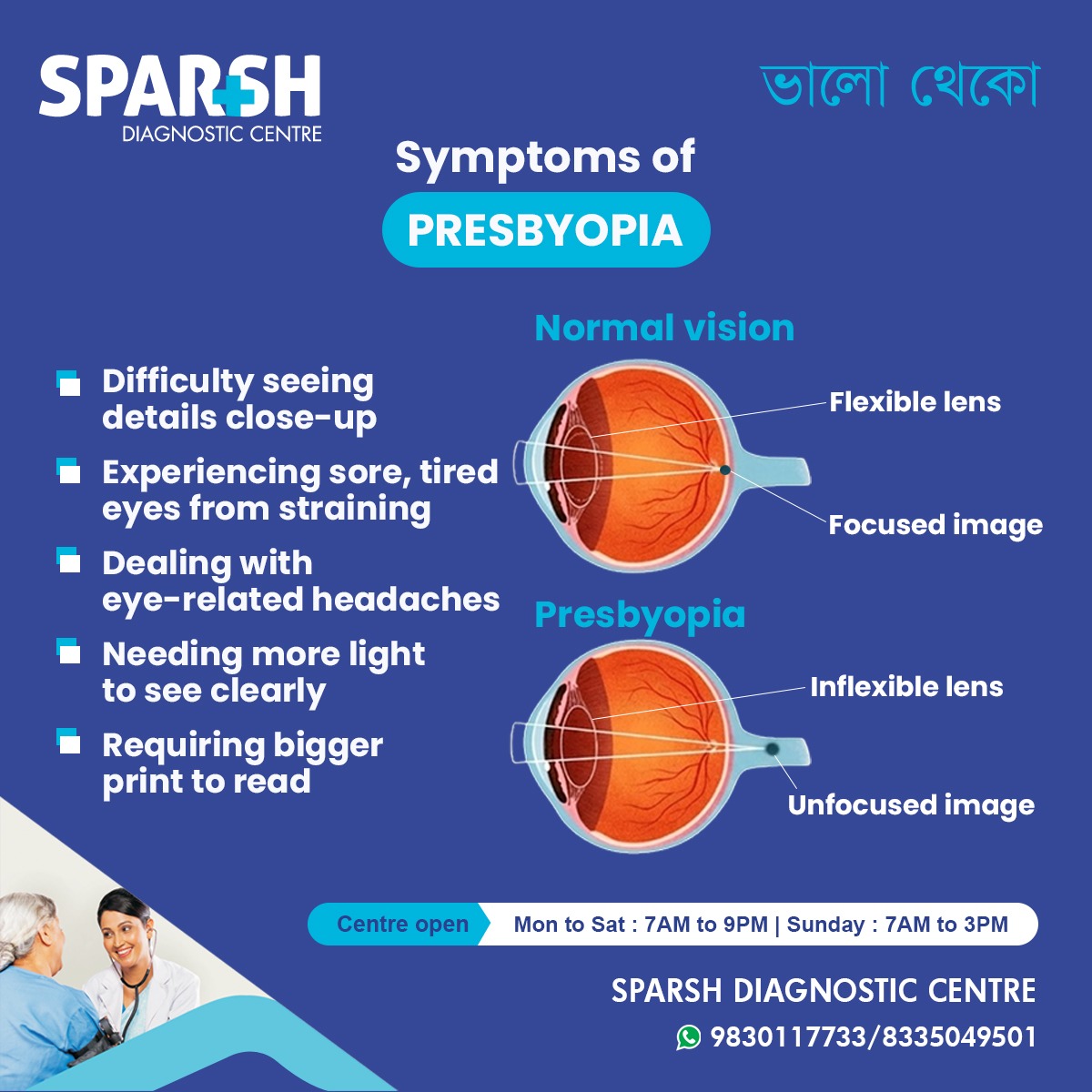
When you look at something far away, the eye’s focusing system is relatively relaxed. When you look at something close, a small muscle around the lens contracts and causes the lens to become more rounded. This process, called accommodation, allows the eye to focus clearly on nearby objects.
With age, the lens loses some of its flexibility. It becomes harder for the eye to change the lens shape sufficiently for close-up vision. Nearby objects therefore become increasingly difficult to see clearly.
Presbyopia generally develops gradually. Many people first notice it in their 40s, although the exact age varies from person to person.
What Is the Main Cause of Presbyopia?
The main cause of presbyopia is natural aging of the eye’s lens.
During childhood and early adulthood, the lens is relatively soft and flexible. It can change shape easily to focus on objects at different distances. As you age, the lens gradually becomes less elastic and less capable of changing shape.
The lens also continues to grow and develop additional layers over time, contributing to its increasing thickness and reduced flexibility. Eventually, the eye cannot accommodate enough to maintain clear focus on nearby objects.
Age is by far the most important risk factor. However, certain medical conditions and medications may be associated with presbyopia appearing earlier than usual. Diabetes, multiple sclerosis, cardiovascular disease and certain medicines, including some antihistamines and antidepressants, have been associated with premature presbyopia.
Unlike myopia, presbyopia is not primarily caused by the eyeball being too long or by an abnormal corneal shape. It is mainly related to the aging and loss of flexibility of the natural lens.
Symptoms of Presbyopia
Presbyopia usually develops slowly, so you may not immediately realize that your near vision is changing.
Common symptoms include:
- Difficulty reading small print
- Blurred vision when reading at a normal distance
- Holding books, newspapers or phones farther away
- Needing brighter light to read
- Eye strain after reading or doing close-up work
- Headaches after prolonged near work
- Difficulty focusing when switching between near and distant objects
- Increasing the font size on phones and computers to see comfortably
One of the classic early signs is holding reading material at arm’s length because it seems clearer at a greater distance.
These symptoms can sometimes be mistaken for simple eye fatigue. However, persistent changes in vision should not automatically be attributed to aging. An eye examination can determine whether presbyopia is responsible or whether another vision problem is present.
What Is Presbyopia and How Is It Corrected?
Presbyopia is the age-related loss of the eye’s ability to focus clearly on nearby objects. It is usually corrected by adding focusing power to compensate for the reduced ability of the natural lens to accommodate.
Reading glasses
Reading glasses are one of the simplest ways to correct presbyopia. They provide additional focusing power for close-up activities such as reading, sewing or using a phone.
Over-the-counter reading glasses may work well for some people, particularly those without significant differences between the two eyes or other refractive errors. A prescription may be preferable when you have myopia, hyperopia, astigmatism or different prescriptions in each eye.
Bifocal and progressive glasses
If you need correction for both distance and near vision, bifocal or progressive lenses may be more convenient.
Bifocals provide separate areas for distance and near vision, while progressive lenses provide a gradual transition between different viewing distances.
Contact lenses
Multifocal contact lenses can provide correction at different distances. Another approach is monovision, in which one eye is corrected primarily for distance and the other for near vision.
Not everyone adapts equally well to monovision, so an eye-care professional can help determine whether it is appropriate.
Prescription eye drops
Prescription eye drops are another treatment option for some adults with presbyopia. Certain drops temporarily make the pupil smaller, increasing the eye’s depth of focus and improving near vision.
These medications are not suitable for everyone and should be used only after discussing the potential benefits and risks with an eye-care professional.
Surgery
Selected patients may consider surgical approaches, including laser-based procedures or lens-based procedures. Presbyopia-correcting intraocular lenses may also be considered in certain circumstances, particularly when lens replacement is otherwise appropriate.
Surgery is not automatically the best choice for someone with presbyopia. The potential benefits, risks, visual expectations and alternatives should be discussed carefully with an ophthalmologist.
What Is Myopia and Presbyopia?
Myopia, also called nearsightedness, is a refractive error in which distant objects appear blurry while nearby objects can remain relatively clear. It commonly occurs when the eye is too long from front to back or when the cornea or lens causes light to focus in front of the retina.
Presbyopia, on the other hand, is an age-related loss of the eye’s ability to focus on nearby objects because the natural lens becomes less flexible.
The two conditions are therefore different, but a person can have both.
For example, someone who has worn glasses for myopia since childhood can still develop presbyopia as they get older. Their prescription may then need to address both distance vision and the additional focusing requirement for near vision.
Is Presbyopia the Same as Nearsightedness?
No. Presbyopia is not the same as nearsightedness.
Nearsightedness or myopia mainly affects distance vision. A person with myopia may see nearby objects reasonably well but struggle to see road signs, television screens or distant faces clearly without correction.
Presbyopia mainly affects near vision. Someone with presbyopia may see distant objects clearly but struggle to read a book, phone or menu at their usual reading distance.
The underlying causes are also different. Myopia is associated with the shape and length of the eye, while presbyopia results primarily from age-related changes in the flexibility of the natural lens.
It is possible to have both conditions at the same time.
Does Everyone Over 40 Have Presbyopia?
Not literally everyone develops noticeable symptoms immediately after turning 40.
Presbyopia is a normal age-related change and becomes extremely common with increasing age. Mayo Clinic notes that nearly everyone develops blurry near vision sometime after 40, while the National Eye Institute states that everyone develops presbyopia as they get older, usually after age 45.
The age at which symptoms become noticeable varies. Some people may notice difficulty reading in their early 40s, while others may not find it troublesome until later.
Your existing prescription can also influence how noticeable the change is. For example, a person with myopia may sometimes remove their distance glasses to read comfortably at close range, even after developing presbyopia.
So, while presbyopia is an expected part of aging, the experience is not identical for everyone.
Can Presbyopia Be Fully Corrected?
Presbyopia can usually be corrected very effectively, but correction is not the same thing as reversing the underlying aging process.
Glasses and contact lenses can compensate for the eye’s reduced ability to focus at close distances. Prescription eye drops may temporarily improve near vision for appropriate patients, and certain surgical procedures can reduce dependence on glasses in selected individuals.
However, conventional treatments do not make the natural aging lens young and flexible again.
For many people, reading glasses are all that is needed. Others may prefer progressive glasses, contact lenses or another treatment based on their lifestyle and visual requirements.
The best correction depends on factors such as your distance prescription, near vision needs, eye health, occupation and personal preferences.
Can You Reverse Presbyopia?
At present, there is no established way to reverse the natural aging process that causes presbyopia.
Presbyopia results from age-related changes in the eye’s focusing system, particularly the reduced flexibility of the natural lens. It cannot be prevented simply by exercising the eyes, changing reading habits or taking vitamins.
However, you can manage and correct presbyopia.
Using appropriate glasses or contact lenses can restore clear functional vision for reading and other close-up activities. Depending on the individual, prescription eye drops or surgical options may also be considered.
It is important to distinguish between improving vision and reversing presbyopia. Treatment can compensate for the loss of accommodation without necessarily restoring the original flexibility of the natural lens.
At What Age Does Presbyopia Stop Getting Worse?
Presbyopia generally progresses gradually for several years before eventually leveling off.
The National Eye Institute states that presbyopia usually stops getting worse after about age 65. Cleveland Clinic describes symptoms as beginning in the 40s and leveling off around the mid-60s.
This does not mean that everyone will suddenly have identical vision at 65. Your prescription can still change because of other eye conditions, cataracts, changes in the cornea or other refractive errors.
If your near vision suddenly changes or becomes significantly worse, it is worth having your eyes examined rather than assuming that presbyopia is the only explanation.
How Is Presbyopia Diagnosed?
Presbyopia can usually be identified during a comprehensive eye examination.
An eye-care professional may assess your vision at different distances and perform refraction testing to determine whether you have presbyopia, myopia, hyperopia or astigmatism.
A proper eye examination is particularly important if your vision has changed recently. Blurry vision can have many causes, and not every change in near vision is due to presbyopia.
When Should You See an Eye Doctor?
Make an appointment with an eye-care professional if near vision problems are interfering with reading, computer work, driving or everyday activities.
You should seek urgent medical attention for sudden vision changes, particularly sudden loss of vision, sudden severe blurring, flashes of light, new black spots or floaters, halos or double vision. These symptoms can sometimes indicate conditions that require prompt evaluation.
Even when your symptoms seem typical of presbyopia, regular eye examinations remain important because age-related eye diseases can occur alongside normal changes in near vision.
Living With Presbyopia
For most people, presbyopia is manageable and does not prevent them from maintaining an active lifestyle.
Simple adjustments can make close-up work more comfortable, especially during the early stages. Increasing the font size on digital devices, using adequate lighting and taking regular breaks during prolonged near work may reduce eye strain.
Once these measures are no longer enough, properly prescribed reading glasses, progressive lenses or contact lenses can make a significant difference.
The important point is that needing reading glasses is not a sign that your eyes are “weak.” Presbyopia is a normal consequence of aging and can affect people who have had excellent vision throughout their lives.
Frequently Asked Questions About Presbyopia
1. What is the main cause of presbyopia?
The main cause is age-related loss of flexibility of the natural lens inside the eye. As the lens becomes harder and less flexible, it becomes increasingly difficult to change shape and focus on nearby objects.
2. What is presbyopia and how is it corrected?
Presbyopia is an age-related loss of near-focusing ability. It is commonly corrected with reading glasses, bifocals, progressive lenses or contact lenses. Some adults may also be candidates for prescription eye drops or surgical treatments.
3. What is myopia and presbyopia?
Myopia is nearsightedness, which mainly causes blurred distance vision. Presbyopia is an age-related reduction in near-focusing ability. A person can have both conditions at the same time.
4. Is presbyopia the same as nearsightedness?
No. Myopia causes difficulty seeing distant objects clearly, whereas presbyopia causes difficulty focusing on nearby objects. They have different causes, although both can occur in the same person.
5. Can presbyopia be fully corrected?
Presbyopia can usually be corrected effectively for functional vision, but conventional treatments do not reverse the age-related changes in the natural lens. Glasses, contact lenses, prescription drops and selected surgical treatments can improve near vision.
6. Does everyone over 40 have presbyopia?
Presbyopia is extremely common with age, but noticeable symptoms do not necessarily begin at exactly 40. Many people develop symptoms after 40, and the National Eye Institute describes it as something everyone develops as they get older, usually after 45.
7. Can you reverse presbyopia?
There is currently no established method that reverses the underlying age-related loss of lens flexibility. However, several treatments can compensate for the change and restore useful near vision.
8. At what age does presbyopia stop getting worse?
Presbyopia generally levels off around the mid-60s. The National Eye Institute states that it usually stops worsening after about age 65.
Final Thoughts
Presbyopia is a natural part of aging, not a disease. If reading small print has become harder, you need more light to see clearly, or you find yourself holding your phone farther away, presbyopia may be the reason.
Although it cannot currently be reversed, it can be corrected very effectively. The right solution may be as simple as reading glasses, or you may benefit from prescription lenses, contact lenses or other treatments depending on your individual needs.
If you notice a change in your near vision, a comprehensive eye examination is the best way to confirm whether presbyopia is responsible and make sure there is no other underlying eye problem.
#BhaloTheko
Disclaimer:
No content on this site, regardless of date, should ever be used as a substitute for direct medical advice from your doctor or other qualified clinician.


