

Handwriting is something most of us take for granted. For many children and adults, however, writing is not just a skill but a daily struggle. Dysgraphia, a neurological learning disorder, affects writing abilities and makes it hard for individuals to express their thoughts on paper. Unlike simply having “bad handwriting,” dysgraphia can significantly impact a person’s academic performance, self-esteem, and overall communication.
This article takes an in-depth look at the condition — its causes, symptoms, diagnosis, and evidence-based strategies for support. Whether you are a parent, teacher, or healthcare provider, understanding dysgraphia is the first step in helping individuals reach their full potential.
What is Dysgraphia?
It is a learning disability that specifically affects writing abilities. It impairs fine motor skills, making it difficult for individuals to form letters, spell words, or express ideas through writing. People with dysgraphia may have legible handwriting at times, but it often appears inconsistent, messy, or slow.
It is important to note that dysgraphia is not related to intelligence. Many individuals with the condition are bright and creative but struggle to communicate effectively in written form.
Types of Dysgraphia
Researchers categorize dysgraphia into different types, depending on the root cause:
Dyslexic – Writing is illegible, spelling is poor, but copying text may be relatively better.
Motor – Caused by poor fine motor skills; handwriting is slow, laborious, and often painful.
Spatial – Difficulty with spatial awareness and alignment, leading to inconsistent spacing and poorly organized writing.
Understanding the type can help tailor specific support strategies.
Causes of Dysgraphia
The exact cause is not always clear, but it is believed to stem from neurological differences affecting writing-related brain functions. Some contributing factors include:
Neurological differences: Brain imaging shows variations in the areas controlling fine motor skills and written language.
Genetics: Learning disabilities, including dysgraphia, often run in families.
Developmental delays: Delays in motor skill development may contribute to dysgraphia.
Coexisting conditions: Dysgraphia frequently co-occurs with ADHD, dyslexia, and other learning disabilities.
Symptoms of Dysgraphia
Symptoms of dysgraphia vary by age, but some common signs include:
In Children:
Difficulty forming letters and numbers
Holding a pencil awkwardly or with great effort
Inconsistent spacing between words and letters
Mixing upper- and lower-case letters
Writing that is slow, labored, and painful
Trouble with grammar, punctuation, and sentence structure
Avoidance of writing tasks
In Adults:
Illegible handwriting despite practice
Difficulty organizing written thoughts
Frequent spelling errors
Trouble with signature consistency
Reliance on typing instead of handwriting
Dysgraphia vs. Dyslexia
While dysgraphia affects writing, dyslexia primarily impacts reading. However, the two often overlap. A child may struggle to read due to dyslexia and then face additional writing challenges because of dysgraphia. Identifying both conditions early is essential to ensure appropriate interventions.
How is Dysgraphia Diagnosed?
Diagnosing dysgraphia requires a comprehensive evaluation by specialists, such as educational psychologists, neurologists, or occupational therapists.
Steps in Diagnosis:
Developmental history – Reviewing medical, educational, and family background.
Cognitive and academic testing – Assessing reading, spelling, and writing abilities.
Motor skills assessment – Evaluating fine motor control, pencil grip, and coordination.
Writing samples – Analyzing handwriting, spelling, grammar, and organization.
Early diagnosis can prevent frustration, low self-esteem, and academic struggles.
Support Strategies for Dysgraphia
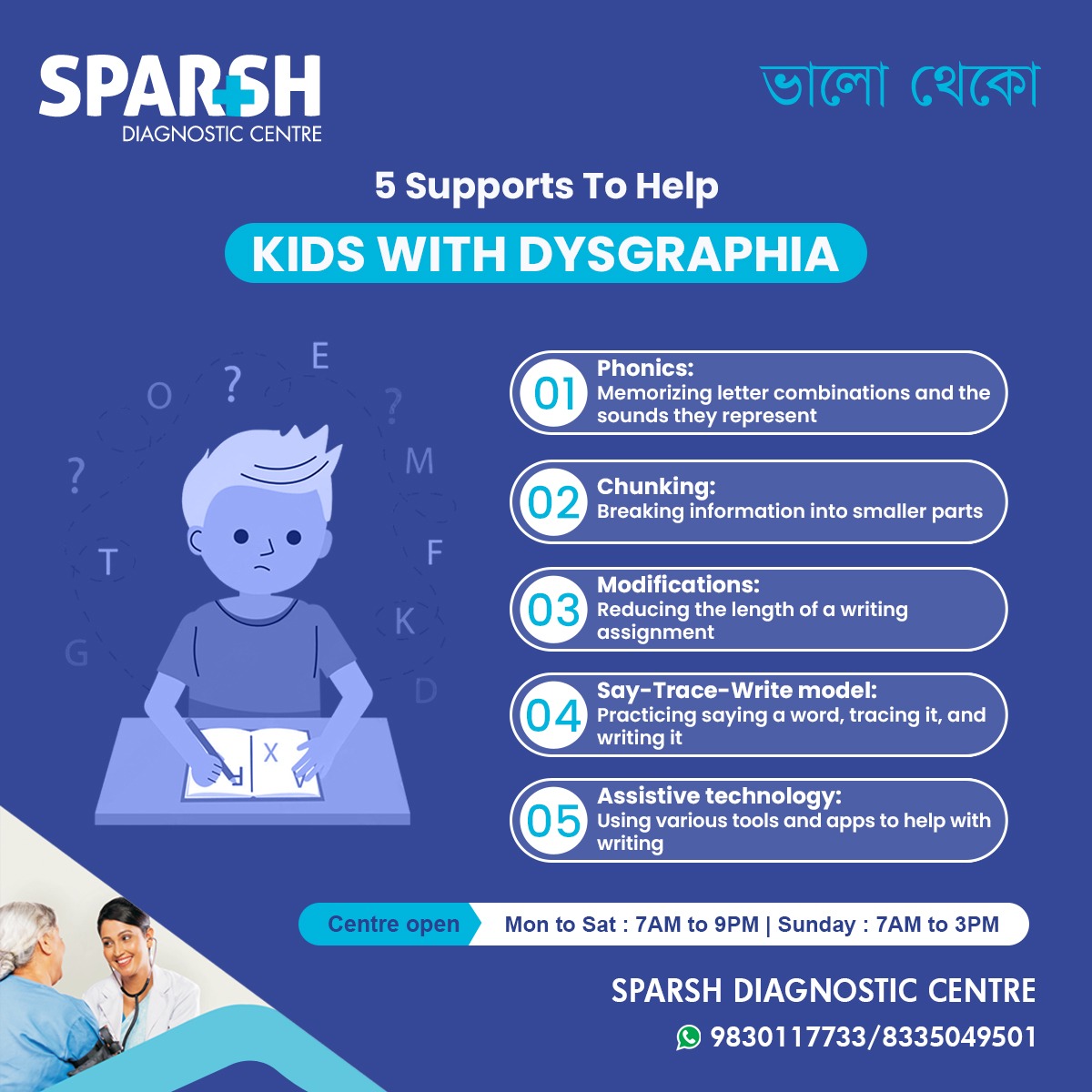
Helping children and adults with dysgraphia involves a combination of educational techniques, therapies, and assistive technology. Below are five key strategies highlighted in the Sparsh Diagnostic Centre awareness campaign:
1. Phonics
Memorizing letter combinations and their sounds helps individuals build stronger spelling and word formation skills. Phonics-based instruction reinforces the connection between spoken and written language.
2. Chunking
Breaking information into smaller, manageable parts reduces cognitive overload. For example, instead of writing an entire paragraph, a child may focus on one sentence at a time.
3. Modifications
Teachers and parents can reduce the length of writing assignments, allowing students to demonstrate knowledge without being overwhelmed by handwriting demands.
4. Say–Trace–Write Model
This technique involves practicing by saying a word, tracing it, and then writing it independently. It reinforces memory through multiple sensory channels — auditory, visual, and kinesthetic.
5. Assistive Technology
Technology offers powerful support for dysgraphia:
Speech-to-text software
Typing instead of handwriting
Spell-check and grammar tools
Graphic organizers to structure ideas
Classroom Strategies for Teachers
Teachers play a vital role in supporting students with dysgraphia. Some effective accommodations include:
Allowing oral responses instead of written ones
Providing printed notes or outlines
Allowing extra time for assignments and exams
Encouraging typing on laptops or tablets
Using lined or graph paper for better alignment
Therapies for Dysgraphia
Several therapies can improve writing abilities and fine motor control:
Occupational Therapy – Improves pencil grip, hand strength, and motor skills.
Cognitive Behavioral Therapy (CBT) – Helps manage anxiety and frustration related to writing tasks.
Multisensory Instruction – Combines sight, sound, and movement to strengthen learning.
Living with Dysgraphia
Living with dysgraphia can be challenging, but with the right strategies, individuals can thrive academically and professionally. Building confidence is just as important as improving writing skills. Parents and educators should focus on strengths, such as creativity, problem-solving, and verbal communication, while supporting areas of difficulty.
Future Outlook
Awareness of dysgraphia is growing, and with modern tools like assistive technology and early intervention programs, individuals can overcome barriers to writing. The future is promising for children diagnosed early, as they can adapt and succeed in school and beyond.
FAQ on Dysgraphia
Q1. What is dysgraphia in simple terms?
Dysgraphia is a learning disability that makes writing difficult. It affects handwriting, spelling, and the ability to organize written thoughts.
Q2. Is it the same as bad handwriting?
No. Dysgraphia is more than poor handwriting — it is a neurological condition that affects the brain’s ability to process writing tasks.
Q3. Can it be cured?
There is no “cure,” but with therapies, teaching strategies, and technology, individuals with dysgraphia can significantly improve their writing skills and academic performance.
Q4. How is it treated?
Treatment involves occupational therapy, specialized teaching strategies, and assistive technology. Supportive learning environments are also critical.
Q5. Does it affect reading?
Dysgraphia primarily affects writing, but some individuals may also struggle with reading, especially if they have coexisting dyslexia.
Q6. At what age can it be diagnosed?
Dysgraphia is usually diagnosed in early elementary school when children begin writing, but it can also be identified in teenagers or adults.
Q7. What careers are suitable for people with the condition?
Individuals with dysgraphia can succeed in any field, especially those that don’t rely heavily on handwriting, such as technology, art, design, entrepreneurship, and public speaking.
Dysgraphia is a lifelong condition, but it does not define an individual’s potential. With early diagnosis, appropriate support strategies, and the use of assistive technology, children and adults with dysgraphia can thrive. Awareness, patience, and encouragement from parents, teachers, and healthcare professionals are key to helping individuals succeed despite writing challenges.
By recognizing strengths and providing structured support, society can ensure that people with dysgraphia achieve academic success and live fulfilling lives.
#BhaloTheko
Disclaimer:
No content on this site, regardless of date, should ever be used as a substitute for direct medical advice from your doctor or other qualified clinician.





[…] 3. Dysgraphia […]