If your urine stream has become weaker, you need to strain to urinate, or you feel that your bladder is not emptying properly, your doctor may recommend a uroflowmetry test. It is a simple, painless test that measures how quickly and how much urine you pass.
Unlike a routine urine test, uroflowmetry does not analyse the urine itself. Instead, it looks at how your bladder empties. The test records your urine flow rate, the amount of urine passed and the pattern of urination. This information can help a doctor identify possible urinary obstruction, bladder weakness or other problems affecting the lower urinary tract.
Uroflowmetry is particularly useful in men with urinary symptoms associated with an enlarged prostate, but it can also be performed in women and children.
For people searching for a uroflowmetry test in Kolkata, understanding what the numbers mean can be just as important as having the test. There is no single “normal” number that applies to everyone. Age, sex, the amount of urine in the bladder and the shape of the flow curve all matter.
What is uroflowmetry?
Uroflowmetry, sometimes called a uroflow test or urine flow test, is a non-invasive investigation that measures the rate at which urine leaves the bladder.
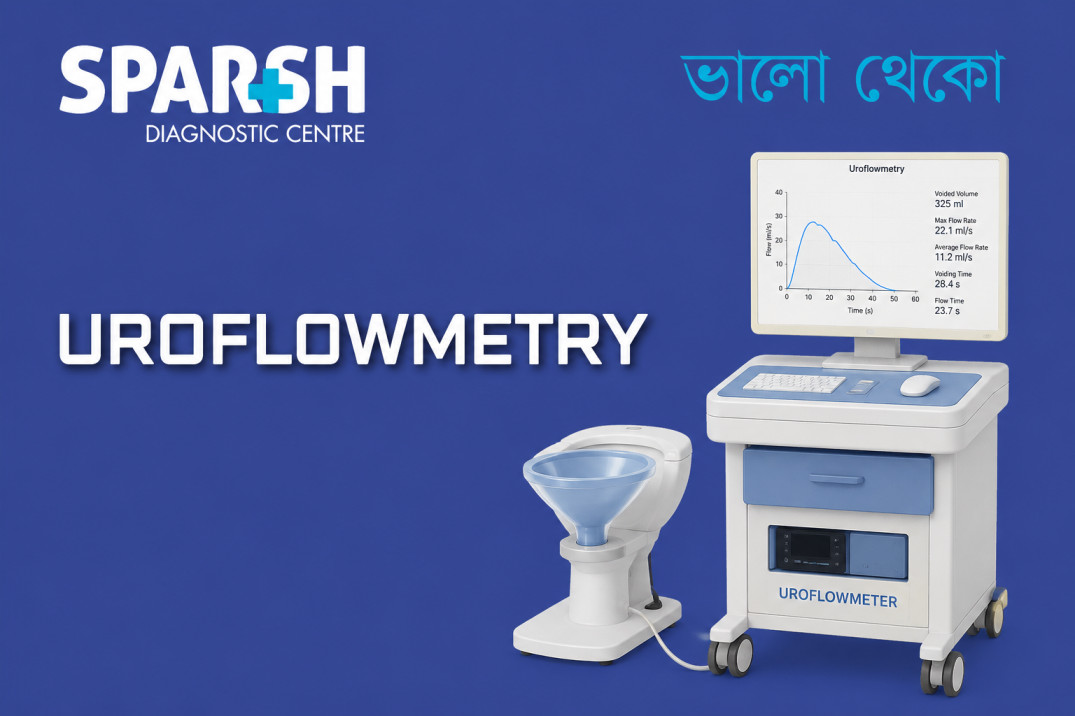
The test is performed using a special uroflowmeter. Instead of urinating into an ordinary toilet, you urinate into a funnel or specially designed collection device connected to the machine.
The equipment records several measurements, including:
- Qmax: the maximum or peak urine flow rate
- Qavg: the average urine flow rate
- Voided volume: the total amount of urine passed during the test
- Flow time: how long urine actually flows
- Voiding time: the overall time taken to complete urination
- Flow curve: the pattern of urine flow throughout the void
The result is usually displayed as a graph. A healthy urine stream generally rises, reaches a peak and then gradually falls. A flattened, prolonged or interrupted curve can sometimes suggest a problem, although the graph must always be interpreted alongside the patient’s symptoms and medical history.
Uroflowmetry is painless and does not require a catheter, injections or anaesthesia.

Why is a uroflowmetry test done?
Your doctor may recommend uroflowmetry if you have symptoms suggesting that urine is not leaving the bladder normally.
Common reasons include:
- Weak urine stream
- Difficulty starting urination
- Straining to pass urine
- Interrupted urine flow
- Taking a long time to urinate
- Feeling that the bladder has not emptied completely
- Frequent urination
- Urgency to urinate
- Getting up repeatedly at night to urinate
- Dribbling after urination
- Suspected enlarged prostate
- Suspected urethral narrowing or stricture
- Bladder muscle weakness
- Follow-up after treatment for a urinary problem
The test can also be used to monitor whether treatment has improved urinary flow.
Importantly, uroflowmetry does not by itself diagnose the exact cause of a weak stream. A low flow rate may occur because of an obstruction, reduced bladder muscle strength, an inadequate bladder volume during testing or other factors.
How is uroflowmetry performed?
The test itself is usually very straightforward.
You will generally be asked to arrive with a comfortably full bladder. When you are ready, the technician will direct you to a private area containing the uroflowmeter.
You simply urinate normally into the device.
There is no need to push, strain or deliberately make the stream faster. In fact, trying to “perform well” during the test can make the result less representative of your usual urination.
The machine automatically records your urine volume, flow rate and timing and produces a flow curve for interpretation.
Afterwards, your doctor may combine the result with other investigations, such as a urine test, ultrasound, post-void residual urine measurement or prostate assessment, depending on your symptoms.
What are normal uroflowmetry results?
This is one of the most important points to understand: there is no single uroflowmetry number that is normal for everybody.
Peak flow rate, or Qmax, tends to decrease with age and is also strongly affected by the amount of urine passed during the test.
For example, research involving more than 1,000 healthy people in India found that healthy adult men aged 16–50 had an average maximum flow rate of approximately 22.5 mL/s, while men over 50 had an average Qmax of about 17 mL/s. The same study showed that urine flow varies with both age and voided volume.
As a broad clinical reference, a Qmax above about 15 mL/s is often reassuring in adult men, while values below 10 mL/s may raise concern for obstruction or impaired bladder contraction. However, these numbers should not be treated as a diagnosis by themselves.
A reliable interpretation considers:
- Your age
- Your sex
- Voided urine volume
- Qmax
- Qavg
- Flow curve
- Symptoms
- Post-void residual urine
- Prostate and urethral findings where relevant
Some guidelines also emphasise that a very small voided volume can make interpretation less reliable.
What is a normal uroflowmetry result?
A normal result generally means that urine passes at an appropriate rate for your age and sex, with a reasonably shaped flow curve and without evidence suggesting significant obstruction or poor bladder emptying.
It is therefore better to think of a normal uroflowmetry result as a pattern rather than a single number.
For example, someone with a Qmax of 14 mL/s may not necessarily have a serious problem, while someone with a Qmax of 18 mL/s could still have urinary symptoms that require further investigation.
What is a normal male urine flow rate?
For adult men, a commonly used reference point is a peak urine flow rate of around 15 mL/s or higher, although healthy younger men can have considerably higher values.
An Indian study found an average Qmax of approximately 22.5 mL/s in healthy men aged 16–50 and approximately 17 mL/s in men over 50.
This is why age matters when interpreting uroflowmetry.
A man in his 30s may naturally have a considerably faster stream than a man in his 70s. A lower flow in an older man is not automatically abnormal, but a significant reduction accompanied by difficulty urinating, straining or incomplete emptying deserves medical assessment.
What is the average urine flow rate for a 70-year-old?
There is no universally applicable “normal” flow rate specifically for every 70-year-old man.
However, age-related studies show that Qmax generally declines as men get older. In a large population study, the mean Qmax for men aged 70–79 was approximately 14.1 mL/s.
An Indian study of healthy men over 50 found a mean Qmax of approximately 17 mL/s, with a median age of 67 years.
These figures should be used as reference information rather than a pass/fail test.
For a 70-year-old man, a Qmax around 14–17 mL/s may be seen in healthy populations, but the result needs to be interpreted in relation to the amount of urine passed and the person’s symptoms.
If a 70-year-old suddenly develops a much weaker stream, has difficulty starting urination, strains frequently or feels unable to empty the bladder, a urological evaluation is appropriate.
What can cause a low uroflowmetry result?
A low Qmax can have several possible explanations.
Enlarged prostate
Benign prostatic hyperplasia, or BPH, is common as men age. An enlarged prostate can narrow the passage through which urine leaves the bladder and reduce urine flow.
Urethral stricture
A narrowing of the urethra can restrict urine flow. Previous infections, trauma, instrumentation or certain medical procedures can sometimes contribute to urethral strictures.
Weak bladder muscle
The bladder muscle needs to contract effectively to push urine out. If it becomes weak, the urine stream may become slow.
Neurological conditions
Conditions affecting the nerves controlling the bladder can interfere with normal urination.
Small voided volume
If there is not enough urine in the bladder when the test is performed, the result may not accurately represent your usual maximum flow.
Anxiety or an unfamiliar environment
Some people find it difficult to urinate normally in a clinical setting. This can affect the test and is another reason doctors consider the complete clinical picture rather than one number.
What are the symptoms of weak urine flow?
Weak urine flow does not always feel the same for everyone.
Common symptoms include:
- A thin or weak stream
- Taking longer than usual to urinate
- Difficulty getting the stream started
- Having to strain or push
- Urine stopping and starting
- Dribbling at the end
- Feeling that the bladder has not emptied
- Needing to urinate again shortly after finishing
- Frequent urination, particularly at night
- Urgency
- A progressively weaker stream over months or years
A gradually weakening stream in an older man can be associated with prostate enlargement, but it should not automatically be blamed on ageing.
How much water should you drink for uroflowmetry?
The goal is not to drink as much water as possible. You need a comfortably full bladder, not an painfully overfilled one.
Preparation instructions vary between centres, so follow the instructions provided when you book your test.
In general, drinking water before the appointment and avoiding urinating immediately beforehand may help you arrive with an adequately full bladder. Some uroflowmetry protocols advise patients to drink a specified amount of water and wait for the bladder to fill.
Do not force yourself to drink excessive quantities of water. Overhydration can make you uncomfortably full and may cause urgency before the test.
For the most accurate result, tell the technician if you were unable to follow the preparation instructions or if you could only pass a very small amount of urine.
How to improve uroflowmetry?
If your uroflowmetry result is low, the answer is not necessarily to find a drink or home remedy that makes urine flow faster.
The best way to improve urine flow is to identify and treat the reason for the reduced flow.
Depending on the cause, treatment may involve:
- Adequate hydration
- Treating a urinary infection
- Managing constipation
- Reviewing medications that affect urination
- Treatment for an enlarged prostate
- Treatment of a urethral stricture
- Bladder training where appropriate
- Pelvic floor therapy in selected cases
- Treatment of neurological bladder problems
- A urological procedure when a significant obstruction is present
If prostate enlargement is responsible, a urologist may recommend medication or, in selected cases, a procedure to improve the urinary passage.
Simply drinking more water does not remove a prostate obstruction or urethral stricture.
What to drink to improve urine flow?
Plain water is generally the best drink for maintaining adequate hydration.
There is no specific juice, tea or beverage proven to permanently increase urine flow when the underlying problem is obstruction.
If dehydration is making your urine concentrated and reducing your urinary output, drinking an appropriate amount of water may help restore normal hydration.
On the other hand, excessive caffeine, alcohol and certain beverages may worsen urgency or frequency in some people.
If you have kidney, heart or liver disease and have been advised to restrict fluids, do not increase your water intake without discussing it with your doctor.
What is the best remedy for urine flow?
There is no single best remedy for weak urine flow because the cause matters.
For example:
- Dehydration: adequate fluid intake may help.
- BPH: prostate-directed treatment may improve flow.
- Urethral stricture: a urologist may need to treat the narrowing.
- Urinary infection: appropriate medical treatment is required.
- Bladder muscle dysfunction: the treatment is different again.
If weak flow persists, especially if it is worsening, the most useful next step is evaluation rather than repeatedly trying home remedies.
How much urine is normal in 24 hours?
For many healthy adults, daily urine output is roughly 800–2,000 mL in 24 hours, although it varies according to fluid intake, weather, sweating, diet, medications and health conditions.
A person who drinks more fluids will generally produce more urine. Someone who sweats heavily on a hot Kolkata summer day may produce less urine despite drinking a reasonable amount.
Very low urine output, particularly when accompanied by thirst, dizziness, swelling or illness, should be discussed with a doctor.
Similarly, unusually high urine output may require investigation, particularly if it occurs with excessive thirst, weight changes or frequent nighttime urination.
Is urinating every 2 hours normal?
For many adults, urinating every two to four hours can fall within a normal pattern, depending on how much fluid they drink.
Urinating every two hours is therefore not automatically abnormal.
However, frequency becomes more important when it is a new change or occurs alongside:
- Burning while urinating
- Urgency
- Weak stream
- Difficulty starting
- Blood in urine
- Pelvic pain
- Excessive thirst
- Nighttime urination
- Incomplete bladder emptying
Caffeine, alcohol, high fluid intake, diabetes, urinary infections and overactive bladder are among the possible causes of frequent urination.
What is the “21-second pee rule”?
You may have seen the 21-second pee rule online, which suggests that most mammals should take around 21 seconds to urinate.
It is an interesting observation, but it is not a recognised medical rule for diagnosing normal or abnormal urination in humans.
Urination time varies substantially according to bladder volume, fluid intake, age, sex, bladder function and urinary tract anatomy.
You should not try to make yourself urinate for exactly 21 seconds or use the duration alone to decide whether your urinary system is healthy.
A uroflowmetry test provides much more useful information because it objectively measures urine volume and flow rate.
How should you prepare for a uroflowmetry test?
Preparation is usually simple.
Before the test
- Follow the centre’s instructions regarding fluid intake.
- Arrive with a comfortably full bladder.
- Avoid urinating immediately before the test unless instructed otherwise.
- Take your regular medications unless your doctor tells you not to.
- Tell the technician about significant urinary symptoms.
- Bring previous reports if the test is being performed as part of an ongoing urological evaluation.
During the test
Urinate normally.
Do not:
- Strain
- Push
- Stop and restart intentionally
- Try to make the stream faster
- Try to “perform” for the machine
The objective is to record your usual urinary pattern.
Is uroflowmetry painful?
No. Uroflowmetry is a non-invasive and painless investigation.
You simply urinate into the measuring device. There is normally no catheter, needle or anaesthesia involved.
This makes it particularly useful as an initial assessment for people experiencing lower urinary tract symptoms.
Uroflowmetry test cost in Kolkata
The uroflowmetry test cost in Kolkata varies between diagnostic centres and hospitals.
Current online listings show prices ranging from approximately ₹900 to ₹1,500, depending on the facility and booking route. One Kolkata listing currently shows ₹900, while another citywide price service lists ₹1,350 as a current Kolkata price.
The exact price may change depending on:
- Diagnostic centre
- Location
- Whether a urologist consultation is included
- Whether uroflowmetry is part of a prostate or urinary package
- Additional tests such as ultrasound or post-void residual measurement
If you are looking specifically for a uroflowmetry test in Kolkata, it is sensible to confirm the current price and preparation instructions with the diagnostic centre before visiting.
Where can you get uroflowmetry in Kolkata?
Uroflowmetry is available at selected diagnostic centres, hospitals and urology facilities across Kolkata.
For patients in South Kolkata, Sparsh Diagnostic Centre in Bansdroni provides uroflowmetry as part of its urology diagnostic services and has consultant urologists available through its urology department.
The centre is located at 231/1, NSC Bose Road, Bansdroni, Kolkata – 700047. Its published contact numbers are 9830117733 and 8335049501.
If you are experiencing persistent urinary symptoms, combining uroflowmetry with a consultation can be more useful than interpreting the flow-rate number on its own.
When should you see a urologist?
A weak urine stream that occurs once or twice may not be significant. A persistent or progressively worsening change deserves attention.
You should consider seeing a urologist if you have:
- Persistent weak urine flow
- Difficulty starting urination
- Repeated straining
- Frequent nighttime urination
- A feeling of incomplete bladder emptying
- Recurrent urinary infections
- Blood in the urine
- Painful urination
- Urinary retention
- Repeatedly abnormal uroflowmetry results
Sudden inability to pass urine despite a strong urge is an emergency and requires prompt medical attention.
Uroflowmetry: the key numbers at a glance
| Measurement | What it tells you |
|---|---|
| Qmax | Fastest point of urine flow |
| Qavg | Average flow rate throughout urination |
| Voided volume | Total amount of urine passed |
| Flow time | Duration of actual urine flow |
| Voiding time | Overall time taken to complete urination |
| Flow curve | Pattern of urine flow |
The most important number is often Qmax, but it should never be interpreted in isolation. Indian research has demonstrated that both age and voided volume significantly influence uroflowmetry measurements.
Frequently asked questions about uroflowmetry
What are normal uroflowmetry results?
A normal result depends on age, sex and voided volume. In adult men, a Qmax above approximately 15 mL/s is commonly considered reassuring, but healthy younger men may have much higher values. The complete flow curve and clinical symptoms are also important.
What is a normal male urine flow rate?
A Qmax of around 15 mL/s or higher is commonly used as a general adult male reference, but there is considerable individual variation. Healthy younger men may have Qmax values above 20 mL/s.
What is the average urine flow rate for a 70-year-old?
There is no single normal value. Population data suggest that men aged 70–79 have a mean Qmax of approximately 14.1 mL/s, although individual results vary substantially.
How much water should I drink for uroflowmetry?
Drink enough to arrive with a comfortably full bladder, following the instructions provided by your diagnostic centre. Do not deliberately overdrink large amounts of water.
How much urine is normal in 24 hours?
Approximately 800–2,000 mL per day is a commonly used adult range, but actual urine production varies with hydration, climate, diet, medications and health.
What should I drink to improve urine flow?
Plain water is generally the best choice for maintaining hydration. However, drinking more water will not correct structural problems such as an enlarged prostate or urethral stricture.
What is the best remedy for weak urine flow?
The best treatment depends on the cause. Persistent weak flow should be evaluated rather than treated solely with home remedies.
What are the symptoms of weak urine flow?
A thin stream, difficulty starting, straining, interrupted flow, prolonged urination, terminal dribbling and incomplete bladder emptying are common symptoms.
Is urinating every 2 hours normal?
It can be normal, especially if you drink substantial amounts of fluid. It becomes more concerning when it is a new change or occurs with urgency, burning, weak flow, pain or excessive thirst.
What is the 21-second pee rule?
The 21-second rule is an internet observation rather than a recognised clinical standard. Urination time varies considerably between individuals and should not be used alone to diagnose a urinary problem.
Can uroflowmetry diagnose an enlarged prostate?
Uroflowmetry can show reduced urinary flow that may occur with prostate enlargement, but it cannot by itself confirm BPH. Doctors may combine it with examination, prostate assessment, ultrasound, post-void residual measurement and other investigations.
Is a low Qmax always a sign of blockage?
No. A low Qmax can occur because of obstruction, weak bladder contraction, inadequate voided volume or other factors. The result must be interpreted in context.
Is uroflowmetry safe?
Yes. It is a non-invasive, painless test that simply measures urination using a specialised device.
Take control of urinary symptoms with the right test
A weak urine stream is easy to dismiss as “just ageing”, especially in older men. But persistent changes in urination can sometimes indicate prostate enlargement, urethral narrowing, bladder dysfunction or another treatable condition.
Uroflowmetry provides an objective measurement of how urine is leaving your bladder. When interpreted alongside your symptoms and other investigations, it can help your doctor decide what should happen next.
If you are looking for a uroflowmetry test in Kolkata, Sparsh Diagnostic Centre offers uroflowmetry and urology diagnostic services in Bansdroni, along with access to consultant urologists.
To enquire about uroflowmetry or book an appointment at Sparsh Diagnostic Centre, Kolkata, call 9830117733 or 8335049501.
Early evaluation is often the simplest way to understand why your urine flow has changed — and whether anything needs to be treated.
To consult a Doctor or get full body check-up done at Sparsh Diagnostic Centre, call our helpline numbers 9830117733/ 8335049501.
#BhaloTheko
Medically reviewed by: Dr. Soumen Saha, MBBS, DNB (Gen. Surg.), MCh (Urology)
Speciality: Consultant Urologist
Reviewed on: 28 August 2026
This article has been medically reviewed by Dr. Soumen Saha, a qualified urologist, for medical accuracy, clinical relevance and clarity. The information has been reviewed to ensure that it provides reliable and easy-to-understand information about uroflowmetry, its purpose, procedure, results and clinical significance.
About the medical reviewer:
Dr. Soumen Saha is a qualified Urologist & Andrologist with an MBBS, DNB in General Surgery and MCh. in Urology. He has expertise in the evaluation and management of urological and kidney conditions and urinary problems.
Disclaimer:
No content on this site, regardless of date, should ever be used as a substitute for direct medical advice from your doctor or other qualified clinician.