


A painful spot inside the mouth can make something as simple as eating, drinking or brushing your teeth surprisingly uncomfortable. Mouth sores are common and can appear on the tongue, gums, inside the cheeks, lips or other parts of the mouth. Some are short-lived and harmless, while others may point to an infection, nutritional deficiency, medication reaction or an underlying medical condition.
The important thing is not to assume that every mouth sore is a simple mouth ulcer. A canker sore, cold sore, oral thrush, traumatic sore, gingivitis and conditions such as oral lichen planus can look quite different and may require different treatment.
Most minor sores improve within 1–2 weeks, but a sore that persists, repeatedly returns, becomes increasingly painful or is accompanied by other symptoms should be evaluated by a doctor or dentist.
What are mouth sores?
Mouth sores are painful, irritated or abnormal areas affecting the tissues inside or around the mouth. They can range from a small, shallow ulcer to blisters, white patches, red inflamed areas or cracks at the corners of the mouth.
Common examples include:
- Canker sores or aphthous ulcers
- Cold sores or fever blisters
- Traumatic sores caused by biting or sharp teeth
- Oral thrush
- Tongue ulcers
- Gum sores associated with gingivitis
- Angular cheilitis
- Leukoplakia
- Oral lichen planus
- Herpetic sores
- Mouth sores associated with viral infections
The appearance alone does not always tell you the exact cause. A healthcare professional may need to consider your symptoms, medications, diet, dental history and other health conditions.
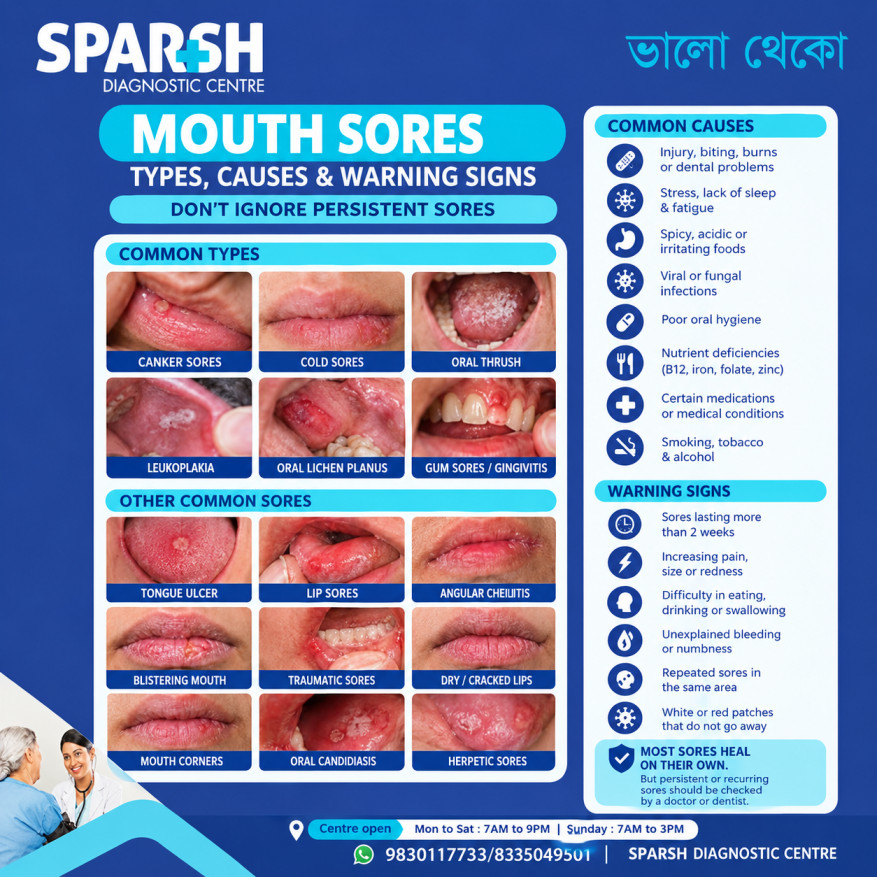
What is the reason for mouth sores?
There isn’t one single reason for mouth sores. The cause can range from something as simple as accidentally biting the inside of your cheek to an infection or nutritional deficiency.
Some of the most common causes include:
Injury or irritation
Minor trauma is one of the most frequent explanations for a mouth sore. You may develop a sore after:
- Biting your cheek, lip or tongue
- Eating very hot food
- Eating hard or sharp foods
- Brushing too aggressively
- Wearing poorly fitting dentures
- Having braces rub against the mouth
- Having a sharp or broken tooth
- Having an irritating dental filling
Repeated irritation can prevent the area from healing properly.
Canker sores
Canker sores, also called aphthous ulcers, are usually small, round or oval sores with a white or yellowish centre and a red border. They generally occur inside the mouth and are not contagious.
Their exact cause isn’t completely understood. Stress, hormonal changes, minor injury, certain foods and nutritional deficiencies may contribute to recurrent episodes.
Viral infections
Some viruses can produce painful sores in the mouth. Herpes simplex virus can cause cold sores, while infections such as hand, foot and mouth disease can produce mouth lesions, particularly in children.
Cold sores are contagious, especially when blisters or active lesions are present.
Fungal infections
Oral thrush is caused by an overgrowth of Candida yeast. It can cause creamy white patches, soreness, burning and discomfort while eating or swallowing. Risk can be higher with factors such as antibiotic use, dry mouth or a weakened immune system.
Nutritional deficiencies
Deficiencies of nutrients such as vitamin B12, folate, iron and zinc may be associated with recurrent mouth ulcers. This does not mean every mouth sore is caused by a vitamin deficiency, but recurrent or unexplained sores may warrant evaluation for nutritional problems.
Medical conditions
Persistent or recurrent mouth sores can sometimes occur alongside conditions such as celiac disease, Crohn’s disease, ulcerative colitis, Behçet disease, autoimmune disorders and certain immune-system problems.
What is the difference between mouth sores and mouth ulcers?
The terms are often used interchangeably, but they aren’t exactly the same.
Mouth sore is a broad term for an irritated, painful or abnormal area in or around the mouth.
Mouth ulcer specifically refers to an open sore or break in the lining of the mouth. A canker sore is one type of mouth ulcer.
So, all mouth ulcers can be described as mouth sores, but not every mouth sore is a mouth ulcer.
For example, a cold sore begins as fluid-filled blisters, while oral thrush produces white patches rather than a typical ulcer.
What are the common types of mouth sores?
Recognising the general appearance and location can provide useful clues.
Canker sores
These are usually shallow, painful ulcers inside the cheeks, lips, gums or tongue. They are not contagious and usually heal within one to two weeks.
Cold sores
Cold sores are generally associated with herpes simplex virus and often appear as clusters of fluid-filled blisters around the lips. Tingling or burning may occur before the blisters develop.
Oral thrush
Thrush commonly causes creamy white patches on the tongue or other areas inside the mouth and may be accompanied by soreness or burning.
Traumatic sores
These develop after physical damage such as cheek biting, burns from hot food or irritation from braces, dentures or sharp teeth.
Leukoplakia
Leukoplakia can cause persistent white patches inside the mouth. Some cases are harmless, but persistent white patches should be assessed rather than assumed to be ordinary ulcers.
Oral lichen planus
This inflammatory condition may produce white, lace-like patterns or painful red areas and ulcers inside the mouth.
What deficiency causes mouth sores?
Several nutritional deficiencies can be associated with mouth sores. The most commonly discussed include:
- Vitamin B12 deficiency
- Iron deficiency
- Folate deficiency
- Zinc deficiency
- Other B-vitamin deficiencies in some cases
Vitamin B12 is particularly relevant when mouth ulcers keep returning. However, taking supplements without establishing a deficiency is not always necessary.
If recurrent mouth sores occur along with tiredness, weakness, pale skin, changes in the tongue, digestive symptoms or dietary concerns, your doctor may recommend blood tests to look for nutritional deficiencies.
What vitamin heals mouth sores?
There isn’t one vitamin that universally heals every mouth sore.
If a person has a vitamin B12, folate or another nutritional deficiency, correcting that deficiency may help reduce or resolve recurrent sores. Vitamin B12 supplementation may help some people with mouth ulcers, particularly when deficiency is present.
It is better to identify the deficiency rather than taking high-dose supplements without medical advice.
What stomach issues cause mouth sores?
Certain digestive conditions can be associated with recurrent mouth ulcers.
These include:
- Coeliac disease
- Crohn’s disease
- Ulcerative colitis
- Other conditions that interfere with nutrient absorption
Mouth ulcers accompanied by persistent abdominal pain, diarrhoea, unexplained weight loss, blood or mucus in the stool, or significant nutritional deficiencies deserve medical evaluation.
A mouth ulcer by itself does not mean you have a digestive disease.
What disease gives you mouth sores?
Many different conditions can cause mouth sores. Examples include:
- Herpes simplex infection
- Hand, foot and mouth disease
- Oral thrush
- Celiac disease
- Crohn’s disease
- Ulcerative colitis
- Behçet disease
- Oral lichen planus
- Certain autoimmune disorders
- Conditions affecting the immune system
- Some blood disorders
- Oral cancer
This is why persistent or unusual sores should not simply be treated repeatedly at home without determining the cause.
How do you heal mouth sores?
Most minor mouth sores heal naturally. The aim of treatment is usually to reduce pain, protect the sore and address whatever caused it.
You can help the healing process by:
- Drinking plenty of fluids
- Eating soft foods
- Avoiding very hot food and drinks
- Avoiding spicy, acidic and very salty foods
- Using a soft-bristled toothbrush
- Rinsing gently with salt water
- Avoiding tobacco
- Limiting alcohol
- Managing stress
- Avoiding repeatedly touching or picking the sore
A salt-water rinse can be made by dissolving about half to one teaspoon of salt in a cup of warm water and gently rinsing before spitting it out.
What is the best medicine for a mouth sore?
There is no single “best medicine” because treatment depends on the type and cause of the sore.
For a simple canker sore, an over-the-counter oral gel may temporarily numb pain. Some people may need prescription topical steroid treatment when ulcers are severe or recurrent.
For cold sores, antiviral treatment may be recommended, particularly when started early.
For oral thrush, an antifungal medicine may be required.
If a sharp tooth, denture or braces are responsible, correcting the source of irritation is an important part of treatment.
For severe or persistent ulcers, a doctor or dentist may recommend treatments such as topical steroids, prescription mouth rinses or other medicines depending on the diagnosis.
What is the best medicine for mouth infection?
The right medicine depends entirely on the infection.
A fungal infection, such as oral thrush, may require an antifungal medicine. A viral infection, such as herpes, may sometimes require antiviral treatment. A bacterial infection may require treatment directed at the specific bacteria.
This is why taking an antibiotic whenever you have a sore in your mouth is not a good approach. Antibiotics do not treat viral or fungal infections and unnecessary antibiotic use can cause problems, including antibiotic resistance.
If your mouth sore is accompanied by fever, swelling, pus, significant pain, difficulty swallowing or worsening redness, see a healthcare professional.
What worsens mouth sores?
Several everyday habits can make mouth sores more painful or slow recovery.
Common triggers include:
- Spicy foods
- Citrus fruits and other acidic foods
- Very salty foods
- Very hot drinks
- Hard or crunchy foods
- Tobacco
- Alcohol
- Repeatedly touching the sore
- Aggressive brushing
- Continuing to irritate the area with braces, dentures or a sharp tooth
Stress may also contribute to recurrent canker sores in some people.
Does toothpaste help mouth sores?
Regular toothpaste does not directly cure most mouth sores.
In fact, some people find that toothpastes containing sodium lauryl sulfate (SLS) irritate their mouth or trigger recurrent canker sores. If you notice that ulcers repeatedly appear after changing toothpaste or that your toothpaste seems to irritate an existing sore, ask your dentist about trying a gentler, SLS-free alternative.
You should still maintain oral hygiene. Avoiding brushing altogether can allow plaque and bacteria to build up and create additional problems.
Is it safe to kiss with mouth ulcers?
It depends on what is causing the sore.
A typical canker sore is not contagious, so kissing does not spread a canker sore.
A cold sore caused by herpes simplex virus is contagious, particularly when there is an active blister or sore. It is safest to avoid kissing and oral contact until the cold sore has completely healed.
If you aren’t sure whether a mouth lesion is a canker sore or cold sore, avoid close oral contact until it has been assessed or healed.
Do mouth sores go away?
Yes, many mouth sores do go away without specific treatment.
Minor mouth ulcers and canker sores commonly heal within one to two weeks. Some mouth sores caused by injury may take longer depending on the severity and whether the irritation continues.
However, don’t assume that a sore that doesn’t heal is harmless.
A sore lasting longer than about two weeks, particularly if it is persistent or repeatedly returns, should be examined by a doctor or dentist.
How to quickly cure mouth sores?
There is no guaranteed overnight cure for an ordinary mouth sore. The quickest recovery usually comes from protecting the sore and removing whatever is irritating it.
Try:
- Avoid spicy, acidic and very hot foods.
- Use a soft toothbrush.
- Rinse gently with salt water.
- Drink enough fluids.
- Avoid smoking and alcohol.
- Use an appropriate oral pain-relieving gel if needed.
- Avoid biting or picking at the sore.
- Get a sharp tooth, broken filling or irritating dental appliance checked.
- Seek medical advice if sores are severe, recurrent or persistent.
Prescription treatments can sometimes shorten or improve symptoms in selected cases, but the treatment needs to match the cause.
How to tell if mouth sores are healing?
A healing mouth sore generally becomes less painful and less sensitive over time.
You may notice:
- Reduced redness
- Less swelling
- Less burning or stinging
- A smaller sore
- Easier eating and drinking
- The surrounding tissue looking healthier
- Gradual closure of the ulcer
With a cold sore, the lesion may progress through blistering, oozing and crusting before healing.
If the sore is becoming larger, increasingly painful, bleeding without obvious reason or developing spreading redness, it may not be healing normally.
How to stop getting sores in your mouth?
Preventing every mouth sore isn’t possible, particularly if you are prone to recurrent canker sores. But several habits can reduce irritation and potentially reduce recurrences.
Protect the inside of your mouth
Chew slowly and carefully to reduce accidental cheek or tongue biting. Avoid foods and drinks that are consistently associated with your outbreaks.
Look after your teeth and gums
Brush gently with a soft toothbrush and maintain regular dental care. If a sharp tooth, filling, denture or brace repeatedly rubs against the same area, have it checked.
Pay attention to your diet
A balanced diet helps prevent nutritional deficiencies. If ulcers are recurrent, your doctor may consider checking iron, vitamin B12, folate or other nutrients based on your symptoms.
Manage stress
Stress and anxiety can trigger or worsen recurrent mouth ulcers in some people. Regular sleep, physical activity and stress-management techniques may help.
Avoid tobacco
Smoking and other tobacco products can irritate oral tissues and are also important risk factors for serious oral diseases.
Review your medicines
Some medicines can be associated with mouth sores. If your sores began after starting a new medicine, don’t stop the medicine yourself. Speak with your doctor about whether it could be contributing.
When should you see a doctor or dentist?
Most mouth sores aren’t serious, but certain warning signs should not be ignored.
See a doctor or dentist if:
- The sore lasts longer than two weeks
- It keeps coming back
- The sore is unusually large
- Pain is severe or worsening
- You have difficulty eating or drinking
- You have difficulty swallowing
- There is unexplained bleeding
- You have a persistent white or red patch
- You develop fever or a skin rash
- You have unexplained weight loss
- You have abdominal pain or changes in your stool along with recurrent ulcers
- You have a weakened immune system
- The sore appeared soon after starting a new medication
Persistent white or red patches, especially in people who smoke or use tobacco, also deserve professional assessment.
Frequently asked questions about mouth sores
What is the main reason for mouth sores?
There is no single main reason. Minor trauma, such as cheek biting, burns, sharp teeth or dental appliances, is very common. Recurrent sores can also be associated with stress, hormonal changes, nutritional deficiencies, infections, medicines or underlying medical conditions.
What is the difference between a mouth sore and a mouth ulcer?
A mouth sore is a broad term for an abnormal or painful area in the mouth. A mouth ulcer is specifically an open lesion or break in the oral lining. Canker sores are one common type of mouth ulcer.
What is the best medicine for a mouth infection?
There isn’t one medicine that works for every mouth infection. Fungal, viral and bacterial infections require different treatments. A healthcare professional should determine the cause before choosing medication.
What is the best medicine for a mouth sore?
For minor sores, pain-relieving oral gels, protective pastes and appropriate mouth rinses may provide relief. Severe or recurrent sores may require prescription treatment, such as topical steroids, depending on the diagnosis.
What deficiency causes mouth sores?
Iron, vitamin B12, folate and zinc deficiencies can be associated with recurrent mouth ulcers. Testing can help identify whether a deficiency is actually present.
Is it safe to kiss with mouth ulcers?
Canker sores are not contagious, but cold sores caused by herpes simplex are contagious. If you’re unsure what type of sore you have, avoid kissing until the lesion has healed or been assessed.
Do mouth sores go away?
Most minor mouth sores heal naturally within one to two weeks. Persistent sores should be assessed rather than repeatedly treated at home.
What vitamin heals mouth sores?
There is no universal “mouth sore vitamin.” Correcting a vitamin B12, folate or other nutritional deficiency may help when that deficiency is contributing to recurrent ulcers.
How can I quickly cure mouth sores?
There is no guaranteed instant cure. Avoiding irritants, maintaining gentle oral hygiene, using salt-water rinses and managing pain can make recovery more comfortable. Some prescription treatments may help in selected cases.
What stomach issues cause mouth sores?
Coeliac disease, Crohn’s disease and ulcerative colitis can be associated with recurrent mouth ulcers. Mouth sores accompanied by abdominal pain, diarrhoea, blood or mucus in stools or unexplained weight loss should be medically evaluated.
What worsens mouth sores?
Spicy, acidic, salty and very hot foods can make sores more painful. Tobacco, alcohol, repeated trauma and aggressive brushing may also aggravate symptoms.
How can I tell if a mouth sore is healing?
Less pain, reduced redness and swelling, a smaller ulcer and easier eating are reassuring signs. If the lesion continues growing, becomes more painful or fails to improve, seek medical advice.
What disease gives you mouth sores?
Several conditions can cause them, including viral infections, oral thrush, coeliac disease, Crohn’s disease, ulcerative colitis, Behçet disease, autoimmune disorders and, less commonly, oral cancer.
Does toothpaste help mouth sores?
Toothpaste does not directly cure most mouth sores. Some toothpastes containing SLS may actually irritate or trigger canker sores in susceptible people. Gentle brushing remains important for oral hygiene.
How can I stop getting sores in my mouth?
Identify your triggers, avoid foods that consistently cause irritation, protect your mouth from trauma, maintain good oral hygiene, manage stress and address any nutritional deficiency or underlying medical condition. If sores keep recurring, see a doctor or dentist rather than repeatedly self-treating them.
The bottom line
Mouth sores are usually temporary, but persistent or recurrent sores deserve attention. A minor injury or canker sore may settle within a week or two, while infections, nutritional deficiencies, digestive disorders, medication reactions and other conditions require a more specific approach.
Don’t rely on antibiotics or random supplements simply because a sore is painful. The right treatment depends on what is causing it. If a sore lasts more than two weeks, repeatedly returns, interferes with eating or swallowing, or is accompanied by other concerning symptoms, arrange an evaluation with a doctor or dentist.
👉 Visit Sparsh Diagnostic Centre to book your consultation and get expert advice on managing mouth sores effectively.
#BhaloTheko
Medically Reviewed By
This article has been medically reviewed by Dr. Jaydeep Roy, BDS, Dental Surgeon at Sparsh Diagnostic Centre.
The content has been reviewed for medical accuracy, clinical relevance and clarity to ensure that the information about root canal treatment, its procedure, recovery, benefits and potential risks is consistent with current dental practice and patient-care guidance.
Medical Reviewer: Dr. Jaydeep Roy, BDS
Speciality: Dentistry
Medical Review Date: 3rd September 2026
This article is intended for general health information and educational purposes only. It should not be used as a substitute for professional dental advice, diagnosis or treatment.
Disclaimer:
No content on this site, regardless of date, should ever be used as a substitute for direct medical advice from your doctor or other qualified clinician.

Sources
- MedlinePlus – Mouth sores: causes, home care, treatment and warning signs.
MedlinePlus – Mouth sores - National Institute of Dental and Craniofacial Research (NIDCR) – Fever blisters and canker sores: differences between cold sores and canker sores, causes, contagiousness and treatment.
NIDCR – Fever blisters & canker sores - Healthdirect Australia – Mouth sores and ulcers: causes, symptoms, treatment, self-care and when to seek medical attention.
Healthdirect – Mouth sores and ulcers - Mayo Clinic – Canker sore: causes, associated conditions, nutritional deficiencies and symptoms.
Mayo Clinic – Canker sore symptoms and causes - Mayo Clinic – Canker sore diagnosis and treatment: self-care, topical treatments, mouth rinses and nutritional supplementation.
Mayo Clinic – Canker sore diagnosis and treatment - NHS – Mouth ulcers: common causes, associated conditions and treatment advice.
NHS – Mouth ulcers - Medical News Today – Mouth sores: types, causes, diagnosis, treatment and prevention.
Medical News Today – Mouth sores - Healthline – Mouth sores: common types, infections, symptoms, treatment and prevention.
Healthline – Mouth sores


[…] 9. Mouth Sores […]
[…] Mouth Sores: Crohn’s disease can cause sores in the mouth, particularly along the inside of the lips and cheeks. […]
[…] Mouth sores […]