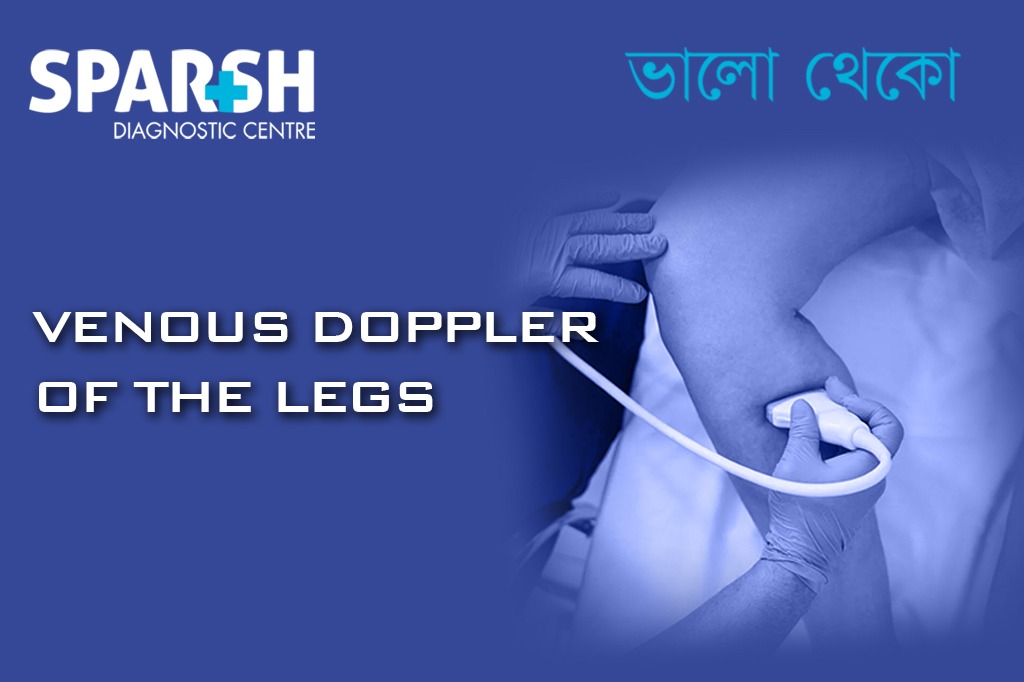
Leg swelling, unexplained pain, visible varicose veins or a feeling of heaviness in the legs can sometimes be more than a simple muscle problem. In some cases, the underlying issue involves the veins and the way blood is flowing back toward the heart. A venous Doppler of the legs is one of the most useful non-invasive tests doctors use to investigate these problems.
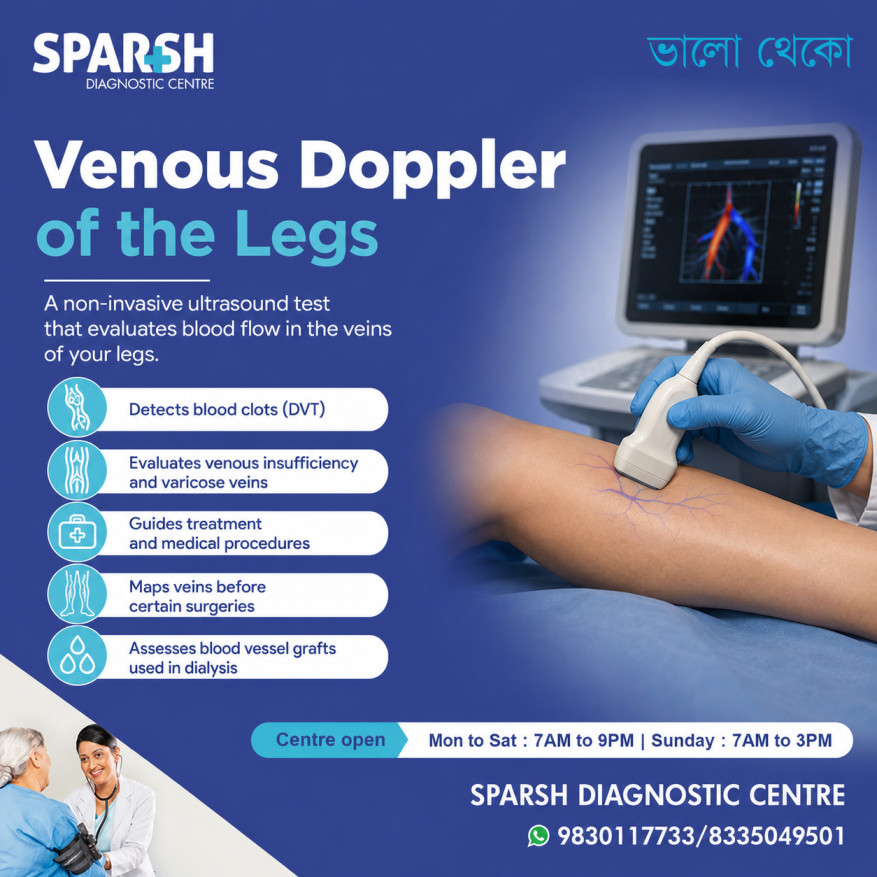
Also called a leg venous Doppler, venous Doppler ultrasound or lower-limb venous Doppler, the test combines conventional ultrasound imaging with Doppler technology. It allows the radiologist to examine the veins and assess how blood is moving through them. It is particularly important when a doctor suspects a deep vein thrombosis (DVT), but it can also help evaluate varicose veins, venous insufficiency and other circulation-related problems.
The test does not involve needles, injections or radiation. In most cases, it is a straightforward examination that takes less than an hour.
What is a venous Doppler of the legs?
A venous Doppler of the legs is an ultrasound examination designed specifically to evaluate the veins in the lower limbs.
During the test, a handheld device called a transducer is moved over the skin. The ultrasound component creates images of the veins, while Doppler technology evaluates the movement of blood through them.
This allows the radiologist to look for abnormalities such as:
- Blood clots or DVT
- Blockages or restricted venous blood flow
- Abnormal blood flow caused by faulty vein valves
- Venous reflux associated with venous insufficiency
- Problems involving varicose veins
- Certain abnormalities following vascular procedures
- Veins that may need to be mapped before surgery or another procedure
Venous ultrasound is especially valuable because it provides real-time information about blood flow without exposing the patient to ionising radiation.
What is a venous Doppler used for?
The most common reason for performing a venous Doppler is to look for a blood clot in the deep veins of the leg, known as deep vein thrombosis or DVT.
A DVT can partially or completely obstruct blood flow. More importantly, a clot can sometimes break away and travel through the bloodstream to the lungs, causing a pulmonary embolism. This is why suspected DVT needs prompt medical evaluation. Ultrasound with Doppler is commonly used as an initial imaging test when a lower-limb DVT is suspected.
However, detecting blood clots is not the only purpose of the test.
A venous Doppler can also help doctors investigate:
Venous insufficiency: When the valves in the leg veins do not work properly, blood can flow backward and pool in the legs.
Varicose veins: Doppler imaging can help determine how blood is flowing through enlarged or abnormal veins and can assist in treatment planning.
Persistent leg swelling: When swelling has no obvious explanation, examining the veins can help identify a vascular cause.
Leg heaviness or aching: Venous problems can sometimes produce aching, heaviness or discomfort, particularly after prolonged standing.
Pre-procedure vein mapping: In selected cases, veins may be mapped before vascular or surgical procedures.
Follow-up after treatment: Doppler ultrasound can be used to assess blood flow after certain vascular procedures.
What is a Doppler legs test used for?
A Doppler legs test is a general term patients often use for an ultrasound examination of the blood vessels in the legs.
The exact type of Doppler depends on what the doctor is investigating. A venous Doppler focuses on veins, while an arterial Doppler evaluates arteries.
A venous Doppler is primarily concerned with blood returning from the legs toward the heart. It can show whether veins are open, whether blood is flowing normally and whether there is evidence of a clot or abnormal backward flow.
This distinction matters because leg symptoms can have several possible causes. Swelling, for example, may be related to a venous problem, lymphatic problem, injury, medication or another medical condition. A Doppler helps the doctor investigate whether the veins are contributing to the symptoms.
Why would a doctor order a leg Doppler?
There are several situations in which a doctor may recommend a leg Doppler.
One of the most important is sudden swelling in one leg, especially when it is accompanied by pain, tenderness, warmth or redness. These symptoms can occur with DVT and should not be ignored.
A doctor may also order the examination when a patient has:
- Persistent or unexplained swelling
- Leg pain or tenderness
- A feeling of heaviness in the legs
- Prominent or painful varicose veins
- Skin changes associated with chronic venous disease
- A non-healing wound or suspected venous ulcer
- A history of DVT
- Recent surgery or prolonged immobilisation
- A need to assess veins before a vascular procedure
- Symptoms suggesting venous reflux or chronic venous insufficiency
The decision to perform the test is based on the patient’s symptoms, medical history and clinical examination. It is not necessary for every person with ordinary leg pain or swelling.
What happens during a venous Doppler test?
For most people, the procedure is simple.
You will usually be asked to lie on an examination table. Depending on the veins being assessed and the type of examination requested, you may be positioned differently during parts of the scan.
The sonographer or radiologist applies a small amount of ultrasound gel to the skin. A handheld transducer is then moved over different areas of the leg.
The operator may gently press the transducer against the veins. This compression is an important part of checking whether a vein is compressible and can help identify a clot.
Doppler technology also produces information about blood movement. You may hear a soft whooshing sound during the examination. This is simply the machine converting blood-flow information into an audible signal.
There are no needles, catheters or contrast injections in a standard venous Doppler examination.
Once the examination is complete, the gel is wiped away and you can generally return to your normal activities.
Is a Doppler test for the legs painful?
Usually, no.
A leg venous Doppler is considered a non-invasive and generally painless examination. The ultrasound probe moves over the skin, and there is no needle or injection involved.
Some people may experience mild discomfort when the probe is pressed over an area that is already swollen, inflamed or tender. This does not mean that the test is causing damage.
If you are experiencing significant pain, tell the person performing the examination so that they can adjust the pressure and positioning where possible.
How long does a venous Doppler test take?
The duration depends on whether one leg or both legs are being examined and what the doctor has requested.
A typical venous Doppler examination may take approximately 30 to 45 minutes, although some examinations can be completed more quickly.
A more detailed study, such as one evaluating venous reflux or both lower limbs, may take longer.
So, if you are wondering, “How long does a Doppler test take on legs?”, a practical expectation is around 30–45 minutes, while allowing some additional time at the diagnostic centre for registration and reporting.
Is any preparation required?
In most cases, there is very little preparation for a venous Doppler of the legs.
You can generally eat and drink normally unless your doctor or diagnostic centre has given you different instructions. RadiologyInfo notes that venous ultrasound usually requires little or no special preparation. Wearing loose clothing can make access to the legs easier.
It is useful to carry:
- Your doctor’s prescription or referral
- Previous Doppler or ultrasound reports
- Relevant medical records
- A list of medicines you currently take
If you have had previous DVT, vascular surgery or treatment for varicose veins, tell the radiologist or sonographer.
What if a venous Doppler test is positive?
A “positive” Doppler result does not mean exactly the same thing in every patient. The meaning depends on what the examination has detected.
If the Doppler shows a DVT, your doctor will assess the location and extent of the clot and decide on appropriate treatment. Anticoagulant medicines, commonly called blood thinners, are frequently used to prevent the clot from getting larger and reduce the risk of further clots. The treatment plan depends on the individual situation.
If the examination shows venous reflux or venous insufficiency, treatment may instead focus on improving venous circulation and controlling symptoms. Depending on severity, management can include lifestyle measures, compression therapy, medicines in selected situations or procedures for problematic veins.
Importantly, a Doppler report should always be interpreted alongside your symptoms and clinical history. Your doctor will explain what the finding means and whether further testing or treatment is required.
If you develop sudden breathlessness, chest pain, coughing with blood or other symptoms suggestive of a pulmonary embolism, seek emergency medical care immediately, particularly if you have a known or suspected DVT.
How serious is venous insufficiency in the legs?
Venous insufficiency is often manageable, but it should not simply be ignored.
In chronic venous insufficiency, damaged or poorly functioning valves allow blood to move backward and pool in the legs. This can increase pressure inside the veins and cause symptoms such as swelling, aching, heaviness, skin changes and varicose veins.
Mild venous insufficiency may mainly cause discomfort or swelling. More advanced disease can lead to changes in the colour and texture of the skin and, in some people, venous ulcers around the ankle or lower leg.
The good news is that treatment can often control symptoms and reduce complications. The appropriate approach depends on the severity and cause of the venous problem.
A Doppler can help doctors understand what is happening inside the veins and decide what type of treatment, if any, may be appropriate.
What are the risks of a venous Doppler?
A standard venous Doppler ultrasound is considered very safe.
It does not use X-rays or ionising radiation, and there are no needles or contrast injections involved in a routine examination. Diagnostic ultrasound has no known harmful effects when used appropriately.
The main inconvenience may be temporary discomfort from pressure applied by the transducer, particularly if the leg is already painful or tender.
There are therefore very few risks associated with the test itself.
It is also worth remembering that the Doppler is a diagnostic examination. If it detects a problem, any risks associated with treatment would depend on the treatment recommended afterward rather than the ultrasound scan itself.
What is the cost of a Doppler test for legs?
The cost of a Doppler test for the legs varies depending on the diagnostic centre, location, whether one or both legs are examined and the type of Doppler study requested.
As an indication of current Kolkata pricing, publicly listed online prices in August 2026 range from around ₹1,890 for a venous Doppler of one lower limb to approximately ₹3,500–₹4,200 for a Doppler examination of both lower limbs, depending on the provider and location.
These figures should be treated as indicative rather than a fixed market price. A detailed venous reflux study or a specialised vascular examination may have a different fee.
If you are planning to have a venous Doppler of the legs at Sparsh Diagnostic Centre, it is best to confirm the current price at the time of booking, as diagnostic test charges can change.
What can a venous Doppler detect?
A venous Doppler can provide information about several aspects of venous circulation.
Deep vein thrombosis
DVT is one of the most important conditions the test is used to investigate. Ultrasound can identify many clots in the larger veins of the leg and show whether blood flow is partially or completely obstructed.
Venous insufficiency
The examination can assess abnormal blood flow caused by poorly functioning venous valves. This is particularly useful in patients with varicose veins, chronic swelling or other symptoms of venous disease.
Varicose veins
Doppler can help identify the veins involved and understand the direction and pattern of blood flow, which may help doctors plan treatment.
Other blood-flow abnormalities
The examination can also identify certain blockages, narrowing and other abnormalities affecting venous blood flow.
Why early evaluation of leg vein problems matters
Not every episode of leg swelling means there is a blood clot, and not every varicose vein is dangerous. However, some symptoms deserve medical attention because the underlying cause may require treatment.
DVT is particularly important because a clot can potentially travel to the lungs and cause a pulmonary embolism. Early diagnosis allows appropriate treatment to begin.
Chronic venous insufficiency is different. It is generally not life-threatening, but it can gradually worsen and affect quality of life. Long-standing venous disease can cause skin changes, persistent swelling and difficult-to-heal venous ulcers.
That is why a doctor may recommend a Doppler even when symptoms seem relatively mild.
Frequently asked questions about venous Doppler of the legs
What is a venous Doppler used for?
A venous Doppler is mainly used to evaluate blood flow through veins and detect problems such as DVT, venous insufficiency, venous reflux and abnormalities associated with varicose veins. It can also be used for vein mapping and follow-up of certain vascular treatments.
What is a Doppler legs test used for?
A Doppler legs test evaluates blood flow through blood vessels in the legs. When it is specifically a venous Doppler, it examines the veins for problems such as blood clots, abnormal blood flow and venous insufficiency.
What is a venous Doppler of the leg used for?
It is most commonly used to investigate suspected DVT and other problems involving the veins of the leg. It can also help evaluate varicose veins, chronic venous insufficiency, persistent swelling and venous blood-flow abnormalities.
What if a venous Doppler test is positive?
The next step depends on what the Doppler has found. A positive result for DVT requires prompt medical assessment and treatment planning. If it shows venous reflux or insufficiency, your doctor may recommend measures such as compression therapy, lifestyle changes or treatment of problematic veins, depending on severity.
What is the cost of a Doppler test for legs?
The cost varies by location, diagnostic centre and whether one or both legs are examined. In Kolkata, publicly listed prices in August 2026 include around ₹1,890 for one lower limb and approximately ₹3,500–₹4,200 for both lower limbs at different providers. Always confirm the current fee before booking.
What are the risks of a venous Doppler?
A standard venous Doppler is considered very safe. It uses sound waves rather than ionising radiation and does not normally require needles or injections.
How long does a venous Doppler test take?
Most examinations take approximately 30–45 minutes, although the exact duration depends on the type of study and whether one or both legs are examined.
How serious is venous insufficiency in legs?
It can range from a mild condition causing heaviness and swelling to more advanced disease associated with skin changes and venous ulcers. Chronic venous insufficiency is generally not life-threatening, but it can progressively affect comfort and quality of life if left unmanaged.
Is a Doppler test for the legs painful?
No. It is generally painless and non-invasive. Some pressure from the ultrasound probe may cause temporary discomfort if the leg is already tender or swollen.
Why would a doctor order a leg Doppler?
A doctor may order it for unexplained leg swelling, suspected DVT, leg pain, varicose veins, venous insufficiency, skin changes, a history of blood clots or to assess veins before or after certain procedures.
How long does a Doppler test take on legs?
A typical leg venous Doppler takes about 30–45 minutes. More detailed examinations may take longer.
Get a venous Doppler when your doctor recommends one
A venous Doppler of the legs is a simple, non-invasive examination that can provide valuable information about the health and function of the veins. Whether the concern is a suspected blood clot, unexplained swelling, varicose veins or chronic venous insufficiency, the scan can help doctors understand what is happening and determine the next step.
If you have sudden swelling, pain, warmth or redness in one leg, do not ignore the symptoms. Speak with a doctor promptly to determine whether a venous Doppler or another investigation is appropriate.
At Sparsh Diagnostic Centre, venous Doppler imaging is performed to assess blood flow and investigate problems affecting the veins of the legs. For appointments and current test charges, contact the centre directly at 9830117733 / 8335049501.
Book Your Doppler Ultrasound Today at Sparsh Diagnostic Centre
At Sparsh Diagnostic Centre, we use state-of-the-art Doppler technology to deliver fast, accurate, and reliable diagnostics. Our expert radiologists ensure you receive the best possible care for your health.
📞 Call: 9830117733 / 8335049501
🌐 Visit: www.sparshdiagnostica.com
#BhaloTheko
Disclaimer:
No content on this site, regardless of date, should ever be used as a substitute for direct medical advice from your doctor or other qualified clinician.